
Results of the British Columbia freshwater recreational fishing survey, 2024
On this page
- Infographics
- BC freshwater recreational fishing 2000 to 2024, fast facts
- BC freshwater fishing spatial and temporal patterns, 2024
- BC freshwater fishing regional patterns in 2024
- BC freshwater fishing 2024, target species
- BC freshwater fishing 2024, salmon
- BC freshwater fishing 2024, Fraser River white sturgeon
- BC freshwater fishing 2024, steelhead
- BC freshwater recreational fishing, 2000 to 2024 trends
- BC freshwater fishing expenditures, 2024
- BC freshwater fishing package deals, 2024
- Notes and methodology
Infographics
BC freshwater recreational fishing 2024, fast facts
Long text version
BC freshwater recreational fishing 2024, fast facts
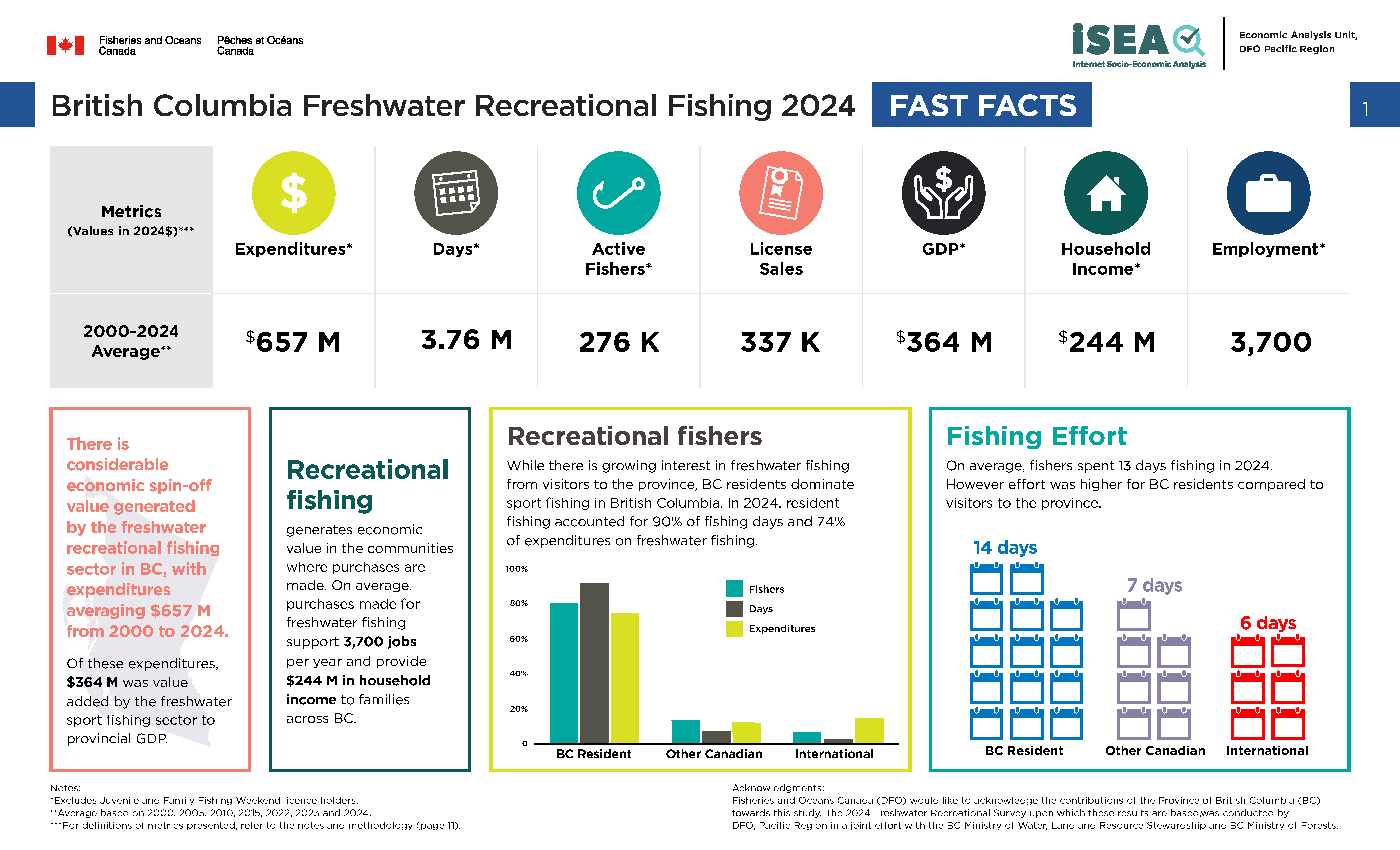
Key metrics for the BC freshwater recreational fishing industry:
(All values reflect the average from 2000 to 2024. Dollar amounts are in 2024 dollars)
- Average expenditures: $657 million
- Average number of fishing days: 3.76 million
- Average number of active fishers: 276,000
- Average licence sales: 337,000
- Average GDP contribution: $364 million
- Average household income: $244 million
- Average employment: 3,700
Key survey findings:
- There is considerable economic spin-off value generated by the freshwater recreational fishing sector in BC, with expenditures averaging $657 M from 2000 to 2024. Of these expenditures, $364 M was value added by the freshwater sport fishing sector to provincial GDP
- Recreational fishing generates economic value in the communities where purchases are made. On average, purchases made for freshwater fishing support 3,700 jobs per year and provide $244 M in household income to families across BC.
- While there is growing interest in freshwater fishing from visitors to the province, BC residents dominate sport fishing in British Columbia.
- In 2024, British Columbia residents made up:
- 79% of fishers
- 90% of days
- 74% of expenditures
- Other Canadians in 2024 accounted for:
- 13% of fishers
- 7% of days
- 12% of expenditures
- International participants in 2024 comprised:
- 8% of fishers
- 3% of days
- 14% of expenditures
- In 2024, British Columbia residents made up:
- On average, fishers spent 13 days per year fishing. However effort was higher for BC residents compared to visitors to the province.
- In 2024, BC Residents fished an average of 14 days in the year.
- Other Canadian residents fished an average of 7 days in the year.
- International participants fished an average of 6 days in the year.
BC freshwater fishing spatial and temporal patterns, 2024
Long text version
BC freshwater fishing spatial and temporal patterns, 2024
Key takeaways
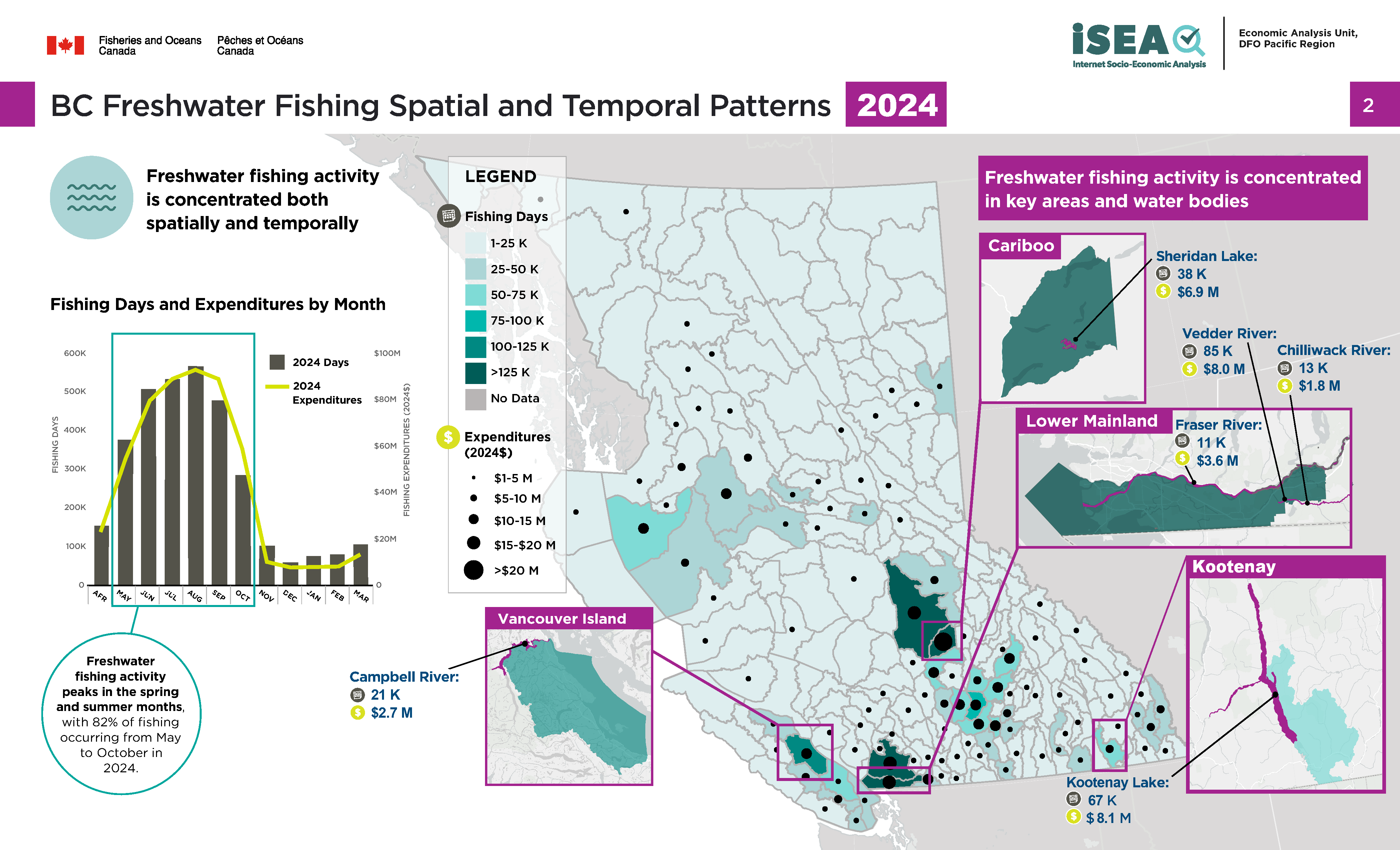
- Fishing expenditures and activity are concentrated both spatially and temporally.
- Fishing activity peaks in the summer months with 82% of fishing occurring from May to October.
- Geographically, freshwater activity is concentrated in a few key management areas and waterbodies.
In 2024, the number of fishing days and corresponding expenditures by month were as follows:
- In April, there were 161,000 fishing days with expenditures totaling $22 million. In May, the fishing days increased to 380,000 and the expenditures rose to $56 million. June saw a further increase with 502,000 fishing days and $79 million in expenditures.
- In July, there were 536,000 fishing days with expenditures of $85 million. August had the most fishing days at 554,000 and the expenditures were at their highest at $90 million. In September, there were 484,000 fishing days with $86 million expenditures.
- In October, the number of fishing days reduced to 293,000 and expenditures were at $58 million. The numbers continued to decrease in November and December, with 103,000 and 68,000 fishing days and expenditures of $11 million and $9 million respectively.
- In January, February, and March, the fishing days were relatively stable at 90,000, 91,000, and 110,000 respectively, with corresponding expenditures of $9 million, $9 million, and $16&mbsp;million.
In 2024, the top waterbodies for freshwater recreational fishing were as follows:
- In the Lower Mainland region, the Chilliwack and Vedder River saw the most angling days with about 13,000 and 85,000 days and expenditures around $1,800,000 and $8,600,000, respectively.
- The Fraser River in the same region had about 11,000 angling days with higher expenditures amounting to approximately $3,600,000.
- In the Cariboo region, Sheridan Lake was had the most activity with about 38,000 angling days with expenditures of approximately $6,900,000
- In the Kootenay region, Kootenay Lake had the most activity with around 67,000 angling days with expenditures at about $8,100,000.
- On Vancouver Island, Campbell River (the river, rather than the city) had the most activity with about 21,000 angling days with expenditures of approximately $2,700,000.
BC freshwater fishing regional patterns in 2024
Long text version
BC freshwater fishing regional patterns in 2024
Key takeaways
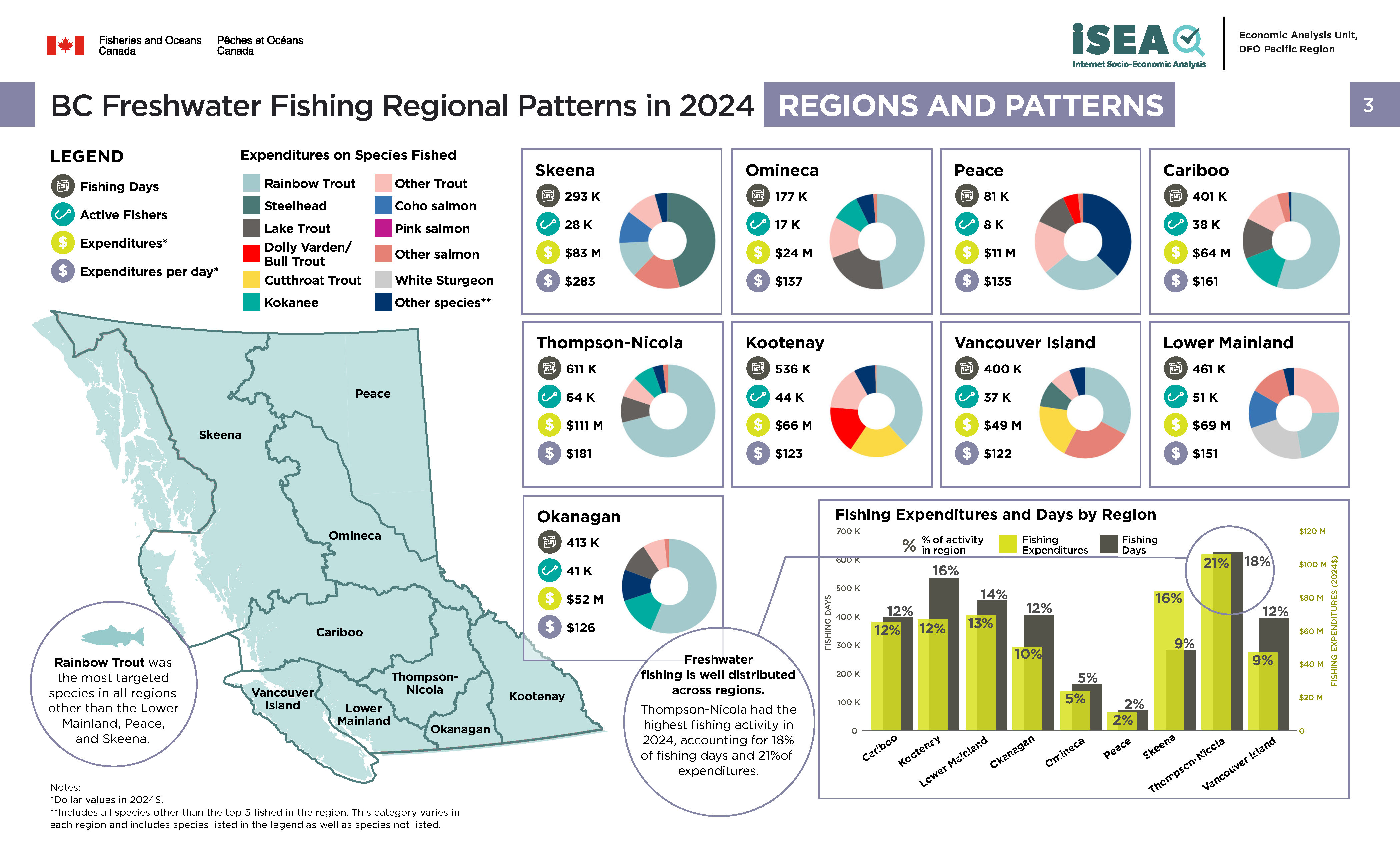
- Freshwater fishing activity is well distributed across regions.
- Thompson-Nicola had the highest fishing activity in 2024, accounting for 18% of fishing days and 21% of expenditures.
- Rainbow Trout was the most targeted species in all regions other than the Lower Mainland, Peace and Skeena.
Key freshwater fishing metrics by BC region
(Values reflect the 2024-25 fishing year and dollar amounts are in 2024 dollars)
Skeena
- Fishing days: 293 K
- Active fishers: 28 K
- Total expenditures: $83 M
- Expenditures per day: $283
- Species Expenditures: Steelhead (46%), Other Salmon (16%), Rainbow Trout (12%), Coho Salmon (11%), Other Trout (10%), Other (non-salmon, non-trout) (4%)
Omineca
- Fishing days: 177K
- Active fishers: 17K
- Total expenditures: $24 M
- Expenditures per day: $137
- Species Expenditures: Rainbow Trout (48%), Lake Trout (21%), Other Trout (14%), Kokanee (9%), Other (non-salmon, non-trout) (6%), Other Salmon (1%)
Peace
- Fishing days: 81 K
- Active fishers: 8 K
- Total expenditures: $11 M
- Expenditures per day: $135
- Species Expenditures: Other (non-salmon, non-trout) (37%), Rainbow Trout (27%), Other Trout (18%), Lake Trout (11%), Dolly Varden/Bull Trout (5%), Other Salmon (2%)
Cariboo
- Fishing days: 401 K
- Active fishers: 38 K
- Total expenditures: $64 M
- Expenditures per day: $161
- Species Expenditures: Rainbow Trout (55%), Kokanee (14%), Lake Trout (14%), Other Trout (13%), Other Salmon (4%), Other (non-salmon, non-trout) (1%)
Thompson-Nicola
- Fishing days: 611 K
- Active fishers: 64 K
- Total expenditures: $111 M
- Expenditures per day: $181
- Species Expenditures: Rainbow Trout (71%), Lake Trout (9%), Other Trout (7%), Kokanee (7%), Other (non-salmon, non-trout) (4%), Other Salmon (2%)
Kootenay
- Fishing days: 536 K
- Active fishers: 44 K
- Total expenditures: $66 M
- Expenditures per day: $123
- Species Expenditures: Rainbow Trout (39%), Cutthroat Trout (21%), Dolly Varden/Bull Trout (17%), Other Trout (16%), Other (non-salmon, non-trout) (8%), Other Salmon (0.5%)
Vancouver Island
- Fishing days: 400 K
- Active fishers: 37 K
- Total expenditures: $49 M
- Expenditures per day: $122
- Species Expenditures: Rainbow Trout (33%), Other Salmon (25%), Cutthroat Trout (20%), Steelhead (10%), Other Trout (7%), Other (non-salmon, non-trout) (6%)
Lower Mainland
- Fishing days: 461 K
- Active fishers: 51 K
- Total expenditures: $69 M
- Expenditures per day: $151
- Species Expenditures: Other Trout (25%), Rainbow Trout (23%), White Sturgeon (22%), Coho Salmon (14%), Other Salmon (13%), Other (non-salmon, non-trout) (4%)
Okanagan
- Fishing days: 413 K
- Active fishers: 41 K
- Total expenditures: $52 M
- Expenditures per day: $126
- Species Expenditures: Rainbow Trout (56%), Kokanee (14%), Lake Trout (8%), Other (non-salmon, non-trout) (11%), Other Trout (8%), Other Salmon (2%)
Fishing expenditures and days by region — summary of pattern observed
- In terms of fishing days, the Thompson-Nicola region accounted for the highest percentage at 18%, followed by Kootenay at 16% and the Lower Mainland at 14%. Cariboo, Okanagan, and Vancouver Island each accounted for 12%, while Skeena represented 9%. The regions with the fewest fishing days were Omineca at 5% and Peace at 2%.
- In terms of expenditures, the Thompson-Nicola region again had the highest percentage at 21%, followed by Skeena at 16%. Lower Mainland accounted for 13% of the expenditures. Cariboo and Kootenay each accounted for 12%, while Okanagan made up 10%. Vancouver Island accounted for 9%, Omineca for 5%, and Peace for 2%.
BC freshwater fishing 2024, target species
Long text version
BC freshwater fishing 2024, target species
Key takeaways
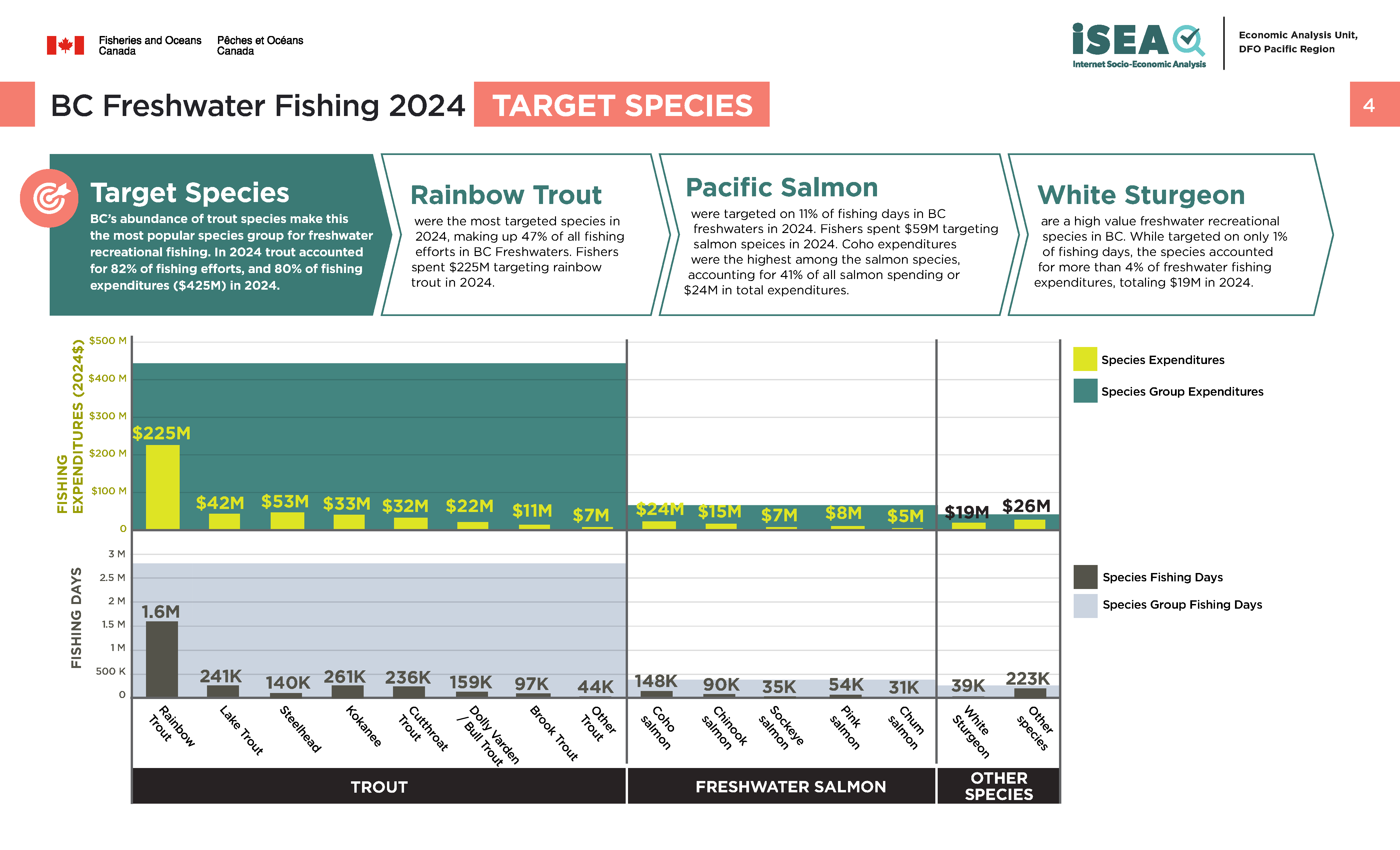
- BC’s abundance of trout species make this the most popular species group for freshwater recreational fishing. In 2024 trout accounted for 82% of fishing efforts, and 80% of fishing expenditures ($425 M) in 2024.
- Rainbow Trout were the most targeted species in 2024, making up 47% of all fishing efforts in BC Freshwaters. Fishers spent $225 M targeting rainbow trout in 2024.
- Pacific Salmon were targeted on 11% of fishing days in BC freshwaters in 2024. Fishers spent $59 M targeting salmon species in 2024. Coho expenditures were the highest among the salmon species, accounting for 41% of all salmon spending or $24 M in total expenditures.
- White Sturgeon are a high value freshwater recreational species in BC. While targeted on only 1% of fishing days, the species accounted for more than 4% of freshwater fishing expenditures, totaling $19 M in 2024.
Fishing days and expenditures by species group and species:
Values reflect the 2024-25 fishing year and dollar amounts are in 2024 dollars.
Trout species group:
- Total species group: 2.8 M fishing days, $425 M expenditures
- Rainbow trout: 1.6 M fishing days, $225 M expenditures
- Lake trout: 241 K fishing days, $42 M expenditures
- Steelhead: 140 K fishing days, $53 M expenditures
- Kokanee: 261 K fishing days, $33 M expenditures
- Cutthroat trout: 236 K fishing days, $32 M expenditures
- Dolly Varden/Bull trout: 159 K fishing days, $22 M expenditures
- Brook trout: 97 K fishing days, $11 M expenditures
- Other trout: 44 K fishing days, $7 M expenditures
Pacific salmon species group:
- Total species group: 358 K fishing days, $59 M expenditures
- Coho salmon: 148 K fishing days, $24 M expenditures
- Chinook salmon: 90 K fishing days, $15 M expenditures
- Sockeye salmon: 35 K fishing days, $7 M expenditures
- Pink salmon: 54 K fishing days, $8 M expenditures
- Chum salmon: 31 K fishing days, $5 M expenditures
Other species:
- Total: 262 K fishing days, $45 M expenditures
- White Sturgeon: 39 K fishing days, $19 M expenditures
- Other Species: 223 K fishing days, $26 M expenditures
BC freshwater fishing 2024, salmon
Long text version
BC freshwater fishing 2024, salmon
Key takeaways
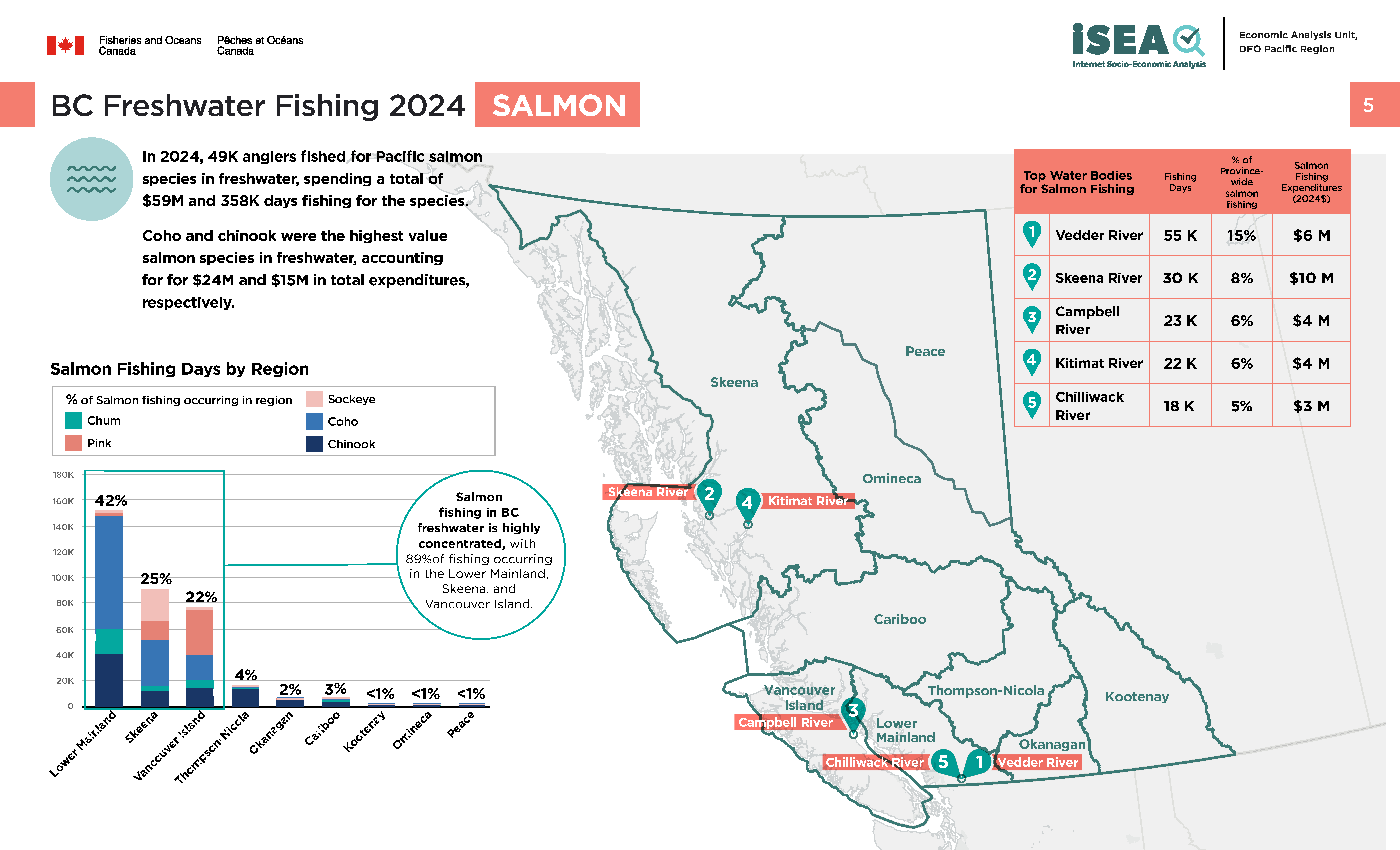
- Pacific salmon are an important species for the freshwater recreational fishing sector.
- In 2024, 49 K anglers fished for Pacific salmon species in freshwater, spending a total of $59 M and 358 K days fishing for the species.
- Coho and chinook were the highest value salmon species in freshwater, accounting for for $24 M and $15 M in total expenditures, respectively.
- Salmon fishing in freshwater is highly concentrated, with 89% of fishing occurring in the Lower Mainland, Skeena, and Vancouver Island.
- The top waterbodies for freshwater salmon fishing in 2024 were Vedder River, Skeena River, Campbell River on Vancouver Island, Kitimat River in the Skeena, and Chilliwack River in the Lower Mainland.
Salmon: Fishing days by BC region and species
Lower Mainland:
- Chinook: 41,690
- Coho: 85,322
- Sockeye: 2,661
- Pink: 2,576
- Chum: 19,735
- All Salmon: 151,985
- Percentage of total salmon fishing in region: 42%
Skeena:
- Chinook: 10,711
- Coho: 34,462
- Sockeye: 27,235
- Pink: 14,944
- Chum: 3,925
- All Salmon: 91,277
- Percentage of total salmon fishing in region: 25%
Vancouver Island:
- Chinook: 13,945
- Coho: 20,496
- Sockeye: 2,229
- Pink: 34,003
- Chum: 6,437
- All Salmon: 77,109
- Percentage of total salmon fishing in region: 22%
Thompson-Nicola:
- Chinook: 13,366
- Coho: 1,611
- Sockeye: 430
- Pink: 413
- Chum: 271
- All Salmon: 16,090
- Percentage of total salmon fishing in region: 4%
Okanagan:
- Chinook: 5,316
- Coho: 717
- Sockeye: 1,526
- Pink: 118
- Chum: 200
- All Salmon: 7,876
- Percentage of total salmon fishing in region: 2%
Cariboo:
- Chinook: 4,392
- Coho: 3,908
- Sockeye: 482
- Pink: 1,151
- Chum: 323
- All Salmon: 10,256
- Percentage of total salmon fishing in region: 3%
Omineca:
- Chinook: 216
- Coho: 322
- Sockeye: 587
- Pink: 229
- Chum: 52
- All Salmon: 1,406
- Percentage of total salmon fishing in region: <1%
Peace:
- Chinook: 138
- Coho: 249
- Sockeye: 150
- Pink: 170
- Chum: 77
- All Salmon: 783
- Percentage of total salmon fishing in region: <1%
Kootenay:
- Chinook: 492
- Coho: 863
- Sockeye: 128
- Pink: 85
- Chum: 39
- All Salmon: 1,607
- Percentage of total salmon fishing in region: <1%
In 2024, the top waterbodies for freshwater salmon fishing, as well as their fishing days and expenditures were as follows:
Vedder River (Lower Mainland):
- Salmon fishing days: 55 K
- % of province-wide salmon fishing: 16%
- Salmon expenditures: $6 M
Skeena River (Skeena):
- Salmon fishing days: 30 K
- % of province-wide salmon fishing: 8%
- Salmon expenditures: $10 M
Campbell River (Vancouver Island):
- Salmon fishing days: 23 K
- % of province-wide salmon fishing: 6%
- Salmon expenditures: $4 M
Kitimat River (Skeena):
- Salmon fishing days: 22 K
- % of province-wide salmon fishing: 6%
- Salmon expenditures: $4 M
Chilliwack River (Lower Mainland):
- Salmon fishing days: 18 K
- % of province-wide salmon fishing: 6%
- Salmon expenditures: $3 M
BC freshwater fishing 2024, Fraser River white sturgeon
Long text version
BC freshwater fishing 2024, Fraser River white sturgeon
Key takeaways
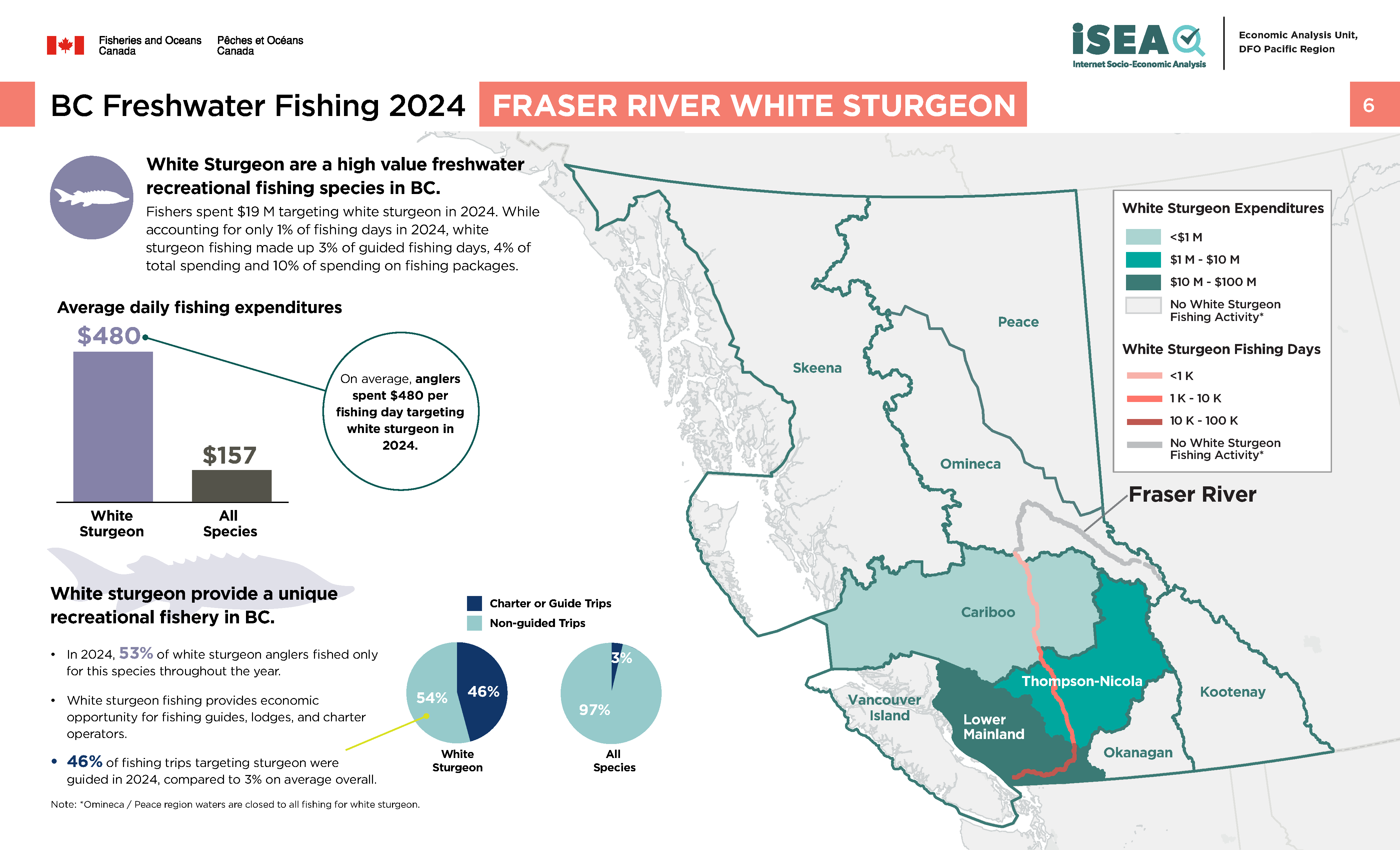
- White sturgeon are a high value freshwater recreational fishing species in BC:
- Fishers spent $19 million targeting white sturgeon in 2024.
- While accounting for only 1% of fishing days in 2024, white sturgeon fishing made up 3% of guided fishing days, 4% of total spending and 10% of spending on fishing packages.
- Anglers spent $480 per fishing day on average targeting white sturgeon in 2024, compared to $157 per day on average overall.
- White sturgeon provide a unique recreational fishery in BC:
- In 2024, 53% of white sturgeon anglers fished only for this species throughout the year.
- White sturgeon fishing provides economic opportunity for fishing guides, lodges, and charter operators. 46% of fishing trips targeting sturgeon were guided in 2024, compared to 3% on average overall.
White sturgeon: Fishing days and expenditures by BC region
Values reflect the 2024-25 fishing year and dollar amounts are in 2024 dollars.
- White sturgeon fishing in BC is limited to the Fraser River, which runs through the Lower Mainland, Thompson-Nicola, Cariboo, and Omineca regions. However, Omineca region is closed to all fishing for white sturgeon.
- In 2024, the most white sturgeon fishing occurred in the Lower Mainland portion of the Fraser River, with around 80% of days and 85% of expenditures spent targeting the species in this region.
- Sturgeon fishing in the Thompson-Nicola region accounted for around 15% of days and 15% of fishing expenditures in 2024.
BC freshwater fishing 2024, steelhead
Long text version
BC freshwater fishing 2024, steelhead
Key takeaways
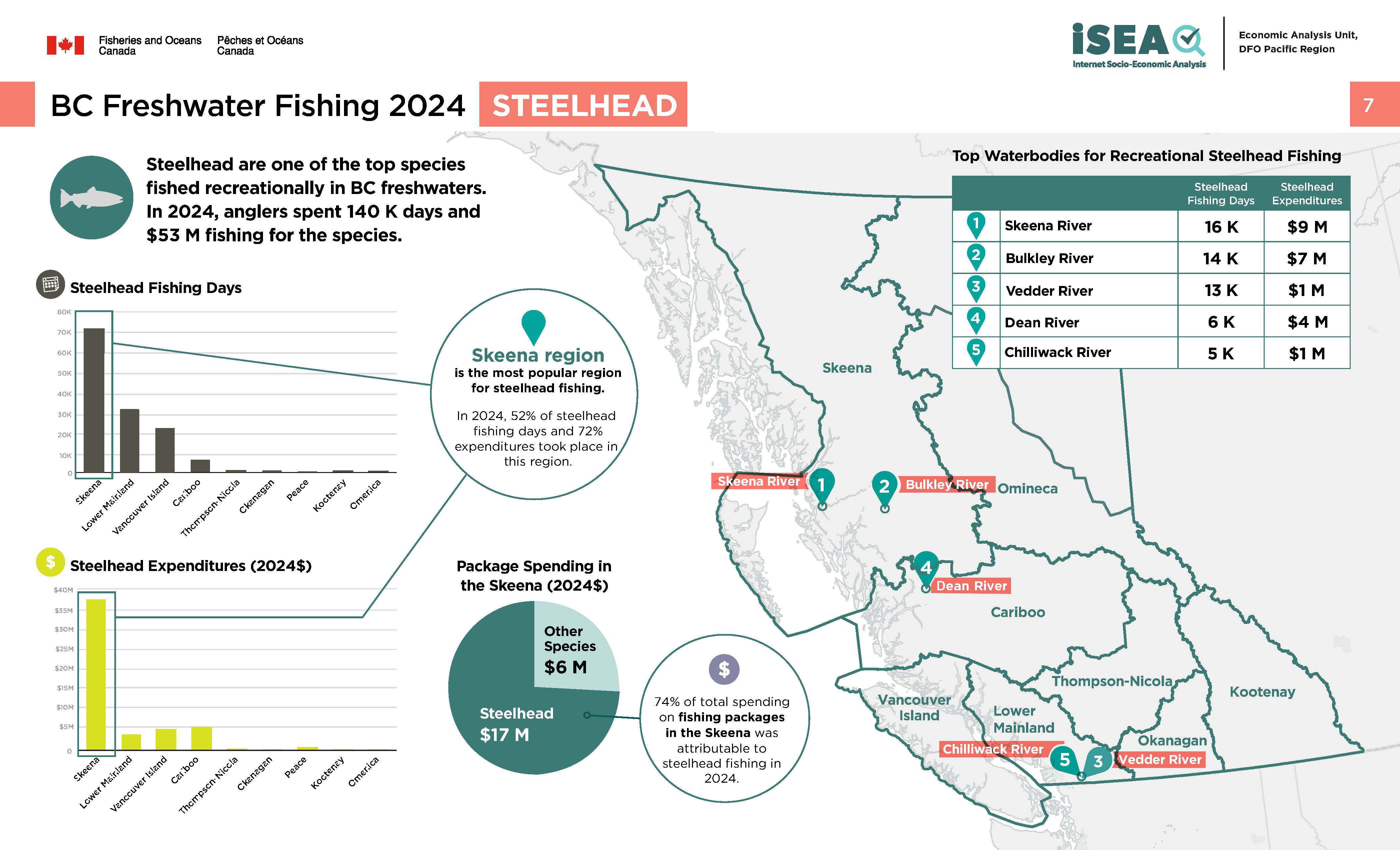
- Steelhead are one of the top species fished recreationally in BC freshwaters.
- In 2024, anglers spent 140 K days and $53 M fishing for the species.
- Skeena region is the most popular region for steelhead fishing.
- In 2024, 52% of fishing days and 72% of expenditures spent targeting steelhead took place in this region.
- 74% of total spending on fishing packages in the Skeena region was attributable to steelhead fishing in 2024, accounting for $17&nbdp;M in expenditures.
Steelhead: Fishing days and expenditures by BC region
Values reflect the 2024 fishing year and dollar amounts are in 2024 dollars.
Skeena:
- Fishing days: 72,231
- Total expenditures: $$38,031,621
Lower Mainland:
- Fishing days: 32,536
- Total expenditures: $3,218,323
Vancouver Island:
- Fishing days: 23,074
- Total expenditures: $4,644,392
Cariboo:
- Fishing days: 6,692
- Total expenditures: $4,846,403
Thompson-Nicola:
- Fishing days: 1,594
- Total expenditures: $398,942
Kootenay:
- Fishing days: 1,013
- Total expenditures: $50,553
Omineca:
- Fishing days: 1,043
- Total expenditures: $180,459
Peace:
- Fishing days: 598
- Total expenditures: $1,149,230
Okanagan:
- Fishing days: 850
- Total expenditures: $40,004
In 2024, the top waterbodies for steelhead fishing, as well as their fishing days and expenditures were as follows:
- In Skeena, Skeena River had the most Steelhead fishing days at 16,499, with expenditures reaching $9 million.
- Also in Skeena Region, Bulkley River came in second with 14,231 Steelhead fishing days and higher expenditures totaling $7 million.
- In the Lower Mainland, Vedder River was the third most common waterbody for steelhead fishing with 13,203 fishing days but with lower expenditures of $1 million.
- Following this, Dean River in Cariboo has 5,745 Steelhead fishing days and expenditures amounting to $4 million.
- Finally, in the Lower Mainland, Chilliwack River also has 4,794 Steelhead fishing days but with lower expenditures of $1 million.
BC freshwater recreational fishing, 2000 to 2024 trends
Long text version
BC freshwater recreational fishing, 2000 to 2024 trends
Key takeaways
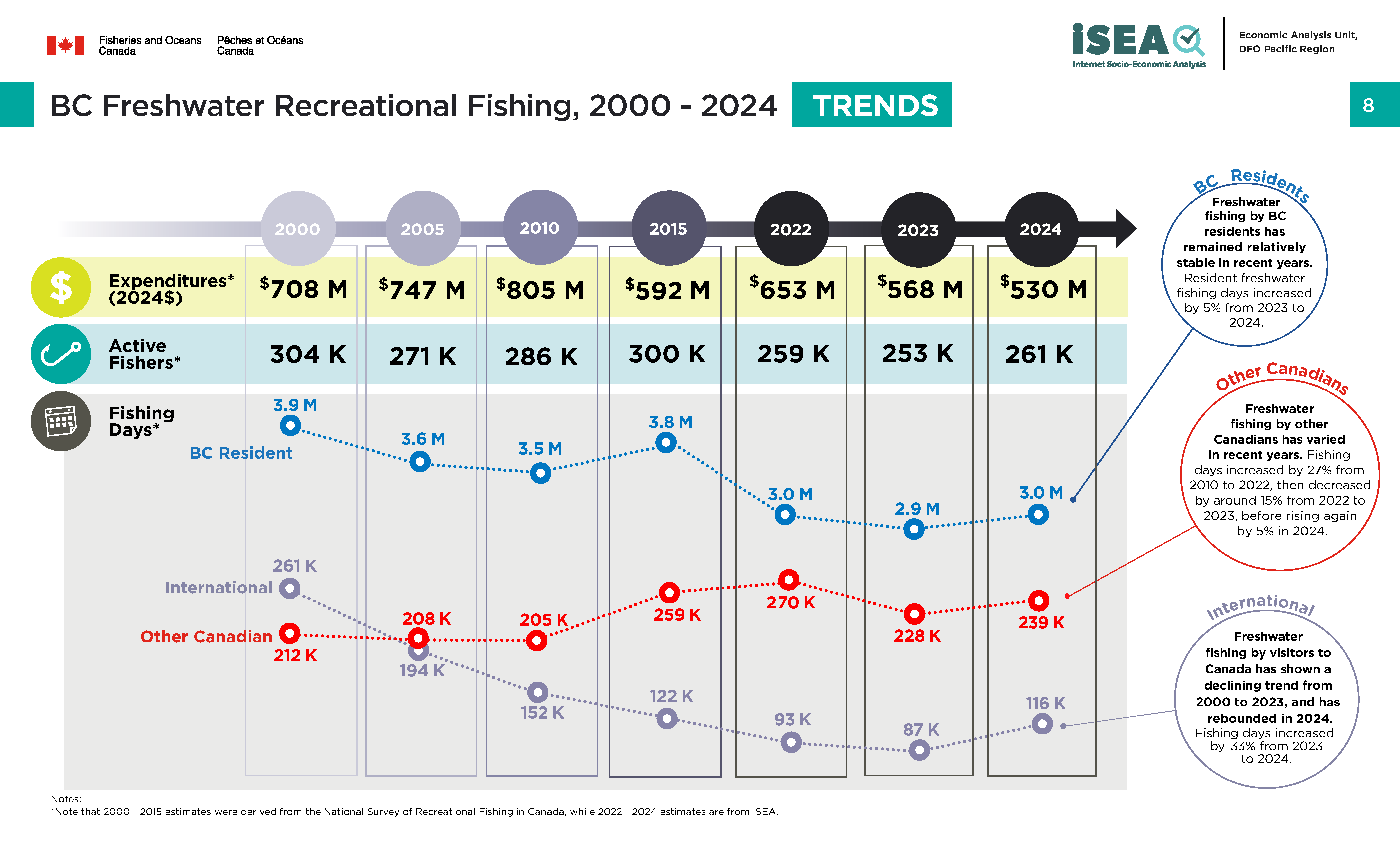
- The total expenditures for fishing and the number of active fishers have fluctuated substantially since 2000:
- Active fishers fell from 2000 to 2005, rose from 2005 to 2015, then decreased from 2015 to 2023 and rebounded in 2024.
- Expenditures increased from 2000 to 2010 and dropped from 2010 to 2024.
- Total fishing days showed a declining trend from 2000 to 2024, however the trend varies by fisher residency:
- BC Residents have consistently had highest fishing days across residencies throughout the years, fishing activity by BC residents has remain relatively stable in recent years. From 2023 to 2024, BC resident fishing activity increased by 5%.
- Similarly, fishing by International residents has shown a declining trend from 2000 to 2023, and has rebounded. Fishing days by visitors to Canada increased by 33% from 2023 to 2024.
- Freshwater fishing by other Canadians has varied in recent years. Fishing days increased by 27% from 2010 to 2022, then decreased by around 15% from 2022 to 2023, before rising again by 5% in 2024.
Key freshwater metrics by year, 2000 to 2024
Total expenditures (2024$)
- 2000: $708 M
- 2005: $747 M
- 2010: $805 M
- 2015: $592 M
- 2022: $653 M
- 2023: $568 M
- 2024: $530 M
Active fishers:
- 2000: 304 K
- 2005: 271 K
- 2010: 286 K
- 2015: 300 K
- 2022: 259 K
- 2023: 253 K
- 2024: 261 K
Fishing days:
- 2000: Total 4.4 M (Resident 3.9 M, Non-Resident Canadian 212 K, International 261 K)
- 2005: Total 4.0 M (Resident 3.6 M, Non-Resident Canadian 208 K, International 194 K)
- 2010: Total 3.8 M (Resident 3.5 M, Non-Resident Canadian 205 K, International 152 K)
- 2015: Total 4.2 M (Resident 3.8 M, Non-Resident Canadian 259 K, International 122 K)
- 2022: Total 3.4 M (Resident 3.0 M, Non-Resident Canadian 270 K, International 93 K)
- 2023: Total 3.2 M (Resident 2.9 M, Non-Resident Canadian 228 K, International 87 K)
- 2024: Total 3.4 M (Resident 3.0 M, Non-Resident Canadian 239 K, International 116 K)
BC freshwater fishing expenditures, 2024
Long text version
BC freshwater fishing expenditures, 2024
Key takeaways
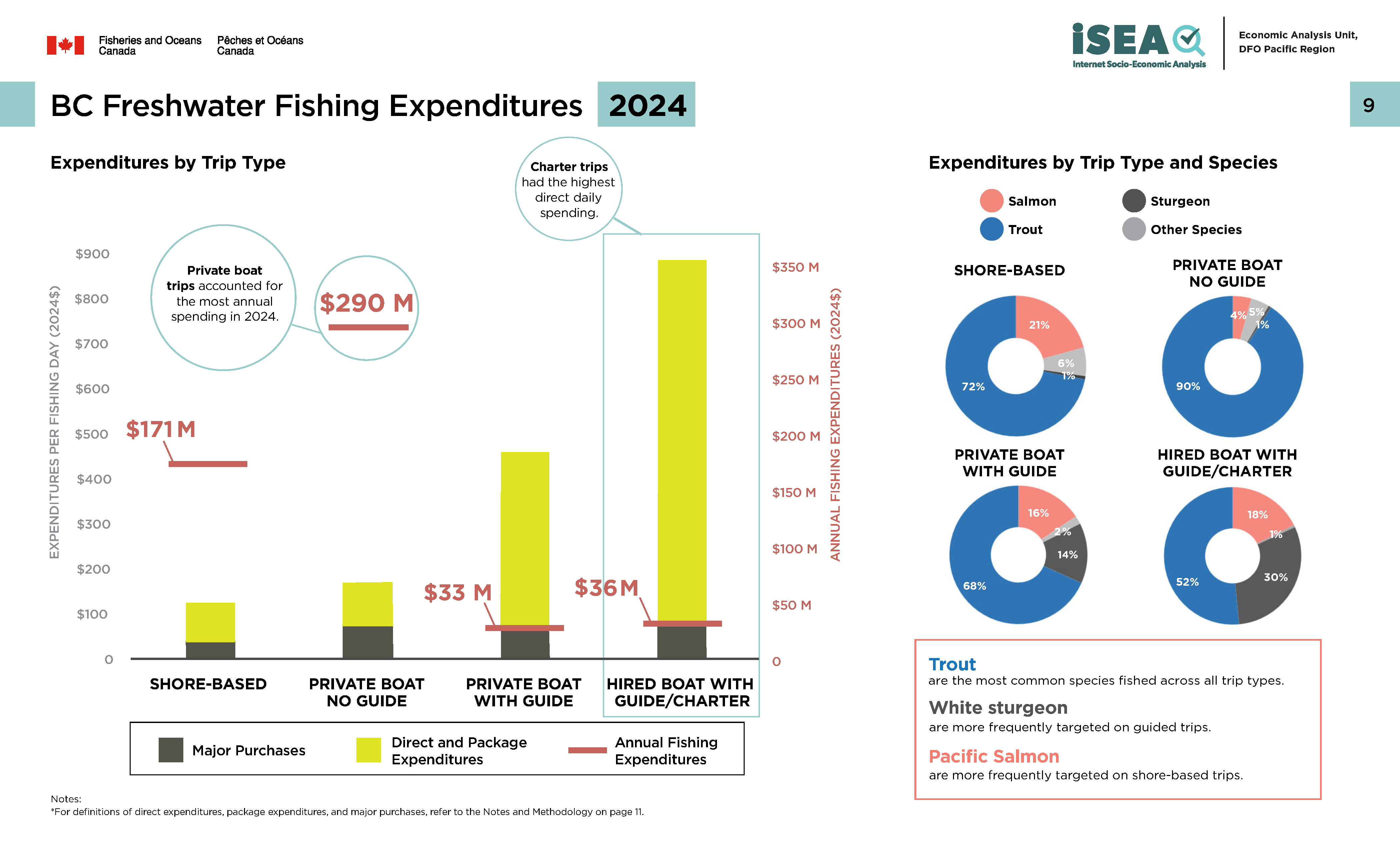
- Fishing expenditures vary by trip type and target species.
- In terms of expenditures, in 2024:
- Shore-Based Trips had the lowest daily expenditures in 2024 ($118), but accounted for $171 million in total annual spending.
- Private Boat Trips without a guide had the second lowest daily expenditures in 2024 ($160), but accounted for the highest annual total fishing expenditures, at $290 million
- Private Boat Trips with a guide had the second highest daily expenditures on major purchases and the second highest daily expenditures overall ($447). However, the annual total fishing expenditure were the lowest among trip types at $33 million.
- Hired Boat Trips with a guide or charter have the highest overall daily expenditures ($882), and annual total fishing expenditure of $36 million. The majority of daily spending on charter trips came from on direct and package expenditures, at around $816 per day.
- Across all trip types, the majority of spending is attributable to trout fishing.
- White sturgeon are more frequently targeted on guided fishing trips with 30% of spending on charter trips being attributable to white sturgeon fishing.
- Salmon are most commonly targeted on shore-based fishing trips, with 21% of spending on shore-based trips being attributable to salmon fishing.
Shore-Based Trips:
- Major purchases per day: $38
- Direct and package expenditures per day: $80
- Total annual fishing expenditures: $171 million
Private Boat Trips (without guide):
- Major purchases per day: $73
- Direct and package expenditures per day: $87
- Total annual fishing expenditures: $290 million
Private Boat Trips (with guide):
- Major purchases per day: $61
- Direct and package expenditures per day: $386
- Total annual fishing expenditures: $33 million
Hired Boat Trips with Guide/Charter:
- Major purchases per day: $66
- Direct and package expenditures per day: $816
- Total annual fishing expenditures: $36 million
Species expenditures by trip type
Values reflect the 2024-25 fishing year and dollar amounts are in 2024 dollars.
Shore-Based Trips:
- Freshwater Salmon: $36 million
- Other species: $11 million
- Sturgeon: $1 million
- Trout: $123 million
Private Boat Trips (without guide):
- Freshwater Salmon: $12 million
- Other species: $14 million
- Sturgeon: $2 million
- Trout: $261 million
Private Boat Trips (with guide):
- Freshwater Salmon: $5 million
- Other species: $1 million
- Sturgeon: $5 million
- Trout: $22 million
Hired Boat Trips with Guide/Charter:
- Freshwater Salmon: $6 million
- Other species: $1 million
- Sturgeon: $11 million
- Trout: $19 million
BC freshwater fishing package deals, 2024
Long text version
BC freshwater fishing package deals, 2024
Key takeaways
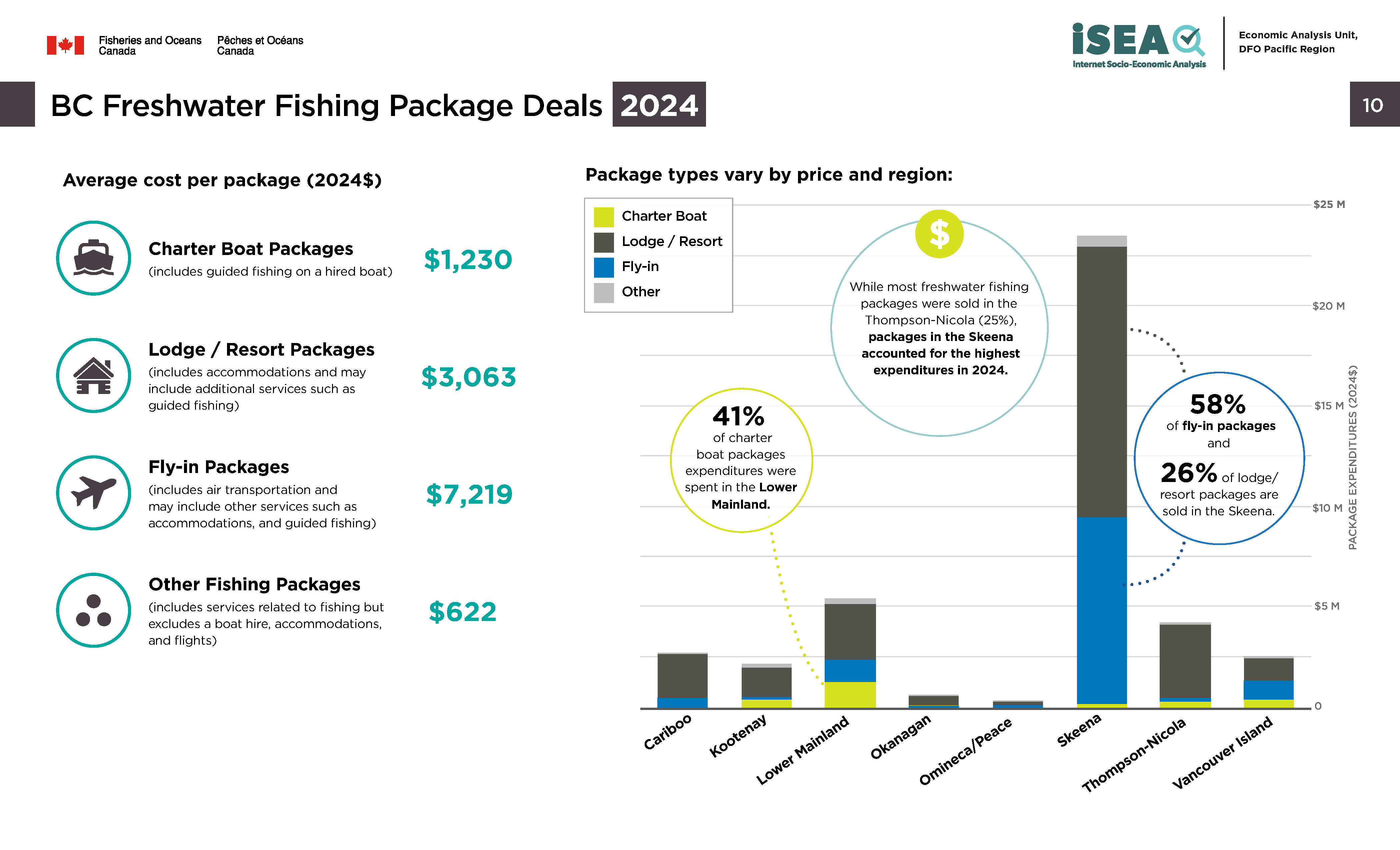
In 2024, the average cost for a fishing package varied based on the services included:
- Charter Boat Packages, which include guided fishing on a hired boat, are priced on average at $1,230.
- Lodge/Resort Packages, which include accommodations and may also include additional services like guided fishing, cost more at an average of $3,063.
- Fly-in Packages, which include air transportation and may also encompass other services such as accommodations and guided fishing, were the most expensive package type, with an average cost of $7,219.
- Other Fishing Packages, which include services related to fishing but exclude a boat hire, accommodations, and flights, are the least expensive and average around $622.
In 2024, package types and expenditures varied by region:
- The most freshwater fishing packages were sold in the Thompson-Nicola Region (25%), followed by the Lower Mainland region (23%) and Skeena region (22%).
- Packages in the Skeena accounted for the highest expenditures in 2024.
- 58% of fly-in packages, and 26% of lodge/resort packages were sold in the Skeena region in 2024.
- The most charter boat packages expenditure (41%) were spent in the Lower Mainland.
Package expenditures by region and package type
Values reflect the 2024-25 fishing year and dollar amounts are in 2024 dollars.
- In the Cariboo region, the total package expenditure was $2,713,000, which made up 8% of the total packages in the region. This included $23,000 for Charter Boat, $649,000 for Fly-in, $2,029,000 for Lodge/Resort, and $12,000 for other packages.
- The Kootenay region had a total package expenditure of $2,151,000, or 9% of the region's total. This included $525,000 for Charter Boat, $126,000 for Fly-in, $1,068,000 for Lodge/Resort, and $432,000 for other packages.
- The Lower Mainland region spent $5,589,000 in total, or 23% of the region's total. This included $1,293,000 for Charter Boat, $1,073,000 for Fly-in, $2,797,000 for Lodge/Resort, and $425,000 for other packages.
- In the Okanagan region, the total package expenditure was $826,000, or 4% of the region's total. This included $23,000 for Charter Boat, $227,000 for Fly-in, $480,000 for Lodge/Resort, and $96,000 for other packages.
- The Omineca and Peace region had a total expenditure of $310,000, making up 1% of the total packages in the region. This included $244,000 for Fly-in, $61,000 for Lodge/Resort, and $5,000 for other packages.
- The Skeena region spent $23,295,000 in total, or 22% of the region's total. This included $286,000 for Charter Boat, $8,373,000 for Fly-in, $14,282,000 for Lodge/Resort, and $353,000 for other packages.
- The Thompson-Nicola region had a total expenditure of $3,927,000, or 25% of the region's total. This included $470,000 for Charter Boat, $181,000 for Fly-in, $3,207,000 for Lodge/Resort, and $69,000 for other packages.
- In the Vancouver Island region, the total package expenditure was $2,562,000, or 8% of the region's total. This included $517,000 for Charter Boat, $742,000 for Fly-in, $1,157,000 for Lodge/Resort, and $146,000 for other packages.
Notes and methodology
Concepts, terms and definitions
- Active fisher:
- an individual who fished in the corresponding fishing season.
- Fishing day:
- a day or part of a day on which an individual fished for recreation.
- Direct expenditures:
- expenditures on goods and services (food, camping, accommodation, transportation, supplies, etc.) incurred during fishing trips or excursions.
- Major purchases:
- the purchase of durable goods and investments in support of recreational fishing activities. These include boats, motors, special vehicles, camping gear and other durable goods, as well as land and building purchases. Respondents reported the total purchase price as well as the percentage which the respondent felt was directly attributable to recreational fishing. In this report, only purchases attributable to recreational fishing are presented.
- Package expenditures:
- monies paid to a lodge or outfitter for a complete range of services such as lodging, food, transportation, use of fishing equipment, etc. Four types of packages were defined for the purposes of this survey:
- Charter boat package: a package which includes fishing in a boat and may include other goods or services such as a guide, food, or fishing supplies, but excludes accommodation and airfare.
- Lodge package: a package which includes accommodation and may include other goods or services such as a guided charter, food, or fishing supplies, but excludes airfare.
- Fly-in package: a package which includes airfare and may include other goods or services such as accommodations, a guided charter, food, or fishing supplies.
- Other: a package which does not include fishing in a boat, accommodations, or airfare, but may include other goods or services such as a guide, food, or fishing supplies.
- Total economic impact:
- the total impact of the industry on the economy. This is the sum of the direct, indirect and induced economic impacts.
- Direct economic impact: measures the actual expenditures made by establishments operating in the sector.
- Indirect economic impact: measures the economic activity of industries supplying goods and services used by sector operators. This is also referred to as “supplier industry impact.”
- Induced economic impact: measures the impact on the economy of spending by workers employed as a result of the sector’s activity.
- GDP:
- the annual contribution of the recreational fishing sector to BC provincial gross domestic product. This includes the direct, indirect and induced economic contribution.
- Household income:
- the total/aggregated annual contribution of the recreational fishing sector to household income. This includes the direct, indirect and induced economic contribution.
- Employment:
- The total annual number of jobs (FTEs) in BC which are sustained by the recreational fishing sector. This includes direct, indirect and induced jobs.
- Percent change:
- calculated as 𝑟 = ((𝑝𝑛 − 𝑝0)/𝑝0) ∗ 100 where 𝑟 is average annual percent change, 𝑝𝑛 and 𝑝0 are the final and initial observations in the period, respectively.
- Recreational fishing:
- refers to non-commercial fishing; recreational angling and sport fishing are covered in the definition used by the survey. Note that food, social and ceremonial fishing is not covered by the survey and is therefore, not included in any of the estimates presented in this report.
- Residency:
- the place in which the license holder permanently resided within the survey year.
- BC resident: an individual who lived within British Columbia during the survey year.
- Other Canadian: an individual who lived within Canada, but outside British Columbia during the survey year.
- International fisher: an individual who lived outside of Canada during the survey year.
- Visitor: an individual who’s primary residence is outside of BC (includes Other Canadian and International fishers).
- Trip type:
- Respondents distributed their days fished across four types of fishing days. This considers all fishing days and is separate from package types which are specific to package expenditures.
Data description
The primary data source used for this report was the Internet Socioeconomic Analysis (iSEA) Survey of Freshwater Recreational Fishing in British Columbia, 2024. This survey was administered by DFO Pacific and collected socioeconomic information on freshwater recreational fishing activity in British Columbia (BC) throughout the 2024 fishing season (from April 2024-March 2025). The survey questions were organized into two sections – fishing effort (days), and fishing expenditures. A random sample of 100,000 individuals, who purchased a Freshwater fishing licence in the 2024 season, were selected to complete the survey. In total 17,556, individuals completed the survey in full, which represents 5% of the freshwater fishing population.
This survey was similarly administered in the 2023 fishing season. The data from this iteration was also used in generating some of the statistics presented in this report. The 2023 survey achieved an effective sample rate of 6%.
In addition to the iSEA survey, the figures presented in this report were supplemented using data from the Survey of Recreational Fishing in Canada. This survey was historically run by DFO every 5-years up until 2015, and collected socioeconomic information on all fishing activity (tidal and freshwater) across Canada. In contrast to iSEA, this survey was run based on the calendar year rather than the fishing season. Information from the 2000, 2005, 2010, and 2015 iterations were used for generating reported recreational fishing statistics for BC prior to 2022. More information on this survey is available from DFO’s national website.
Note that survey results presented in this report have been weighted in order to scale results to the licence population level. Additionally, many survey results presented in this report are transformed data. Fields such as fishing days and expenditures were calculated by distributing reported values across species, spatial and trip categories.
Additional notes on methodology
- Unless otherwise specified, all dollar metrics presented in this report are in 2024$.
- Throughout this report, Fishing Expenditures refers to the sum of Direct Expenditures, Major Purchases, and Package Expenditures reported in the corresponding survey year.
- On page 1 of this report GDP, Household Income, and Employment statistics were calculated using multipliers from British Columbia’s Fisheries and Aquaculture Sector Report, developed by BC Stats. These statistics represent outcomes from the total economic impact of BC’s Freshwater recreational fishing sector, which includes the direct, indirect and induced impacts. For more information, the report is available on the government of British Columbia’s website.
Page details
- Date modified: