
Terms of Reference for the Pacific Salmon Allocation Policy Review in BC
In April 2018, the Minister of Fisheries, Oceans, and the Canadian Coast Guard released a statement following the B.C. Supreme Court Ahousaht decision. The statement contained the following commitment – “As an immediate step, I have directed Fisheries and Oceans Canada to review the Pacific Salmon Allocation Policy. We will work in collaboration with Indigenous groups and all stakeholders to renew and co-develop this policy.” This process will be conducted in a manner that respects Canada’s nation-to-nation relationship with Indigenous peoples and engages stakeholders, and seeks to develop and build consensus for recommended policy options.
In January 2021, the Minister was directed to work in close collaboration with relevant ministers, as well as with First Nations, provincial and territorial authorities, fishing and stewardship organizations and implicated communities across the Pacific Region to bring forward a Pacific Salmon Strategy Initiative and deliver on the commitment to conserve and protect wild Pacific salmon and their habitats and ecosystems Footnote 1. The strategy will implement a series of immediate and long-term solutions that focus on four key areas: conservation and stewardship; enhanced hatchery production, harvest transformation; and, integrated management and collaboration Footnote 2.
The Salmon Allocation Policy Review is a key initiative under the harvest transformation pillar, and will align with and support the broader goals and objectives of the Pacific Salmon Strategy Initiative.
Table of contents
- Terms of Reference purpose
- Policy scope
- Content
- Policy objectives and parameters
- Process-related guiding principles
- Phases of review
- Engagement
- Recommendations and decision-making
- Issue resolution
- Resourcing
- Figures - Workflow diagrams
- Appendix - Terms of Reference for the Pacific Salmon Allocation Policy review in BC
A. Terms of Reference purpose
This Terms of Reference serves as a road map that Fisheries and Oceans Canada (DFO), First Nations, and stakeholders will utilize to develop recommendations towards renewing the 1999 Salmon Allocation PolicyFootnote 3 (SAP). Included in this document are both the scope of the review (objectives of the review and topic areas that the policy review will or will not address) and process for the review (e.g. guiding principles, engagement, workflow, phases, etc.).
B. Policy scope
1. Geographic Scope
The review of the current SAP will apply only to the allocation of salmon to be fished within the boundaries of British Columbia. A separate Yukon Allocation Policy Renewal Process is underway in the Yukon, which will be responsive to differences in species, Indigenous Treaty and fishery considerations.
C. Content
The review will consider the main harvest groups and principles used to define allocation priority among these harvest groups. The policy review will not consider new fisheries access or allocations within sectors, as this is defined in separate policies where applicable (e.g. 2015Commercial Salmon Allocation Framework). The policy review will also not be used to develop specific operational guidance or implementation measures, as these are available in separate documents, such as salmon Integrated Fisheries Management Plans or other management plans. However, factors that may inform operational and/or management guidance may be considered in developing the policy recommendations.
The SAP review will not in any way define or limit any treaty or Aboriginal title or rights of First Nations and will be without prejudice to the positions of Canada and First Nations with respect to reconciliation processes, and treaty and Aboriginal title or rights.
After conservation, First Nations’ priority for Food, Social and Ceremonial (FSC) and Treaty Domestic fisheries will remain the highest priority for domestic allocation and that principle will not be reconsidered in the SAP review.
Policy discussions are anticipated to include topics such as, but not limited to:
- relative priority of allocation of salmonFootnote 4 among the different harvest groups
- the relative priority of recognized Indigenous rights-based sale fisheries Footnote 5 and of other Indigenous fisheries which authorize sale of fish
- inter-sectoral allocation between recreational and commercial harvesters
- principles for priority, management and allocation of fish caught as by-catch, and incidental mortality and
- the priority of fish required to provide scientific information necessary for conservation (e.g. test fisheries)
Review of the SAP will be consistent with existing policies and case law, while also considering ways to be flexible and adaptable to future changes (e.g., First Nations’ rights that may be recognized in the future). For example, the review would include policy considerations for priority of rights-based fisheries that are defined through negotiated agreements or court decisions.
Throughout the SAP renewal process, it is acknowledged that issues and interests may be raised that are related to the Policy but not within the direct scope of this review such as other fisheries policies, regulations, issues and processes. Other related interests will be recorded and potential venues where they could be addressed will be identified. Related issues may include: intra-sectoral allocationsFootnote 6, operational and implementation details, compensation, mitigation and voluntary licence relinquishment, stock assessment, fishery monitoring and catch reporting, enforcement, species at risk of extinction but not legislatively protected, in-season management, localized management, co-governance, species rebuilding plans, habitat restoration, predation, and climate change impacts and adaptations.
Developments in other concurrent policy review processes will be taken into account during the SAP review process.
Two primary deliverables will be produced through the process:
- Recommendations for the Minister’s consideration on a renewed Salmon Allocation Policy for BC (through the process described in Section G).
- Summary document of related issues (not within the direct scope of SAP) and suggested processes or venues for addressing these issues where possible.
D. Policy objectives and parameters
The following objectives will be used as guidance during the process when participants are assessing different options and considering issues of interest. To the extent possible, suggestions made for updating the SAP will need to be consistent with the principles and objectives as outlined below. These objectives will also be used to create measurable criteria in the Evaluation phase of this process. Further details on these objectives can be found in the Appendix.
The policy will be consistent with:
- conservation requirements
- case law
- constitutional requirements
- international obligations
- federal responsibilities
- sustainable use
- existing/ emerging DFO policies
The policy review will provide recommendations for revisions which are enabling and adaptive, flexible, clear and unambiguous.
E. Process-related guiding principles
The following requirements and principles will guide the process for the policy review. Further details are provided in the Appendix, Section 3.
- Crown consultation
- Application of UNDRIP
- Reconciliation and government-to-government relationships
- Values respecting sustainable, inclusive and accessible fisheries
- Clarity and transparency
- Best available information
- Relationships and constructive participation
- Respect
- Accountability and reciprocal accountability
- Efficient use of limited resources
Engagement with First Nations will reflect a nation to nation relationship and respect the requirements of section 35 of the Constitution Act, 1982, as interpreted by the courts, and will be consistent with Canada’s commitment regarding implementation of UNDRIP and other commitments regarding reconciliation. DFO remains responsible for addressing any consultation requirements stemming from section 35 of the Constitution Act, 1982, as interpreted by the courts.
F. Phases of review
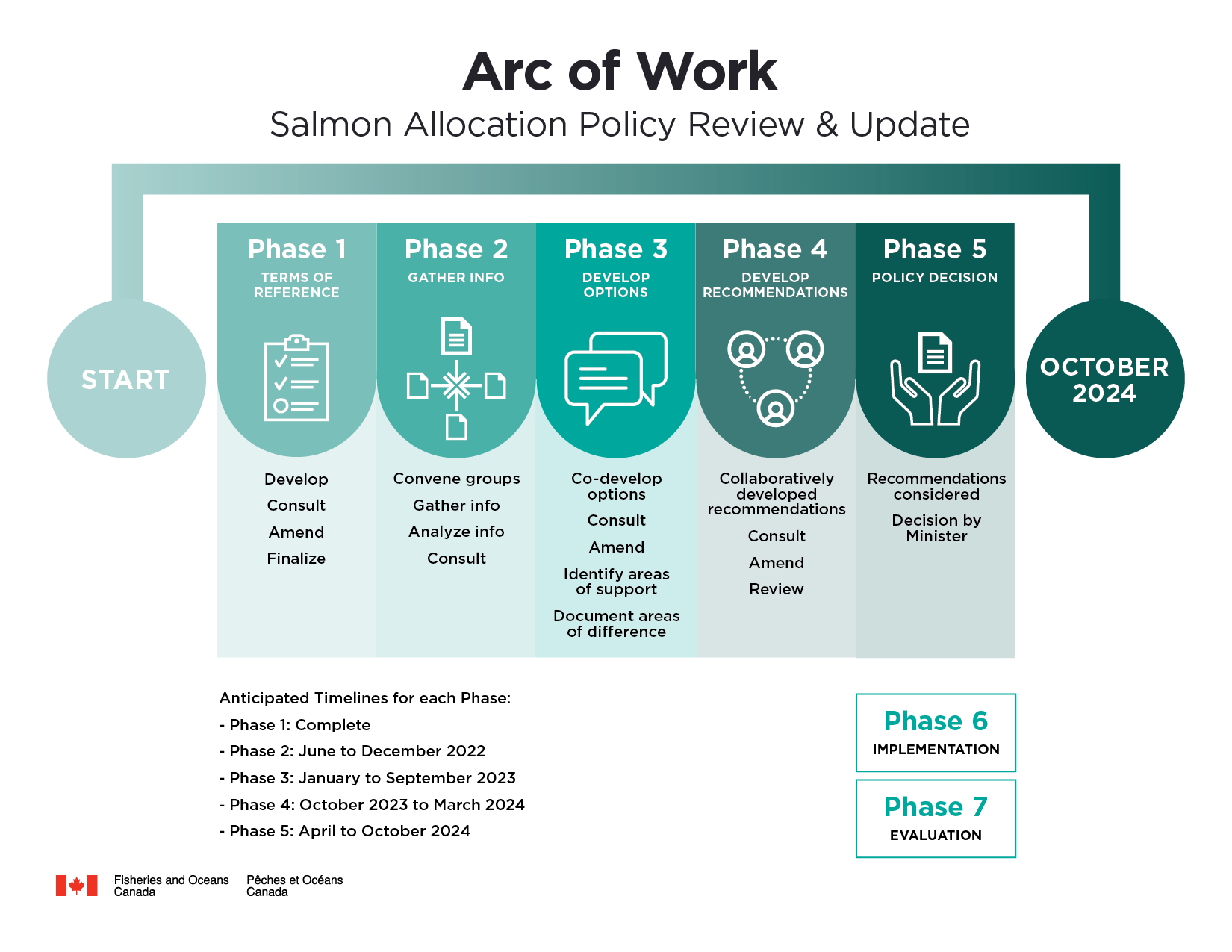
Long text version
Arc of work
Salmon Allocation Policy review and update
Start
Phase 1: Terms of Reference
- Develop
- Consult
- Amend
- Finalize
Phase 2: Gather info
- Convene groups
- Gather info
- Analyze info
- Consult
Phase 3: Develop options
- Co-develop options
- Consult
- Amend
- Identify areas of support
- Document areas of difference
Phase 4: Develop recommendations
- Collaboratively developed recommendations
- Consult
- Amend
- Review
Phase 5: Policy decision
- Recommendations considered
- Decision by Minister
End: October 2024
Phase 6: Implementation
Phase 7: Evaluation
Anticipated Timelines for each Phase:
- Phase 1: Complete
- Phase 2: June to December 2022
- Phase 3: January to September 2023
- Phase 4: October 2023 to March 2024
- Phase 5: April to October 2024
G. Engagement
Key elements of engagement for the review include neutral facilitation, several working groups, broad consultations at key process milestones and the need for effective and ongoing communication between everyone involved.
1. Independent facilitation
- Independent facilitator(s) identified with input from all key parties will provide neutral facilitation to support engagement.
- The facilitator(s) will provide impartial management of the process so participants can focus on substantive issues. They will design sessions in a way that all participants can contribute to their fullest, discussions are generative, options can emerge, and issues are brought to closure as well as ensuring that the Terms of Reference and other group agreements are adhered to.
- The facilitator(s) will support communication and engagement between the parties and information accessibility and management by establishing and maintaining collective and individual mechanisms for providing information to all parties.
2. Role of Fisheries and Oceans Canada
DFO will act as both a convener and a participant in the SAP review process. This includes working collaboratively with the independent facilitator and participants in the review process to share information, engage in dialogue and, where possible, building consensus. DFO will also have an important role in terms of advising and supporting the Minister in carrying out his/her responsibilities. To that end, the updated SAP will be developed within, and complementary to the Department and Minister’s existing Constitutional, statutory and regulatory obligations.
3. Key participants
- The main participants for the SAP Review process are those with direct interests in the primary harvest of Pacific salmon. This includes DFO, First Nations, and the commercial and recreational harvest sectors in British Columbia. Further information on the roles and responsibilities of the parties can be found in the Appendix.
- Further to point #2, above, DFO participation in the review process will include representatives from Fisheries Management (Salmon), Policy and Economic Analysis, Reconciliation and Partnerships and others, as appropriate.
- First Nations in British Columbia with salmon interests, including Treaty Nations, may engage at an individual level, through aggregates (e.g. AAROM organizations), and/or through other First Nations’ fisheries organizations. This includes the Five Nations (Ahousaht, Ehattesaht/Chinehkint, Hesquiaht, Tla-o-qui-aht, Mowachaht/Muchalaht), who will organize as a coordinated body to represent the rights and interests of their member Nations, engaging through an internal process that involves the Lead Negotiators, Ha’oom Fisheries Society, Fishers Advisory Committee, Fisheries Managers, Main Table, and community members as needed.
- Commercial
- Commercial salmon harvesting interests will coordinate their participation through the CSAB via Area Harvest Committee representatives from Area A, B, C, D, E, F, G and H, inclusive of members that also represent the UFAWU-Unifor, Native Brotherhood and fish processors. Transboundary harvesters will also work with the CSAB to bring forward their interests during the process. The CSAB will select participants for the Options Development Working Group and Technical Working Group.
- First Nations commercial interests may also participate through the Native Brotherhood of BC, which represents First Nations holders of commercial salmon licences and is included in the CSAB representation, or through the other channels (such as the Native Fishing Association or other First Nations’ organizations) as they determine appropriate.
- Recreational salmon harvesting interests will coordinate their participation through the SFAB. The SFAB will select participants for the Options Development Working Group and Technical Working Group from amongst their members and member organizations.
- The Province of BC also has interests related to the review and has been invited to participate as an observer member of all committees and working groups. B.C. will coordinate their participation through the Ministry of Land, Water and Resource Stewardship (LWARS). LWARS will identify members for Working Groups from the Ministry or other Provincial Ministries as necessary. Alternates may be named, and representation may expand as needed.
- All parties will identify representatives who will consistently attend meetings, respond to correspondence between meetings, adhere to the Terms of Reference, communicate with constituents to report out on the process and bring their interests forward and seek support for draft policy recommendations. All participants agree to avoid participation in activities that may undermine commitments that they have made to the process.
4. Methods of engagement
- Committees and Working Groups
- Participants from all key parties will engage through the committees detailed in the table below.
- Committee discussions will be supported by the independent facilitator(s).
- Bilateral Government-to-Government discussions
- Where requested, individual First Nations and DFO will meet bilaterally on a Government-to-Government basis.
- Engagement may also be coordinated through existing processes such as Treaty Joint Fisheries Committees or collaborative management bodies.
- Where these discussions touch on matters relevant to other parties, DFO and the First Nation will work together to develop a brief, mutually-agreeable summary of discussion that can be shared with other parties.
- Internal engagement
- All key parties will meet internally, as needed, throughout the process to provide updates and seek the views of their members. Other mechanisms (e.g. email) will also be used to support internal communication.
- Inter-party discussions
- Any party may request to meet with another party, at any time throughout the process, for the purposes of developing relationships and better understanding the perspectives of others. Parties may request assistance from the independent facilitator(s) and/or DFO to arrange these discussions.
- Where these discussions touch on matters relevant to other parties, the two parties will work together to develop a brief, mutually-agreeable summary of discussion that can be shared with other parties.
- Consultations
- As outlined in the workflow diagrams in the Figures section, broader consultations will occur in each phase of the process. Consultations will provide opportunities to seek feedback and views on: the Terms of Reference (Phase 1), technical analyses (Phase 2), draft policy options (Phase 3) and policy recommendations (Phase 4).
- Consultations with First Nations will be conducted by DFO in accordance with the Crown Duty to Consult.
- Items for consultation will be distributed to all First Nations in BC with salmon interests, including Treaty Nations. First Nations will have the opportunity to share their views through written feedback and other mechanisms.
- Creative efforts will be made to ensure First Nations are engaged and able to share their views through various mechanisms including virtual engagement and regional engagement sessions. Their use will be guided by expressed First Nation preferences, FN-DFO Committee advice and available resources.
- First Nations organizations (e.g. FNFC or other aggregate organizations) may support the coordination of regional engagement sessions.
- Consultations with commercial and recreational harvest interests via CSAB, and SFAB, will support good governance and sound policy development.
- Items for consultation will be sent to the CSAB and SFAB representatives for distribution to their members/constituents and member organizations, who will have the opportunity to provide written feedback via CSAB and SFAB.
- Additional communication and engagement methods such as virtual engagement and targeted engagement sessions may also be used. CSAB and SFAB may assist in coordinating engagement sessions.
- Organizations addressing Indigenous commercial interests will be engaged through their membership in CSAB and/or their participation in DFO-FN committee discussions.
- Engagement beyond the key parties
- Updates on the review will be made available to interested groups or individuals through the review website and existing advisory processes such as the Integrated Harvest Planning Committee.
- Communication
- Clear, ongoing, communication within parties, between parties and between the various working groups and committees will be needed throughout the process.
- DFO, the independent facilitators and all parties will work together to ensure that relevant information and summaries from these different types of engagement are shared with all parties via the Multi-Party Working Group and DFO-FN Committee.
- The facilitator(s) will support information sharing by setting up and supporting a mechanism for each party to easily access relevant documents.
5. Committees
The engagement process will consist of a First Nations-DFO Committee, Multi-Party Working Group (MWG) and ad hoc Technical Working Group, complemented by broader consultations during each phase of the review. The facilitator(s) will facilitate all working group discussions.
Table 1. Summary of committee and working group structure
| - | First Nations – DFO Committee | Multi-Party Working Group (MWG) | Technical Working Group (TWG) |
|---|---|---|---|
| Participants | First Nations
All parties involved in this committee will manage the overall number of participants to allow for effective discussion. |
First Nations (8 members, including 1 from Treaty First Nations and 1 from Five Nations) SFAB (4 members, including North, South, Main) CSAB (4 members, including one from each gear type) DFO (participants will depend on the focus of discussions) Province of BC (observer). |
The Technical Working Group is ad hoc and issue dependent. Participants include: First Nations (including the Five Nations), SFAB, CSAB, DFO and Province of BC (observer). Numbers will be managed for effectiveness. |
| Role | Provide advice on consultations with First Nations; discuss rights based issues, related analysis needs & options development; identify areas of support & disagreement to inform MWG discussions and review & confirm final package ofrecommendations agreed to by MWG Footnote 7. |
Identify policy issues and analysis needs, direct TWG, develop policy options, develop recommendations and seek agreement on final package of recommendations (including documentation of options where agreement is not reached). |
Conducting technical work or assessing the technical work/reports/analyses of third parties Products arising from the Technical Working Group will be made available to all parties and working groups. |
| Notes | Internal Tier 1 discussions will be needed to identify First Nation participants. These participants could include FNFC Salmon Coordinating Committee and invited delegates from the Five Nations, modern Treaty Nations, Native Fishing Association, FSMC, and AAROM organizations. |
Participants will be determined by each party according to their own internal process, with consideration for regional perspectives, inclusion of modern Treaty Nation perspectives and creating space for First Nations commercial participation. Alternates may be identified, but efforts should be made to have consistent participation in discussions |
Participants will be identified internally by each party based on who has expertise and knowledge to contribute to the identified issues. Direction on the focus of the technical work will be provided by the Multi-Party Working Group. |
The independent facilitator(s) will provide neutral facilitation for all working groups and all working group discussions. Participants will make best efforts to bring forward the views and perspectives within each party, informed by internal discussions. Observers may be allowed upon agreement by working group members. |
|||
H. Recommendations and decision-making
1. Recommendations
- Participants will strive to reach consensus on policy recommendations for consideration by the Department and the Minister. As defined in the Appendix, consensus seeks to arrive at a unanimity, but does not require that everyone be in complete agreement. Where possible, policy recommendations should be collaboratively developed, address interests of all parties, be broadly acceptable to all, and may require some compromise.
- Any agreements reached during the development of recommendations will be considered tentative pending agreement on the total package of recommendations to be submitted for the Department and the Minister’s consideration, unless participants explicitly agree otherwise on a specific item.
- DFO will circulate the draft policy recommendations to BC First Nations, CSAB and SFAB for consultation in Phase 4. The results of these consultations and potential revisions will be shared with the FN-DFO Committee and the Multi-Party Working Group for discussion.
- As detailed in the workflow diagrams, the recommendations package supported by the Multi-Party Working Group (including documentation of options to address any areas where mutual agreement was not reached) will be sent to the First Nations-DFO Committee for review .
- If the First Nations-DFO Committee does not suggest changes during their review, the recommendations will be sent to for consideration by the Department and, ultimately to the Minister of Fisheries, Oceans and the Canadian Coast Guard’s (the Minister) for decision.
- If the First Nations-DFO Committee does identify suggested changes, the recommendations package will be sent back to the Multi-Party Working Group for further discussion, using Issue Resolution as needed.
2. During multi-party working group discussions
- If a party wishes to revisit an item for which consensus had previously been achieved, the onus will be on that party to bring the issue to the facilitator at the earliest opportunity and to explain the need for revisiting the item.
- If the parties reach a consensus that resolves most but not all of the issues that are being addressed, the parties will agree on a statement describing the areas of disagreement, any lack of information or data that prevents such agreement and, where possible, a process for resolving agreement on such issues.
- If a party withholds agreement on an issue, that party will explain how the proposed agreement fails to meet their interests. The party withholding agreement will have the opportunity to propose alternatives so the other parties can consider how all interests may be met.
- If agreement is still not reached within a reasonable amount of time, DFO will provide the Minister with recommendations accompanied by information that accurately reflect various perspectives of the participants.
- First Nations, recreational and commercial process participants will not directly present the Minister with policy recommendations or submissions that have not been previously presented to or shared with the Multi-Party Working Group and the FN-DFO Committee.
3. Final decision making
- Following consultations, a recommendations package, based on support of the Multi-Party Working Group, will be provided to the Department and the Minister.
- The FN-DFO Committee may also submit a supplementary report on the proposed options to accompany the recommendations package.
- DFO will prepare a formal decision note to accompany the package of recommendations. This decision note will not be shared with the parties, consistent with the principle of confidentiality of public service advice.
- The responsibility for the final decision resides with the Minister. The Department will provide a written rationale for the decision made.
I. Issue resolution
Throughout the process, the independent facilitator(s) will work with the parties to identify areas of agreement and to identify and resolve obstacles to reaching consensus on key issues.
Should the parties fail to reach consensus during the process within a reasonable timeframe, DFO will consult on and then bring forward policy recommendations to the Minister that reflect areas of agreement and identify options to address any areas where mutual agreement was not reached.
J. Resourcing
DFO will identify resources to support the SAP review process in a cost-effective way. DFO will work to find mechanisms to flow funding to First Nations (Nations, aggregates or organizations), CSAB, and SFAB to assist these parties’ participation in the process. These parties will be invited to submit proposals to DFO to request funds at key points throughout the review.
Parties will also bring to each other’s attention other possible sources of support.
Figures - Workflow diagrams
Please see pages below for diagrams outlining the workflow process for the review.
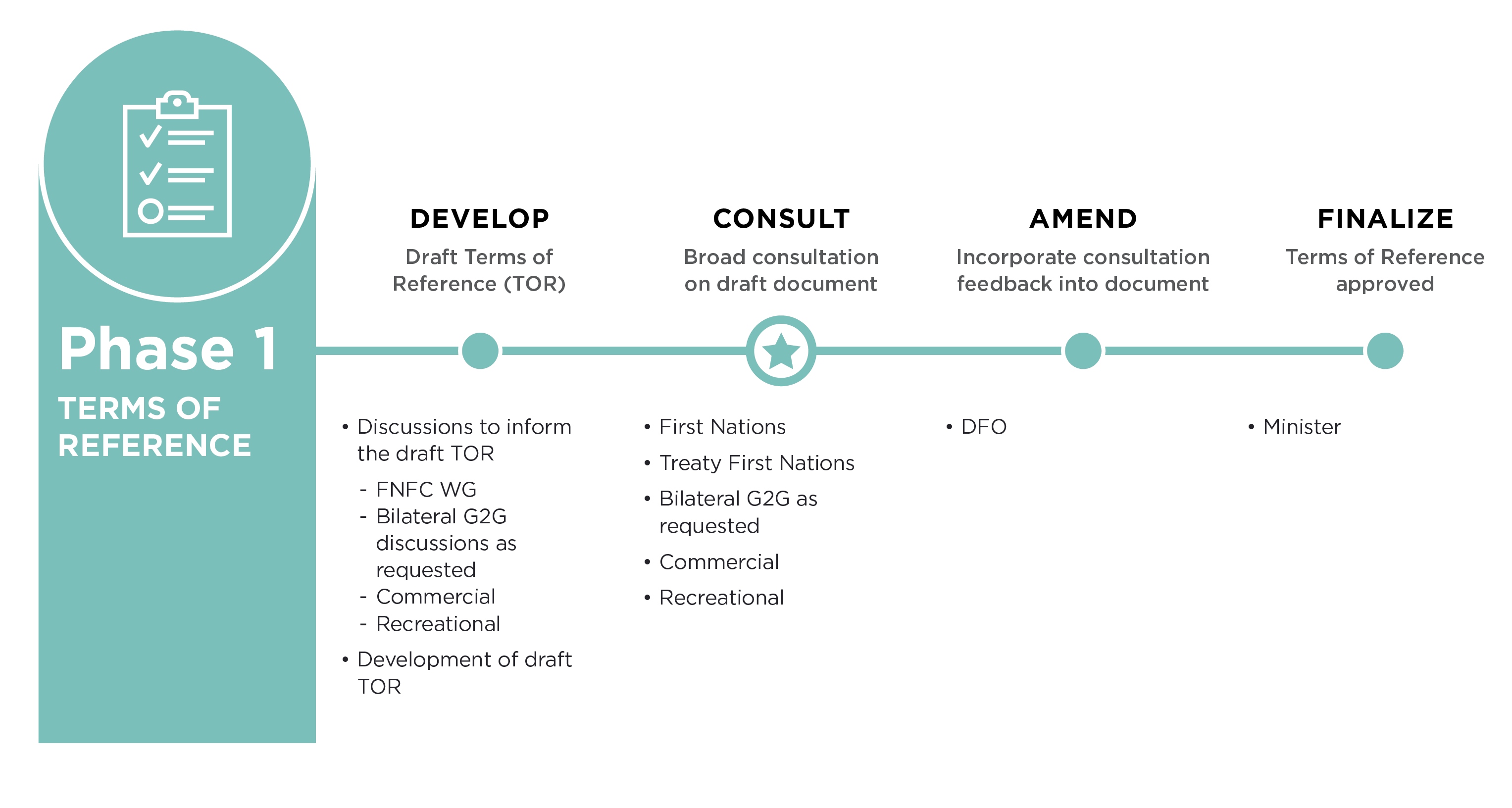
Long text version
Phase 1: Terms of Reference
Develop: Draft Terms of Reference
- Discussions to inform the draft
- TOR-FNFC WG
- Bilateral G2G discussions as requested
- Commercial
- Recreational
- Development of draft TOR
Consult: Broad consultation on draft document
- First Nations
- Treaty First Nations
- Bilateral G2G as requested
- Commercial
- Recreational
Amend: Incorporate consultation feedback into document
- DFO
Finalize: Terms of Reference approved
- Minister
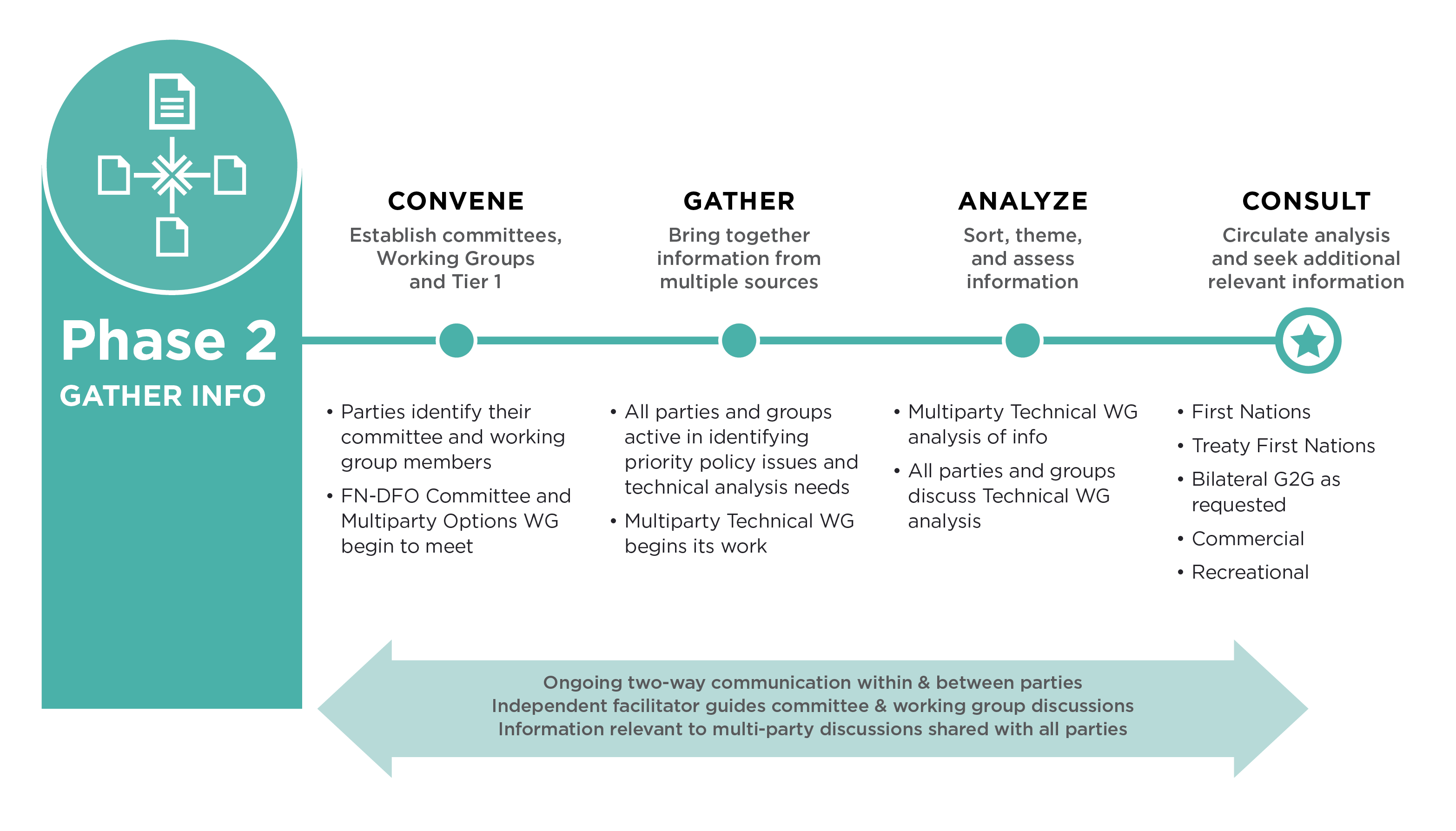
Long text version
Phase 2: Gather info
Convene: Establish committees, Working Groups and Tier 1
- Parties identify their committee and working group members
- FN-DFO Committee and Multiparty Options WG begin to meet
Gather: Bring together information from multiple sources
- All parties and groups active in identifying priority policy issues and technical analysis needs
- Multiparty Technical WG begins its work
Analyze: Sort, theme, and assess information
- Multiparty Technical WG analysis of info
- All parties and groups discuss Technical WG analysis
Consult: Circulate analysis and seek additional relevant information
- First Nations
- Treaty First Nations
- Bilateral G2G as requested
- Commercial
- Recreational
Across all steps:
- Ongoing two-way communication within and between parties
- Independent facilitator guides committee and working group discussions
- Information relevant to multi-party discussions shared with all parties
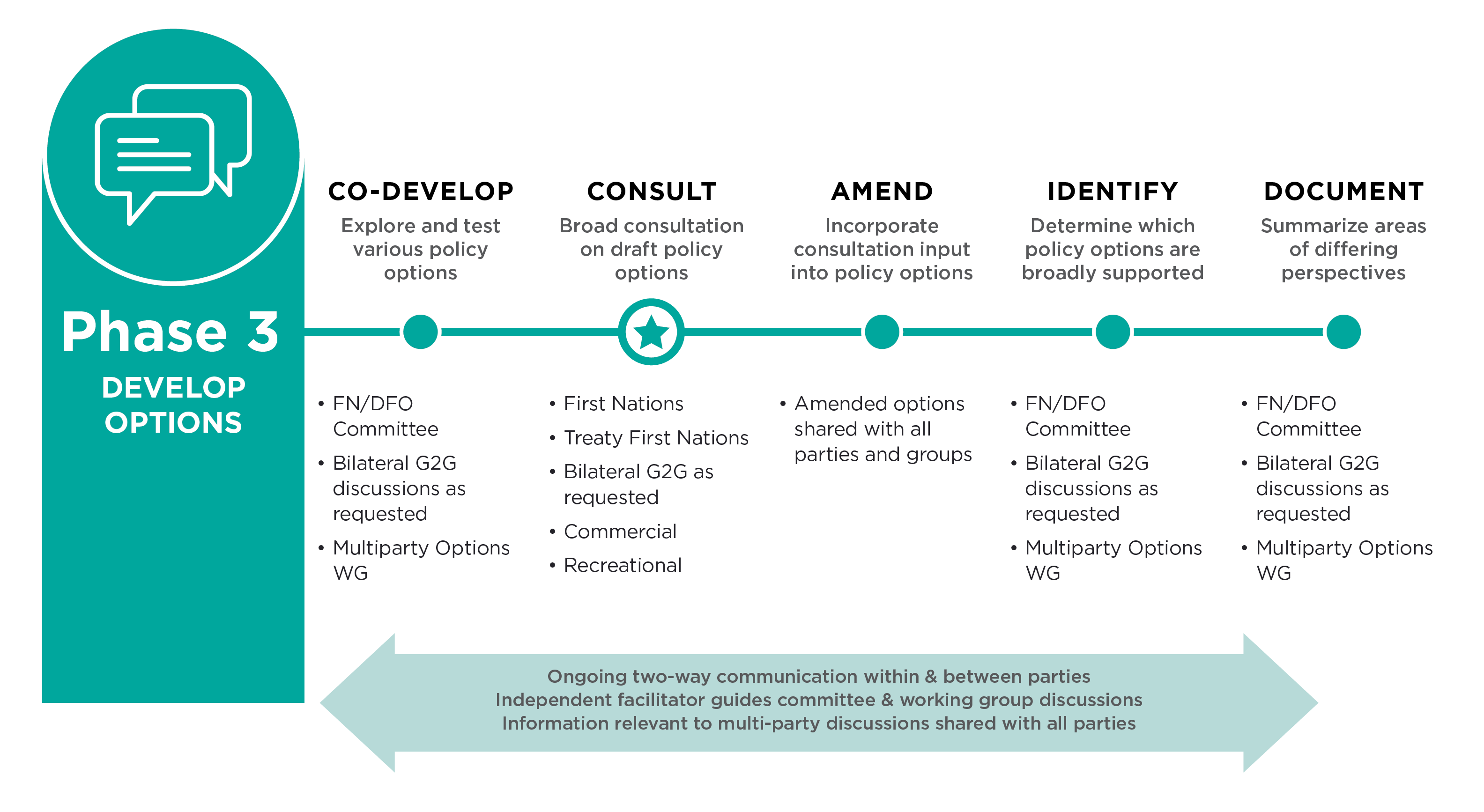
Long text version
Phase 3: Develop options
Co-develop: Explore and test various policy options
- FN/DFO Committee
- Bilateral G2G discussions as requested
- Multiparty Options WG
Consult: Broad consultation on draft policy options
- First Nations
- Treaty First Nations
- Bilateral G2G as requested
- Commercial -
- Recreational
Amend: Incorporate consultation input into policy options
- Amended options shared with all parties and groups
Identify: Determine which policy options are broadly supported
- FN/DFO Committee
- Bilateral G2G discussions as requested
- Multiparty Options WG
Document: Summarize areas of differing perspectives
- FN/DFO Committee
- Bilateral G2G discussions as requested
- Multiparty Options WG
Across all steps:
- Ongoing two-way communication within & between parties
- Independent facilitator guides committee & working group discussions
- Information relevant to multi-party discussions shared with all parties
Long text version
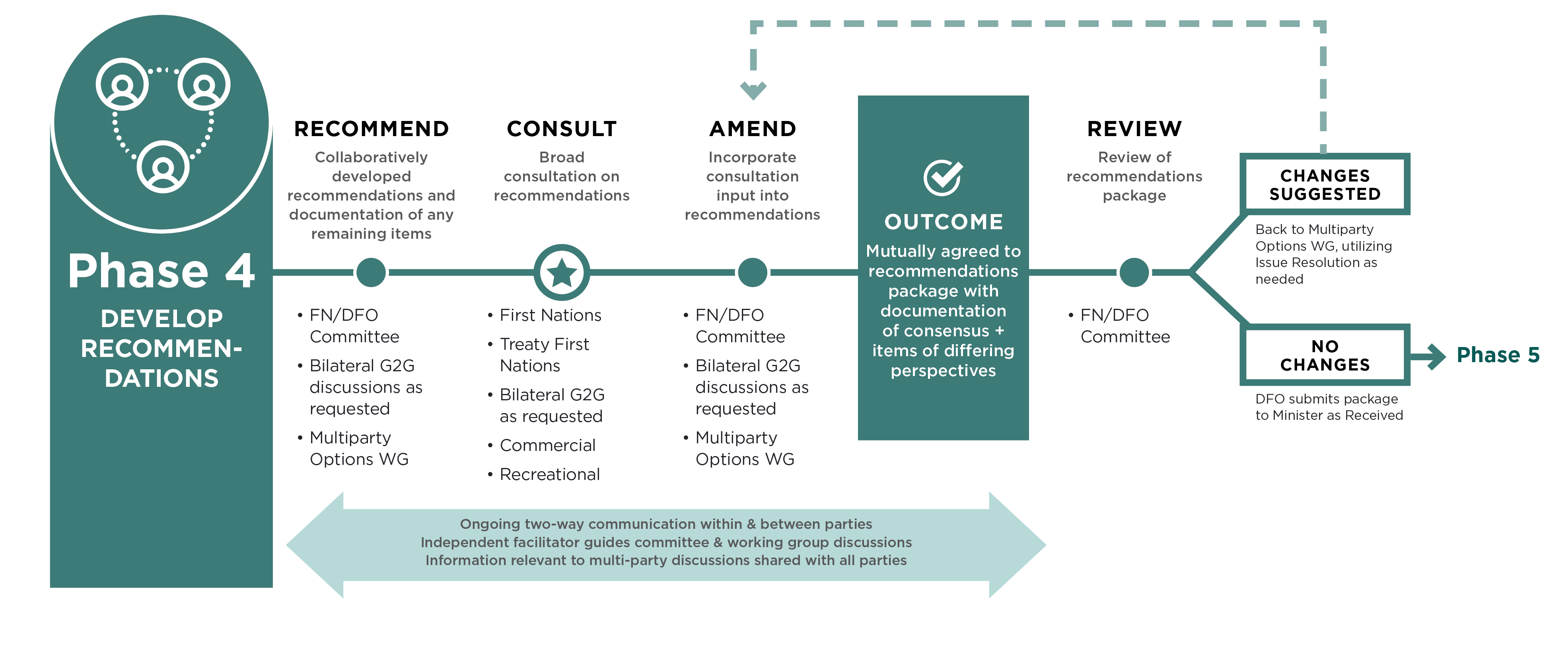
Phase 4: Develop recommendations
Recommend: Collaboratively developed recommendations and documentation of any remaining items
- FN/DFO Committee
- Bilateral G2G discussions as requested
- Multiparty Options WG
Consult: Broad consultation on recommendations
- First Nations
- Treaty First Nations
- Bilateral G2G as requested
- Commercial
- Recreational
Amend: Incorporate consultation input into recommendations
- FN/DFO Committee
- Bilateral G2G discussions as requested
- Multiparty Options WG
Outcome: Mutually agreed to recommendations package with documentation of consensus and items of differing perspectives
Review: Review of recommendations package
- FN/DFO Committee
If there are:
- Changes suggested:
- Back to Multiparty Options WG, utilizing Issue Resolution as needed
- Return to the Amend step
- No changes:
- DFO submits package to Minister as Received
- Continue to Phase 5
Across all steps:
- Ongoing two-way communication within & between parties
- Independent facilitator guides committee & working group discussions
- Information relevant to multi-party discussions shared with all parties
Long text version
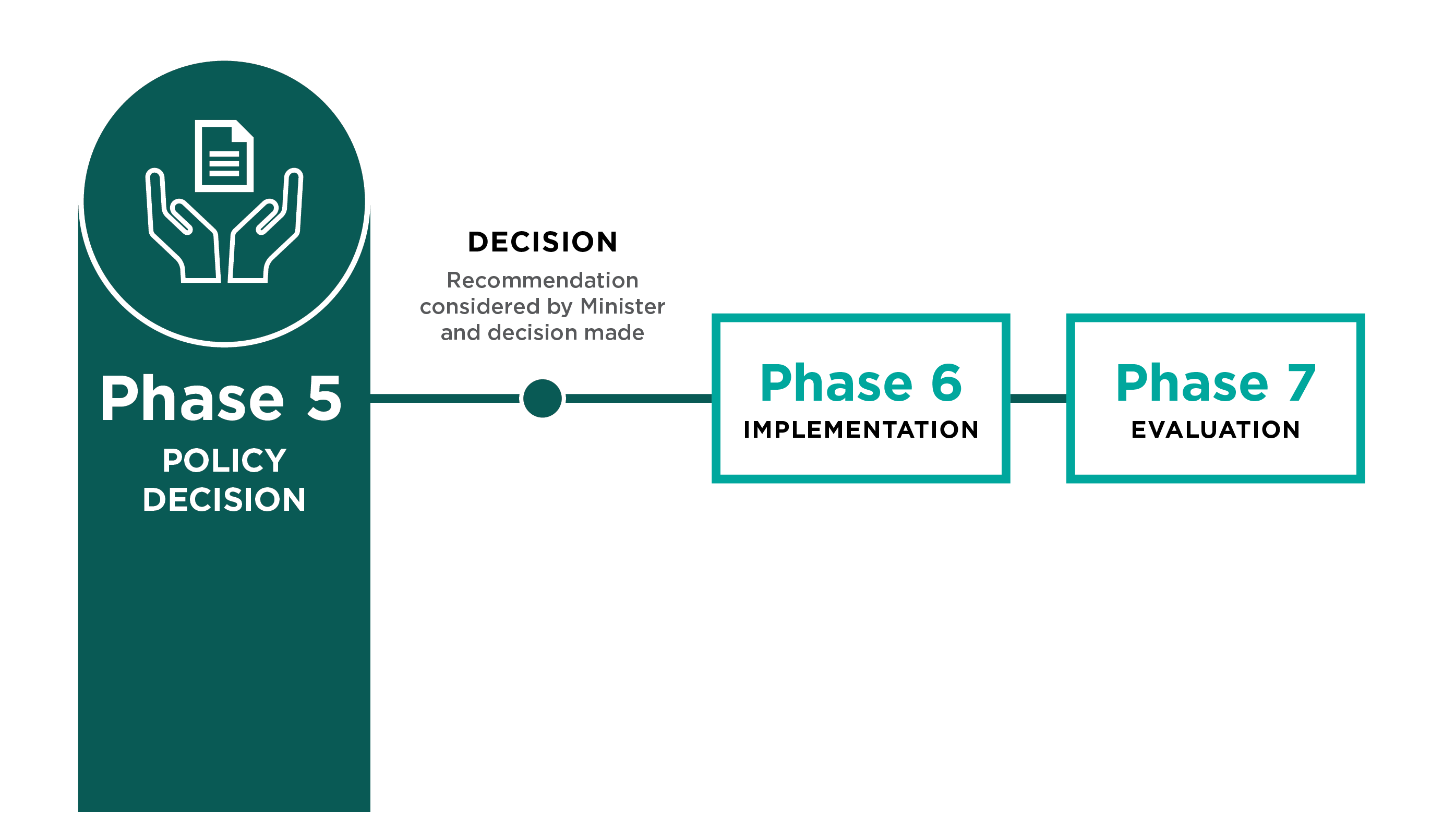
Phase 5: Policy decision
Decision: Recommendation considered by Minister and decision made
Continue to Phase 6: Implementation and Phase 7: Evaluation
Appendix - Terms of Reference for the Pacific Salmon Allocation Policy Review in BC
Section 1 – Context for review
The 1999 Salmon Allocation Policy (SAP)Footnote 8 sets out a series of principles for salmon allocation and priority in British Columbia among three harvest groups (First Nations’ Food, Social and Ceremonial (FSC) and treaty defined fisheries; commercial fisheries; and recreational fisheries) and within the commercial fishery among gear types (gillnet, seine and troll). This policy has guided the priority of annual domestic allocations of salmon harvested in B.C. Since the SAP was first adopted twenty years ago, there have been substantial changes in terms of fisheries management, fisheries policy, Aboriginal rights, treaties and reconciliation. These changes include modern treaties signed with eight First Nations Footnote 9, which confer constitutionally-protected rights to harvest fish and aquatic plants for domestic food, social and ceremonial purposes.
There have also been increased conservation requirements for stocks of concern and Pacific salmon returns have become more uncertain and variable from year to year.
Most recently, within the 2018 BC Supreme Court Ahousaht decision Footnote 10, the application of the SAP (1999) was found to be an unjustified infringement of five Nuu-chah-nulth Nations’ (Ahousaht, Ehattesaht/ Chinehkint, Hesquiaht, Mowachaht/Muchalaht, and Tla-o-qui-aht) Aboriginal rights to fish and sell fish insofar as the SAP accords priority in allocation to the recreational fishery over the Five Nations’ right-based sale fishery for Chinook and Coho salmon. To the extent that the SAP applies to the Five Nations in the manner declared an unjustifiable infringement by the Court, the SAP is of no force and effect in its application to the Five Nations’ exercise of their aboriginal right to fish and sell fish. DFO has responded to the court decision through the development of a Fisheries Management Plan for the Five Nations, which accommodates their right to fish and sell fish and remedies the unjustified infringements. Rather than designing a process solely to address the Court’s findings in Ahousaht, DFO has initiated a comprehensive process to review and replace the 1999 SAP.
The process for replacing the 1999 SAP will entail provincial scale engagement that will reflect Canada’s nation-to-nation relationships with First Nations, and involve affected stakeholders, in a collaborative approach.
Section 2 – Detailed description of policy objectives and parameters
1. Conservation
- The overarching context in which the SAP is rooted is conservation. The conservation and sustainable use of Pacific salmon is promoted through a precautionary approach to managing fisheries; efforts to rebuild stocks; addressing incidentally caught species; actions to maintain and restore fish habitat and ecosystem integrity; and recognition of the need for timely and accurate fisheries catch information.
- The policy will allow for precautionary management in its implementation. In general, the precautionary approach in fisheries management is about being cautious when scientific information is uncertain, unreliable or inadequate and not using the absence of adequate scientific information as a reason to postpone or fail to take action to avoid serious harm to the resource Footnote 11. This requires a recognition that the level of uncertainty and risk (e.g. arising from increased variability of salmon returns due to climate changes) will influence fisheries management allocation and management decisions.
- Conservation will not be compromised in the development of principles to guide salmon allocation priority.
- Conservation is a shared responsibility.
2. Case law
- The policy will be consistent with relevant case law including but not limited to Sparrow and the court findings on priority in allocation in implementing the right of the Five Nations (Ahousaht, Ehattesaht/ Chinehkint, Hesquiaht, Tla-o-qui-aht, Mowachaht/Muchalaht) as found in Ahousaht Indian Band and Nation et al. v. Canada. The clear identification of relevant case law will be undertaken in Phase 2 of the review.
3. Constitutional requirements
- The policy will be consistent with constitutional requirements in respect of Aboriginal and Treaty rights under s.35 of the Constitution Act, 1982.
4. International obligations
- The policy will be consistent with Canada’s international obligations including the Pacific Salmon Treaty, which sets out provisions for the conservation, harvest limits and international sharing of Pacific salmon harvests between Canada and the United States.
5. Federal responsibilities
- The federal government has constitutional responsibility for fisheries management including the conservation and protection of salmon resources. This includes responsibility for determining whether or not salmon fishing activities may be carried out and the particular rules under which they may be carried out, consistent with the Constitution (including s. 35 constitutional obligations), treaties, statutes, negotiated agreements with First Nations, and common law. The Department of Fisheries and Oceans Act provides the Minister of Fisheries and Oceans Canada with the legislative authority for the management and regulation of the fisheries, and the Fisheries Act provides a framework for the proper management and control of fisheries, and the conservation and protection of fish and fish habitat, including by preventing pollution. Fisheries management policies, including the SAP, provide guidance for fisheries managers within this legislative framework.
- The new SAP and SAP review process will comply with the Cabinet Directive on the Federal Approach to Modern Treaty Implementation.
6. Consistency with existing and emerging policies
- The revised SAP will need to be consistent and/or compatible with DFO policies and frameworks, including but not limited to the Wild Salmon Policy, Sustainable Fisheries Framework, Fishery Monitoring Policy and the Selective Fishing PolicyFootnote 12, and other policies in development where relevant.
- Where issues are identified with existing policies in relation to options being discussed for SAP, these issues will be raised as early in the process as possible. The goal is for the objectives of the SAP and other policies to be met in a coordinated manner and for inconsistencies to be identified and resolved, where possible.
- Similarly, developments in other concurrent policy review processes will be reflected in the SAP Review process when they touch on salmon fishery allocation.
7. Enabling
- The SAP must provide sufficient guidance and clarity in the immediate term, while being able to adapt to changing contexts over time.
- The policy is intended to be drafted, to the extent possible, so as to not require revisions to account for other First Nations’ rights to fish that may be recognized in the future, or future agreements on First Nations’ fishing.
8. Flexibility
- End outcomes will be described, but the means by which the outcomes are achieved may not be prescribed, thereby allowing for different implementation approaches that are geographically or species appropriate, or which may evolve over time.
9. Clarity
- Terms within the policy are unambiguous.
- The meaning of the policy is easily and commonly understood leading to consistent interpretation.
- The SAP will seek to provide increased predictability and transparency around allocation priorities, while recognizing that changing environmental conditions and fluctuating abundance may result in uncertainty regarding year-to-year harvest opportunities.
10. Sustainable use
- The Wild Salmon Policy defines sustainable use as the use of biological resources in a way and at a rate that does not lead to their long term decline, thereby maintaining the potential for future generations to meet their needs and aspirations. Footnote 13
- Goals for Sustainable Use of salmon include:
- Meeting obligations to First Nations for FSC, Domestic Treaty, and negotiated agreements; and
- Contributing to social well-being (e.g. food source, enjoyment), and providing employment and other economic benefits to Indigenous people, other Canadians and fisheries-dependent communities.
- Opportunities for sustainable use are subject to meeting conservation objectives.
- With respect to Pacific salmon fisheries, selective fishing is an important component of sustainable use.
Section 3 – Detailed description of process-related guiding principles
1. Crown consultation
- DFO will consult with First Nations during the SAP review process.
- The Government of Canada has a legal duty to consult, and where appropriate, accommodate First Nations when it considers conduct that might adversely impact potential or established Aboriginal or treaty rights Footnote 14.
- In addition to the legal duty to consult, the Government of Canada also undertakes consultation and engagement with Indigenous communities, stakeholders and the public on various issues for reasons of good governance, sound policy development and decision-making, and to strengthen relationships.
2. Application of UN Declaration on the Rights of Indigenous Peoples
- Canada is committed to implementing the United Nations Declaration on the Rights of Indigenous Peoples (UNDRIP) and recognizes the right of Indigenous peoples to participate in decision-making in matters that affect their rights through their own representative institutions and the need to consult and cooperate in good faith with the aim of securing their free, prior, and informed consentFootnote 15. The United Nations Declaration on the Rights of Indigenous Peoples Act affirms this commitment.
3. Reconciliation and government-to-government relationships
- The Government of Canada is committed to achieving reconciliation with Indigenous peoples through a renewed, nation-to-nation, government to government relationship based on recognition of rights, respect, co-operation, and partnerships as the foundation for transformative change Footnote 16.
- Fisheries and Oceans Canada and the Canadian Coast Guard have a key role in the transformation of Canada’s relationship with Indigenous peoples. We recognize that fisheries, oceans, aquatic habitat and marine waterways are of great social, cultural, spiritual and economic importance to many Indigenous Peoples. The Fisheries and Oceans Canada and the Canadian Coast Guard Reconciliation Strategy sets out the long-term roadmap for advancing meaningful reconciliation Footnote 17.
- The Department encourages all participants to approach the process with an awareness that reconciliation requires establishing and maintaining mutually respectful dialogue and relationships between Indigenous Peoples and non-Indigenous peoples.
4. Values respecting sustainable, inclusive and accessible fisheries
- Pacific salmon are an icon of Canada’s Pacific coast and rivers, providing important cultural, economic and social benefits to Canadians.
- Pacific salmon are an integral part of First Nations' cultural identity, spirituality, and governance and management systems in British Columbia, providing a source of food, income and employment.
- Sustainable fisheries will assist in maintaining the potential for future generations to meet their aspirations for these resources Footnote 18.
- Recreational and commercial Pacific salmon fisheries play an important role in the social, cultural and economic life of British Columbia serving as a source of enjoyment, food, income and employment.
- The SAP renewal process will meaningfully engage an appropriately broad range of groups with harvest rights and interests.
- The process will engage through a variety of methods, that are responsive to regional differences, to encourage full participation for the dissemination of information and collection of feedback.
5. Clarity and transparency
- Clear, transparent and consistent procedures will be established to guide the policy review process.
- As much as possible (excepting confidential material), all parties will have access to the same information.
- Multiparty Options Development Working Group recommendations will be formulated in an open and transparent manner.
- DFO and the independent facilitator(s) will support clear communication between the First Nations-DFO Committee, Multiparty Options Development Working Group, and the Technical Working Group, including the development of mechanisms to support communication between all committees, working groups and parties involved in the process.
6. Best available information
- The best available information (e.g. relevant, up to date, accessible, sourced from multiple knowledge systems, peer reviewed) will be used in the process for option deliberation, recommendation development, and decision making. Where relevant, key uncertainties in the information will be identified.
- The process will not be unduly delayed as a result of waiting for the delivery of (new) information or to address uncertainties. All parties will be mindful of the cost and capacity implications arising from information requests they make.
7. Relationships and constructive participation Footnote 19
- Participants will strive to put relationships first throughout the process.
- Challenge ideas, not people.
- Identify and test assumptions, including one’s own.
- Allow each other the freedom to test ideas (without prejudice to future discussions) and suspend judgment until understanding is reached.
- Look for common ground and creative solutions.
- Treat issues as problems to be solved, not as personal or sectoral conflicts.
8. Respect
- Everyone’s right to be heard will be respected. All participants are encouraged to listen actively and try to see issues from other people’s perspectives. Everyone is a valued member of the process and will treat each other in a way that honours this. The responsibility for creating and maintaining a respectful working atmosphere belongs to everyone.
9. Accountability and reciprocal accountability
- Accountability requires clear expectations to be set as early as possible, and specific commitments made, as well as clear standards that measure the meeting of those expectations and commitments. The obligation of all participating parties, individuals, and organizations is to account for their activities, accept responsibility for them, and to disclose the results in a transparent manner Footnote 20.
10. Efficient Use of Limited Resources
- The review will be conducted in a manner that respects DFO’s responsibility for the efficient use of public funds, and the time and resources of the parties to engage in the process.
Section 4 –Committee and working group participants and focus
1. First Nations - DFO Committee
First Nations and DFO will meet in the First Nations/DFO Committee, per the process workflows. The independent facilitators will provide neutral facilitation for committee discussions.
Participants include:
- First Nations
- Internal Tier 1 communication will be needed to identify participants for this committee. These participants could include FNFC Salmon Coordinating Committee and invited delegates from the Five Nations, modern Treaty Nations, Native Fishing Association, FSMC, and AAROM organizations.
- DFO
- Province of BC (observer)
- All parties involved in this committee will manage the overall number of participants to allow for effective discussion.
Committee roles include:
- Reviewing the process workflow and making adjustments related to engagement with First Nations as necessary
- Advising on engagement and consultation activities with First Nations
- Overseeing broad communications to First Nations
- Coordinating communication about FN-DFO committee activity/feedback as well as First Nations feedback to the Technical Working Group and Options Development Working Group
- Coordinating discussions between First Nations and sectors (where requested)
- Ensuring rights are respected by the Options Development Working Group
- Providing advice to DFO to help ensure legal obligations related to the Duty to Consult are met effectively throughout the process
- Discussing right-based topics, and identifying related priority policy issues and technical analysis needs
- Discussing information gathered and technical analyses, particularly in terms of rights- based elements
- Discuss and develop policy options to address right-based elements
- Considering input from consultations
- Identifying options that are broadly supported and where there are areas of differing perspectives to inform development and discussion of recommendations by Multi-party Working Group
- Reviewing and confirming the final package of recommendations agreed to by the Multi- party Working Group.
- If changes are identified, bringing these changes to the Multi-Party Working Group for further discussion
- If desired, developing a supplemental report to accompany final package of recommendations agreed to by Multi-Party Working Group and reviewed by FN-DFO committee for submission to the Minister.
2. Multiparty Options Development Working Group (Multi-Party Working Group or MWG)
First Nations, the CSAB, the SFAB, DFO and the Province (observer) will meet in this multiparty working group. The independent facilitators will provide neutral facilitation for MWG discussions while DFO will provide process support.
Participants will include:
- First Nations (8 members, including 1 from Treaty First Nations and 1 from Five Nations)
- SFAB (4 members, including North, South, Main)
- CSAB (4 members, including one from each gear type)
- DFO (participants will depend on the focus of discussions)
- Province of BC (observer).
Guidelines:
- Participants will be determined by each party according to their own internal process with consideration for regional perspectives, inclusion of modern Treaty Nation perspectives, and creating space for First Nations commercial participation.
- Alternates may be identified, but efforts should be made to have consistent participation in working group discussions.
- Participants will make their best efforts to bring forward the views and perspectives within each party, informed by internal discussions and communication
- The facilitators will support the work of the MWG by providing neutral facilitation of all MWG discussions.
- Observers may be allowed upon agreement by MWG members.
- MWG activities will include:
- Identifying priority policy issues and related technical analysis needs
- Establishing direction to the Technical Working Group, including striking subcommittees as needed
- Analyzing information provided by the Technical Working Group
- Developing policy options
- Identifying options that are broadly supported and where there are areas of differing perspectives, documenting what these differing perspectives are
- Developing recommendations for broader consultation
- Reviewing and utilizing feedback from broad consultation to adjust recommendations as needed
- Discussing and seeking agreement on final package of recommendations including documentation of options to address any areas where agreement was not reached
3. Multiparty Technical Working Group (TWG)
- The Technical Working Group is ad hoc and issue dependent.
- Participants will be identified internally by each party based on who has expertise and knowledge to contribute to the identified issues.
- The facilitators will support the work of the TWG by providing neutral facilitation for all discussions.
- Participant numbers will be managed for effectiveness.
- Activities include conducting technical work or assessing the technical work/reports/analyses of third parties
- Direction on where to focus the technical work is provided by the Multi-Party Working Group.
- Products arising from the Technical Working Group will be made available for review and use by all parties, committees and working groups in the process.
Section 5 – Roles and responsibilities
1. Fisheries and Oceans Canada
- Represent the Department’s interests, perspectives and objectives
- Maintain internal communication between various, relevant DFO branches and processes
- Identify a team that will consistently attend meetings
- Adhere to the Terms of Reference
- Resource the process in a cost-effective way, to an extent that is feasible
- Contract a facilitator as required and with input from key parties
- Maintain a website as a platform for ongoing communication throughout the process
- Engage and consult with First Nations, including fulfilling the Crown duty to consult with First Nations during the review in accordance with section 35 and relevant case law.
- Meaningfully engage with commercial and recreational stakeholders during the review.
2. First Nations including Five Nations (Ahousaht, Ehattesaht/Chinehkint, Hesquiaht, Tla-o-qui-aht, Mowachaht/Muchalaht), Treaty First Nations, First Nations Fisheries Council and other Indigenous organizations
- Identify First Nations delegates who will consistently attend meetings
- Respond to correspondence between meetings
- Adhere to the Terms of Reference
- Communicate with constituents to report out on the process and bring their interests forward
- Ensure descriptions of the process or draft policy recommendations are as accurate as possible (e.g. mutually defined) before communications are sent to constituents
- Seek support for the draft policy recommendations
3. CSAB and SFAB
- Identify representatives who will consistently attend meetings
- Respond to correspondence between meetings
- Adhere to the Terms of Reference
- Communicate with constituents to report out on the process and bring their interests forward
- Ensure descriptions of the process or draft policy recommendations are as accurate as possible (e.g. mutually defined) before communications are sent to constituents
- Seek support for the draft policy recommendations
4. Province of B.C.
- Identify representatives who will consistently attend meetings
- Respond to correspondence between meetings
- Adhere to the Terms of Reference
5. Facilitators
- Provide impartial management of the process so participants can focus on substantive issues
- Design sessions in a way that all participants can contribute to their fullest, discussions are generative, options can emerge, and issues are brought to closure
- Ensure the Terms of Reference and other group agreements are adhered to
- Contribute to information accessibility and management by establishing and maintaining collective and individual mechanisms for providing information to all parties.
- Develop session summaries and milestone documents including document summarizing policy recommendations that are mutually agreed to by Multi-Party Working Group in Phase 4.
- DFO staff and/ or notetaker may support the documentation aspects of this role as required.
Section 6: Acronyms and abbreviations
- AAROM
- Aboriginal Aquatic Resource and Oceans Management
- CSAB
- Commercial Salmon Advisory Board
- DFO
- Fisheries and Oceans Canada
- FNFC
- First Nations Fisheries Council
- FSC
- Food, Social and Ceremonial
- FSMC
- Fraser Salmon Management Council
- G2G
- Government to Government
- IFMP
- Integrated Fisheries Management Plan
- LWARS
- B.C. Ministry of Land, Water, and Resource Stewardship
- SFAB
- Sport Fishing Advisory Board
- SAP
- Salmon Allocation Policy
- TAC
- Total Allowable Catch
- UFAWU
- United Fishermen and Allied Workers’ Union
- UNDRIP
- United Nations Declaration on the Rights of Indigenous Peoples
Section 7: Definitions
1. Bycatch Footnote 21
- The inadvertent harvest of different species than the target species. Bycatch includes retained and non-retained catch.
2. Consensus Footnote 22
- While unanimity will be sought, consensus does not require that everyone be in complete agreement. Instead, moving forward in the absence of unanimity is acceptable when:
- The direction put forward goes as far as possible towards meeting the interests of all parties;
- all are willing to accept the direction put forward; and
- no one feels that his/her position on the matter was misunderstood or not given a proper hearing.
3. Conservation
- The protection, maintenance, and rehabilitation of genetic diversity, species, and ecosystems to sustain biodiversity and the continuance of evolutionary and natural production processes Footnote 20.
4. Engagement
- A broad term to describe all types of involvement or participation in the SAP process, inclusive of:
- Government-to-government (G2G) engagement between DFO and First Nations, based on constitutional requirements in respect of Aboriginal and Treaty rights under s.35 of the Constitution Act, 1982, Canada’s commitment to implement UNDRIP, and reconciliation commitments including the Principles Respecting the Government of Canada’s Relationship with Indigenous Peoples Footnote 23.
- Collaboration with commercial and recreational sectors
- Consultation with public
- Government-to-government engagement between DFO and the Province of British Columbia
5. Five Nations
- Ahousaht, Ehattesaht/Chinehkint, Hesquiaht, Tla-o-qui-aht, Mowachaht/Muchalaht who have an Aboriginal right to fish and sell all species (except geoduck) within their territories as declared by the BC Supreme Court (Ahousaht Indian Band and Nation et al v. Canada).
6. Incidental Harvest
- The inadvertent harvest of non-target stocks (including stocks of concern) within the same salmon species (e.g. Cultus Lake Sockeye when harvesting Summer Run Sockeye) Footnote 24.
7. Incidental Mortality
- Fishing-related incidental mortality (FRIM) includes all mortality associated with fishing activities, beyond the mortality accounted for in retained catch. FRIM includes estimates of mortality rates for fish that encounter fishing gear but are not captured (e.g. escape mortality), that are dead upon or die during capture (e.g. on-board mortality), or that die after release (e.g. post-release mortality) Footnote 25.
8. Precautionary Approach
- In general, the precautionary approach in fisheries management is about being cautious when scientific information is uncertain, unreliable or inadequate and not using the absence of adequate scientific information as a reason to postpone or fail to take action to avoid serious harm to the resource.
- Applying the precautionary approach to fisheries management decisions entails establishing a harvest strategy that:
- identifies three stock status zones – healthy, cautious, and critical – according to upper stock and limit reference points;
- sets the removal rate at which fish may be harvested within each stock status zone;
- adjusts the removal rate according to fish stock status variations (i.e., spawning stock biomass or another index/metric relevant to population productivity), based on pre-agreed decision rules Footnote 26.
- Further, there are five principles of precaution:
- The application of the precautionary approach is a legitimate and distinctive decision-making approach within a risk management framework.
- Decisions should be guided by society’s chosen level of risk Footnote 27.
- To the extent to which information is available, application of the precautionary approach should be based on sound scientific information.
- Mechanisms for re-evaluation and transparency should exist.
- A high degree of transparency, clear accountability, and meaningful public involvement are appropriate Footnote 28.
Terms that may require further definition during the SAP review or other processes include access, allocation, and priority.
- Date modified: