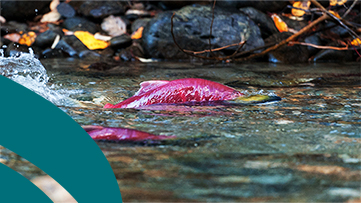
Eulachons are of continuing importance to First Nations who harvest them for food, social and ceremonial purposes. Eulachons are eaten fresh, or often smoked, dried, salted or made into grease. Eulachon grease is an important First Nations food source, it is widely bartered among communities and is given as gifts in potlatch ceremonies.
The making of eulachon grease is a labour intensive process. The general Kwakiutl method of grease extraction was described by MacNair (1971): after the eulachon were caught, they were allowed to decompose in canoes, chests, or pits for one to two weeks. The fish were then put into hot water and heated for half an hour after which the entire mixture was stirred and the fish "bounced" on large forks to release oil from the fish and the resulting oil was skimmed off the surface of the water. It was strained, cooled, and heated again until it turned clear and then stored. Other methods by various groups included pressing the fish to extract the remaining oil after boiling or heating, and heating the fish-water mixture with hot stones. Historically, the grease was often stored in containers made from bull kelp or in wooden boxes.
For groups with access, eulachon grease formed a staple part of the First Nations diet. It was used in many traditional foods, to preserve fruit, as medicine and even to lubricate tools. Eulachon grease is composed mainly of oleic, stearic, and palmitic acids. It added a good dose of vitamins A, D, K, and E to the First Nations diet. The fish when eaten whole was also a source of calcium, iron, and zinc protein.
High value was placed on eulachon grease. When traded, 25 gallons or one box of eulachon grease was worth the equivalent of four blankets or two beaver skins or two boxes of dried halibut. Fifty gallons of eulachon grease could be traded for a canoe. (Hinrichsen, 1998)
The Department negotiates approximately 74 agreements annually with 145 First Nations in British Columbia and the Yukon. First Nations access to fish for food, social and ceremonial purposes are managed through a communal licence. (for additional information on communal licences, see the internet site.
Aboriginal communal licences specify the locations and method permitted for use by First Nations for food, social and ceremonial harvests. Eulachons are harvested when they return to freshwater to spawn. Timing of fisheries on the coast is area dependent, with the Skeena and Nass spawners returning in early March and to the Fraser River in April/May. Fishing methods will vary by First Nations and river system, but may include beach seine, gillnet, conical nets and dipnets.
Limited information is available on the extent of First Nations' harvest of eulachons for food, social and ceremonial purposes. Catch monitoring programs are currently being developed in collaboration with some Aboriginal organizations.
Table 1. First Nations' Nass River Catches (Eulachon Research Council May 4 & 9 2000 Meeting Notes)
| Year | Catch (preliminary) | Peak |
| 1997 | 106 tonnes |
March 20 |
| 1998 | 296 tonnes | March 13 |
| 1999 | 238 tonnes | March 15 |
| 2000 | 168 tonnes | March 17 |
The Department regularly consults with individual First Nations on a bilateral basis on their fisheries for food, social and ceremonial purposes, as well as on activities that might impact on their fisheries (e.g. proposed commercial, recreational fisheries, by-catch issues or fishery closures). It is the objective of the Department to enter into Fisheries Agreements with First Nations that will set out fishing arrangements including area of the fishery, harvest levels, gear to be used and the First Nations involvement in the management of their fishery. The Department also consults with groups of First Nations that share common fishing areas or in some cases, share common interests. Examples of the latter include watershed-based committees such as the Fraser River Aboriginal Fisheries Forum, and the province-wide BC Aboriginal Fisheries Commission. To date, there has not been an agreed-upon process to consult on a multi-lateral basis between First Nations, commercial and recreational fishers.
The recreational fishery for eulachon is believed to be minor. There is presently no reporting of sport caught eulachon; as a result, the Department has no eulachon catch information available for this sector.
Eulachon can be sport fished by dipnet or gillnet. A British Columbia Tidal Waters Sport Fishing Licence is required for the recreational harvest of all species of fish, including eulachon. Licences are available to any person with proof of age and residency, and payment of the applicable fee. Licences are available from hundreds of vendors throughout he region including sporting goods shops, gas stations. Campgrounds and fishing resorts. The British Columbia Tidal Waters Sport Fishing Guide is available free of charge from the same licence vendors.
The daily limit for the recreational harvest of eulachon is 20kg with a possession limit of 40kg. The fishery is officially open year round in most areas, but eulachon are only accessible to the sports fishery when they return to spawn in the spring as this is the only time when eulachon gather in concentrations close enough to the surface/shore to allow for productive fishing with recreational fishing methods.
Eulachon have been commercially harvested on the Fraser River since the 1870's. The only other large commercial fishery of eulachon in BC has been on the Nass River, which ended in the 1940's. In the early 1940's, First Nations asked the Minister of Fisheries not to grant licences to any non-aboriginal individuals or companies to harvest eulachon from anywhere in BC except for the Fraser River. Fraser River eulachon were not used for grease production, perhaps due to lower oil content or quality or lack of interest from First Nations groups living in the area. From 1903 to 1912, the Fraser River eulachon fishery was the fifth largest commercial fishery in BC. (Stacy, 1995).
Historically, anyone with a Category 'C' licence or a limited entry vessel-based category of licence was eligible to fish eulachon. These fish are harvested when they return to the lower Fraser River to spawn between late March and early May.
Up to 1995, the fishery was passively managed with an open time from
March 15 to May 31 for commercial drift gillnets with a one day per week
closure. In 1995, due to concerns raised by First Nations and commercial
fishers that eulachon stocks were at very low levels of abundance, an
active management regime and stock assessment program was initiated. The
fishery was restricted to three days per week in an attempt to provide a
"spawning window" which would allow some fish to swim unimpeded by nets
to their spawning areas.
In 1996, the number of vessels landing eulachon increased to 71 and the
catch dramatically increased to at least 63t (preliminary estimate).
This increase was due to a number of factors, including: speculation
over licensing changes, diminished opportunities in other fisheries,
changes to the unemployment insurance program and an increase in the
availability of eulachon.
The commercial eulachon fishery was closed in 1997 due to the inability to control effort and participation and to ensure conservation objectives were met. Licence limitation was put into effect in 1998 and a separate category of licence for eulachon (ZU) introduced. Due to stock abundance concerns the fishery was not opened in 1998, 1999 or 2000.
The commercial eulachon fishery sells to the fresh fish market for
food. Some of the catch is sold as bait for recreational sturgeon
fishing.
Based on fish slip records for the period 1980 to 1995, the number of
active vessels ranged between 8 and 45 and catches were between 6t and
49t with an average of 20t. The total value of the fishery has ranged
between $9,000 and $64,000.
Figure 1: Fraser River Commercial Eulachon Harvest 1941-1996

Table 2. Summary of Fraser River (Area 29) commercial eulachon fishery value, effort, participation, & catch for 1970 to 1996.
| Year | # Fishers | Value ($) | Effort (days) | Catch (tonnes) |
| 1970 | - | - | - | - |
| 1971 | - | - | - | 34.519 |
| 1972 | - | - | - | 53.162 |
| 1973 | - | - | - | 53.071 |
| 1974 | - | - | - | 75.297 |
| 1975 | - | - | - | 27.669 |
| 1976 | - | - | - | 36.741 |
| 1977 | - | - | - | 32.205 |
| 1978 | - | - | - | 38.610 |
| 1979 | - | - | - | 22.353 |
| 1980 | - | - | - | 24.385 |
| 1981 | - | - | - | 21.204 |
| 1982 | - | 9,150 | 66 | 8.261 |
| 1983 | 35 | 11,863 | 145 | 10.504 |
| 1984 | 28 | 19,577 | 120 | 15.733 |
| 1985 | 42 | 40,391 | 99 | 29.229 |
| 1986 | 30 | 48,596 | 223 | 49.416 |
| 1987 | 22 | 20,859 | 239 | 19.117 |
| 1988 | 30 | 36,449 | 204 | 39.441 |
| 1989 | 24 | 18,052 | 219 | 18.791 |
| 1990 | 23 | 22,081 | 151 | 19.945 |
| 1991 | 26 | 16,788 | 204 | 12.293 |
| 1992 | 27 | 32,566 | 280 | 19.609 |
| 1993 | 25 | 18,001 | 210 | 8.979 |
| 1994 | 8 | 10,514 | 61 | 5.915 |
| 1995 | 45 | 64,152 | 372 | 25.792 |
| 1996 | 35 (71*) | 59,438 | 275 | 29.463 (65.745*) |
| Five year averages | ||||
| 1985-89 | 30 | 32,869 | 197 | 31.199 |
| 1990-94 | 22 | 19,990 | 181 | 13.348 |
| 10 year average | ||||
| 1985-94 | 26 | 26,430 | 189 | 22.274 |
| Source: DFO sales slip data | ||||
| * log book/hail data | ||||