Fisheries and Oceans Canada
www.dfo-mpo.gc.ca
Home
> Pacific >
Fisheries >
Recreational Fishing >
Fishing Responsibly

Fishing Responsibly
Code of Conduct
Fishing
responsibly not only means protecting the environment and the resource,
but also practising safe fishing habits and respect towards others. This
Code of Conduct has been developed and endorsed by the
Sport Fishing Advisory Board.
- Handle all fish with care.
- Limit your catch to ensure fish for the future.
- Leave your fishing spot cleaner than you found it.
- Respect the rights of property owners and other outdoor
enthusiasts.
- Use the proper tackle and methods for the species being targeted.
- Promote the sport by teaching children and new participants how to
fish.
- Become informed about your fishery and participate in its
management.
- Report all illegal fishing activities to the proper authorities.
- Respect the space of others, leave enough room for everyone to fish.
- Learn the fishing and boating laws and abide by them.

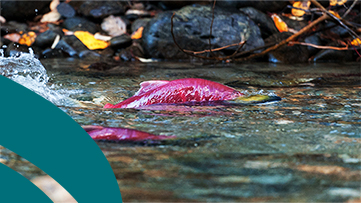
The survival of Pacific salmon is important to recreational anglers -
and non-retention, or catch-and-release, is one way to help ensure that
survival. Studies have shown that the majority of sport-caught and
released salmon survive, as high as 85% to 95% in the ocean, and in some
cases even higher in rivers and streams.
Practicing good catch and release techniques begins before you catch
the fish and doesn’t end until after you set it free and it swims away.
Techniques to Remember
- Remember: when fishing for salmon, barbless hooks are mandatory.
- Use large lures or artificial baits to reduce the incidental
catch of undersize fish.
- Do not overplay the fish, bring it in as quickly as possible.
- For a salmon under 30 cm, unhook it at the water surface to
minimize handling.
- For a larger salmon, if it is too difficult to unhook it in the
water, bring it onboard, remove the hookquickly and release it. This
will cause less stress and damage to the fish.
- Use a soft knotless mesh net to minimize scale loss.
- Handle the fish securely. Keep it immobile while the hook is
removed then quickly release it into the water.
- Remove the hook with needle-nose pliers or surgical hemostats.
- Do not touch or handle a fish by its gills.
- To avoid injury, support the fish when lifting by placing one
hand around the base of its tail and the other under its belly. Do
not lift it by the tail as this will stretch the vertebrae.
- To return the fish to water, release it at a 45° angle with the
head pointing down and just above the waterline. If the fish is
exhausted, revive it in the water by keeping a grip on its tail;
move it back and forth slowly to increase water flow over the gills;
wait until it is strong enough to swim out of your hands.
- Some fish may be hooked deep inside the mouth. If this is the
case, cut the line as close to the hook as possible and leave it in.
The hook will erode in time.
| Additional tips for freshwater flyfishers:
- Flyfishers require room - leave enough space
between you
and the next angler.
- Never step downstream in front of another angler.
Note:
Most rockfish will not survive catch and release. The pressure
difference between the surface and depths they inhabit will inflate the
swim bladder to the point where it will push the fish’s stomach out its
mouth, thereby killing the fish.
|
Did You Know?
- If you wet your hands prior to handling a fish, you improve its
chances of survival.
- Scales are important to a fish; however, they can survive some
scale loss.
- Make it easy to measure your fish by marking your boat (ie.,
side or floor) with the legal lengths.
- To change a barbed hook to a barbless one, simply squeeze the
barb tightly against the hook shank with a pair of pliers.
|
The following publications/videos on catch and release are
available to the public:
Angling for the Future,
Release 'Em Right,
through the website or by calling 604-666-0384.