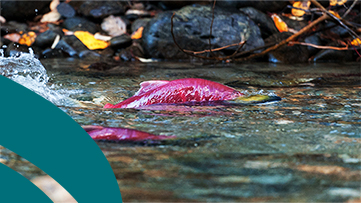
2011 LATE RUN SOCKEYE

Preliminary Escapement Estimates


Preliminary escapement estimates are based on daily data summaries that have been entered into the computer database at the completion of the field projects.  The individual data have not been finally verified, sampling data have not been applied and bias tests have not been performed on the mark-recapture data.  Changes in preliminary estimates are likely.

Background

The Late Run consists of a diverse group of populations that spawn in the southern and east-central portion of the Fraser River system; the Lower Fraser, Harrison-Lillooet, Seton-Anderson and South Thompson areas.  Populations within this timing group enter the lower Fraser River from August to October, after delaying off the mouth of the Fraser River for a period of time, and migrate immediately upstream to terminal spawning areas.  Spawners begin arriving on spawning grounds in early September with peak of spawning for the majority of populations occurring from early October to mid November.  The die-off continues into late December in some lower Fraser stocks (e.g. Harrison and Cultus).


The 2007 brood year escapement for the Late Run totalled 327,814 spawners with an average spawning success of 94.9%.  The largest spawning escapements in 2007 were observed in the Harrison River (128,295), Birkenhead River (93,527) and Adams River (52,713).

Escapement Estimation

The 2011 escapement estimation plan was based on a pre-season spawning escapement goal of 482,800 (at the 50% probability forecast) using standard enumeration methodology for the number of spawners expected to return by population (Andrew and Webb, 1987).  Low precision visual surveys are used to enumerate populations with expected escapements of less than 75,000 spawners.  DIDSON (Dual Frequency Identification Sonar), enumeration fences or mark-recapture studies are used for populations with expected escapements of greater than 75,000 spawners where high precision estimates are required (the actual technique is based on local characteristics).  The 2011 escapement estimation plan had three components:

Visual Surveys

Most Late Run populations had expected escapements of less than 75,000 spawners; consequently, they were assessed visually on foot, by boat or by helicopter.  Survey frequency ranged from weekly coverage on most systems, to single surveys for remote or difficult to access systems. Where single surveys were used, the survey was timed to coincide with expected peak abundance using temporal patterns in nearby populations to schedule coverage.


On each visual survey the entire spawning area is assessed with counts of live and dead Sockeye collected.  The sex and spawning success (females only) is recorded for all carcasses recovered.  After enumeration, all recovered carcasses are chopped in half with a machete to avoid re-counting on subsequent surveys.


For each stream the total escapement is the sum of the maximum count of live spawners and the cumulative count of recovered carcasses through the date of the peak live count multiplied by an index expansion factor.  The total escapement for a stream is reported by males, females and jacks in three steps:


·         The total jack recovery is adjusted by applying an expansion factor of 1.26 (Andrew and Webb MS, 1987).  The adjusted carcass recovery totals are then used to calculate the proportion of adult males, females and jacks for each stream;

·         If the adult carcass recovery sample (excluding unsexed carcasses and jacks) is both temporally and spatially representative throughout the die-off period, then the estimate is stratified by adult males, females and jacks on the basis of the proportions calculated above;

·         If the total adult carcass recovery is not considered both temporally and spatially representative throughout the die-off period, then the adult sex ratio, jack composition and female spawning success is estimated from a nearby stream or population aggregate.  Jacks are excluded from this calculation if none were observed during surveys of the stream in question.


The average female spawning success is calculated from the weighted daily estimates of female egg retention (0%, 50% or 100%) in the female carcass recovery sample.  The effective female escapement is the product of the total female escapement and the average female spawning success (excluding Sockeye killed for biological samples). 


Visual surveys were conducted by DFO (Fraser River Stock Assessment), Douglas First Nations and Lil’wat First Nations (Harrison-Lillooet system). 

Enumeration Fences

Escapement to the Weaver Creek spawning channel, Birkenhead River, Cultus Lake and the upper portion of the Eagle River were assessed using counting fences.  The Weaver Creek spawning channel is managed and operated by DFO, Ecosystems Management Branch. The Birkenhead River fence was operated jointly by DFO (Fraser River Stock Assessment) and the Lil’wat First Nation.  The Cultus Lake and Eagle River fences were operated by DFO (Fraser River Stock Assessment).


The total escapement in fenced streams is estimated from the sum of the daily fence counts.  The sex specific escapement (including jacks) and female spawning success are estimated from carcasses recovered during foot surveys using the methods as described for visual surveys.

Mark-Recapture

Escapements to the Harrison and Adams rivers were assessed using mark-recapture methods.


The procedures used to analyse the mark-recaptures and to estimate sex specific escapement (including jacks) and female spawning success are similar to those described in Schubert 2007.

Escapements

The preliminary 2011 Late Run Sockeye spawning escapement estimate totals 1,087,036 of which 521,195 are adult males, 564,380 are adult females and 1,461 are jacks (Table 1).  This is the second largest Late Run spawning escapement on record for this cycle year (Figure 1).  It is over 3 times the 2007 brood year (327,814) and is 44% higher than the recent (1991-2007) cycle average of 752,239 (Figure 1).  It is 93% of the in-season spawning escapement target of 1,170,000, but falls well below the Pacific Salmon Commission in-season estimate of potential spawning escapement of 2,255,200 (accounting for in-river harvest above Mission).


The largest Late Run escapements in 2011 were observed in the Harrison River (644,014), Birkenhead River (194,496), Adams River (131,042) and Weaver Creek system (72,770).  Relative to the brood year, escapements increased in all areas of the watershed except the Seton-Anderson.  Comparisons of total escapement by area for 2007 and 2011 are:  Lower Fraser from 976 to 8,970 (including Cultus broodstock); Harrison-Lillooet from 264,247 to 928,358; Seton-Anderson from 1,699 to 1,451; and South Thompson from 61,043 to 148,510.  


The elevated levels of pre-spawn mortality observed in all earlier Fraser Sockeye timing groups in 2011 continued through the Late Run spawning period in all areas of the watershed.  Similar to the other groups, pre-spawn mortality was weighted towards the earliest arrivals, but remained abnormally high throughout the duration of the spawning period.  Sockeye (mainly females) were reported as stressed, lethargic and in poor condition at the Harrison and Adams rivers through mid-October. Observations of en-route mortalities were reported in the Harrison River and near terminal areas of the Harrison-Lillooet system (Fraser River mainstem near the confluence of the Harrison River) throughout the month of September.  Opportunistic sampling by DFO and PSC staff in-season confirmed the majority of these mortalities as Harrison River Sockeye.  In contrast, very few observations of en-route mortalities were observed in the South Thompson system, with the majority of the mortality contained in the terminal area (shoreline surrounding Adams River).  Although water levels on the spawning grounds were higher than average in all areas of the watershed, physical conditions (water temperatures and levels) were favourable throughout the Late Run spawning period in all areas of the watershed with the exception of the Lillooet River system where heavy rainfall in mid-September resulted in high water conditions and the removal of the Birkenhead River counting fence before Sockeye migration into the system was complete.


Largely due to the different mortality patterns observed (i.e. en-route / near terminal mortality vs. mortality contained within the terminal area), estimates of spawning success are highly variable throughout the watershed ranging from 9.3% to 99.4% in the Lower Fraser, 64.0% to 92.8% in the Harrison-Lillooet, 77.6% in the Seton-Anderson, and 53.3% to 83.4% in the South Thompson.  Spawning success for the Late Run aggregate is an estimated 80.8% in 2011, below the long term average of 88.1%.


Estimates of escapement and spawning success by watershed area and spawning site are provided in Table 1.


·         Lower FraserThis region has 2 Sockeye populations in the Late Run group including Cultus Lake and Widgeon Slough.  The 2011 escapement to this area totals 8,970 (including Sockeye retained for broodstock) (Figure 2a).  Sockeye counted through Sweltzer Creek fence totals 7,436 of which 253 were retained as captive brood stock and held at Cultus Lake laboratory.  The remaining 7,183 Sockeye were passed into Cultus Lake.  The 2011 escapement to Cultus Lake is over 9 times the 2007 brood year escapement of 800 (including broodstock) and is 81% of the 1991-2007 cycle average (9,185).  Sockeye were reported as being in good condition throughout the arrival period with no reports of en-route mortalities in the near terminal areas.  Despite a relatively large carcass recovery sample in 2011 (>10% of the population), it is expected that that the reported estimate of spawning success (9.3%) is biased low and not representative of the total population.  As most spawning in Cultus Lake occurs at depths below the visual range (>7m), it is expected that standard carcass recovery surveys on Cultus Lake are biased towards unsuccessful spawners (more easily accessible to crews).  Underwater remote video surveys conducted in Cultus Lake in 2011 observed active Sockeye spawning and Sockeye redds between 7-12 m as well as spawned out Sockeye carcasses up to 30 m depths providing further evidence that estimates of spawning success based on standard shore based carcass recovery surveys on Cultus Lake are biased low.


Escapement to Widgeon Slough in 2011 (1,534) is the second largest on record for this cycle year.  It is 9 times greater than the 2007 brood year (176) and 6 times greater than the 1991-2007 cycle average (255).  Spawning success for Widgeon Slough Sockeye is an estimated 99.4%.


·         Harrison-LillooetThis watershed supports ~10 Late Run Sockeye spawning sites.  The 2011 escapement to this area (928,358) is the second largest on record, the majority of which spawned in the Harrison River (Figure 2b).  Escapement to the Harrison River in 2011 (644,014) is the second largest on record.  It is 5 times the 2007 brood year (previous cycle year record escapement) of 128,295 and two orders of magnitude higher than the 2008 brood year of 6,750 (Harrison Sockeye are comprised of both age-4 and age-3 fish).  As noted above, large numbers of Sockeye mortalities were reported in the Harrison River and near terminal areas of the Harrison River (Lower Fraser mainstem near the confluence of the Harrison River) throughout the month of September, prior to the implementation of the mark-recapture project (October 4th).  Therefore, the reported estimates of escapement and spawning success for the Harrison River do not include mortalities prior to October 4th.  Spawning success for the Harrison River is an estimated 90.6%, below the long term average of 98.9%.


Heavy rainfall in the Lillooet River watershed in mid-September resulted in high water conditions in the Birkenhead River and the permanent removal of the Birkenhead River counting fence on September 22nd, preventing a complete assessment of the Birkenhead River Sockeye population for a second consecutive year in 2011.  High water and poor visibility persisted through the remainder of the arrival and spawning period preventing a visual assessment of the system to determine the number of Sockeye unaccounted for by the early fence removal.  Therefore the reported estimate to the Birkenhead River in 2011 (194,496) is a minimum estimate.  From 2005-2009, the total escapement accounted for through the fence by September 22nd has averaged 82% (ranging from 63-96%).  Using this average, the total Birkenhead River escapement may be underestimated by 42,000 spawners.  Spawning success for the Birkenhead River is estimated at 74.4% in 2011, much lower than the long term average of 91.3%.


Escapement to the Weaver Creek system (72,770) is the largest on record for this cycle year.  It is almost double both the 2007 brood year (37,392) and 1991-2007 cycle average (38,952).  Spawning success in the spawning channel and creek is 75.2% and 64.0%, respectively in 2011; well below the respective long term averages of 90.3% and 86.9% for these populations.


·         Seton-AndersonThis area typically supports one Late Run Sockeye population (Portage Creek); however, Sockeye were observed spawning in Bridge River where spawners have been observed previously but inconsistently in recent history.  The 2011 escapement to this area (1,451) represents the fifth consecutive decline relative to the brood year on this cycle year, with escapement decreasing 88% since the 1991 record cycle escapement (12,330) (Figure 2c).  This escapement is 85% of the brood year (1,699) and 21% of the 1991-2007 cycle year average (6,795).  Spawning success to the system is 77.6%, well below the long term average of 93.2%.


·         South ThompsonThis system supports ~ 25 spawning sites, dominated by the Adams River on this cycle year.  The 2011 Late Run escapement to the South Thompson (148,510) is more than double the brood year (61,043), but only 30% of the 1991-2007 cycle average (494,106) (Figure 2d). Escapements more than doubled the brood year at all main spawning sites including Adams River (131,042 vs. 52,713), Lower Shuswap River (10,420 vs. 5,103) and Little River (3,956 vs. 1,937).  The period of Sockeye spawning in the Adams River was very protracted in 2011.  Immediately upon arrival to the spawning grounds in late September, Sockeye began spawning without delay and continued through early November. As noted above, Sockeye were reported as being in poor condition for the majority of the arrival period and pre-spawn mortality levels were abnormally high throughout the duration of the run with most of the mortality contained within the terminal areas (minimal en-route mortalities were observed).  As a result, the reported estimates of escapement and spawning success for the Adams River include Sockeye mortalities that died prior to spawning in the terminal area (in contrast to the Harrison River, described above).  Spawning success in the South Thompson system is the second lowest on record in 2011 at an estimated 55.0%, well below the long term system average of 94.9%.


References


Andrew, J.H., and T.M. Webb.  MS 1987.  Review and assessment of adult Sockeye salmon enumeration programs on the Fraser River.  Prepared by Environmental and Social Systems Analysis Ltd. for the Department of Fisheries and Oceans.


Schubert, N.D.  2007.  Estimating the 1995 Fraser River Sockeye salmon (Oncorhynchus nerka) escapement.  Can. Tech. Rep. Fish. Aquat. Sci. 2737: ix + 71p.


Figure 1.  Total Late Run Sockeye spawning escapement on the 1939-2011 cycle line.


a. Lower Fraser                                                                                      b. Harrison-Lillooet

c. Seton-Anderson                                                                                 d. South Thompson

Figure 2 (a-d).  Late Run Sockeye spawning escapement for the Lower Fraser (a), Harrison-Lillooet (b), Seton-Anderson (c) and South Thompson (d) systems on the 1939-2011 cycle line