Symbol of the Government of Canada

Pacific Region's Habitat Definitions

Pacific Region provides the following compilation of definitions related to fish habitat to facilitate your understanding of DFO's Habitat Management Program.

Active Floodplain
An area adjacent to a lake, stream or other body of water that is periodically flooded, ranging from rare, severe storm events to flows experienced several times a year. For example, a "10 year floodplain" would include the area of inundation that has a frequency of occurring, on average, once every 10 years. It includes lands at the same elevation as areas with evidence of moving water, such as active or inactive flood channels, recent fluvial soils, sediment on the ground surface or in tree bark, rafted debris, and tree scarring.

Ilustration of a typical stream

Activity
Within the context of the Pathways of Effects diagrams, activities represent the component parts, or building blocks of development proposals.

Anadromous
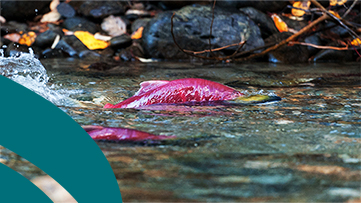
Refers to fish that spend most of their life in saltwater but migrate to freshwater to spawn. Salmon, trout and Arctic char that live in the ocean are prime examples of anadromous species.

Aquatic Species
A wildlife species that is a fish, as defined in section 2 of the Fisheries Act, or a marine plant, as defined in section 47 of that Act.

Artificial Propagation
The use of fish culture to encourage self-sustaining fisheries.

Biological Diversity
The variability among living organisms from all sources - including terrestrial, marine, and other aquatic ecosystems - and the ecological complexes of which they are a part. This includes diversity within species, amongst species and of ecosystems.

Canadian Fisheries Waters
"All waters in the fishing zones of Canada, all waters in the territorial sea of Canada and all internal waters of Canada." (Fisheries Act, sec. 2).

Catadromous
Refers to fish that spend most of their life in freshwater but return to saltwater to spawn. The only North American catadromous species is the American eel.

Compensation (for Loss)
The replacement of natural habitat, increase in the productivity of existing habitat, or maintenance of fish production by artificial means in circumstances dictated by social and economic conditions, where mitigation techniques and other measures are not adequate to maintain habitats for Canada's fisheries resources.

Conservation (of Habitat)
The planned management of human activities that might affect fish habitats to prevent destruction and subsequent loss of fisheries benefits.

Contingency Planning
Management planning utilizing alternative methods or strategies that enable the project to continue if known potential effects increase the risk of the project beyond that which was originally estimated.

Critical Habitat
The habitat that is necessary for the survival or recovery of a listed wildlife species and that is identified as the species' critical habitat in the recovery strategy or in an action plan for the species.

Destruction (of Fish Habitat)
Any permanent change of fish habitat that renders it completely unsuitable for future production of fish, regardless of the means employed in causing the change (e.g. by removal, infilling, blockage etc).

Development (of Habitat)
The creation of fish habitat and the enhancement or other improvement (such as flow regulation, nutrient modification, provision of access to spawning and rearing areas, etc.) applied to any type of fish habitat to provide better conditions for production and maintenance of the fisheries resource.

Development Proposal
A description of an activity or activities related to a proposed development.

Diadromous
Refers to those fish species that migrate between freshwater and saltwater. This category includes both anadromous and catadromous fishes.

Disruption (of Fish Habitat)
Any change to fish habitat occurring for a limited period that reduces its capacity to support one or more life processes of fish.

Ecological Unit
Populations of organisms considered together with their physical environment and the interacting processes amongst them.

Ecosystem
Composed of one or more ecological units where a community of organisms and their physical environment interact.

Effect
A change brought about by a cause or agent. In the context of the Pathways of Effects diagrams, effects reflect a change in fish and fish habitat which has the potential to influence the productive capacity of fish habitat.

Effectiveness Monitoring
Monitoring completed by the proponent to determine the effectiveness of the compensation in achieving No Net Loss of productive capacity of fish habitat.

Endangered Species
A wildlife species that is facing imminent extirpation or extinction.

Enforcement
Enforcement is achieved through the exercise of application of powers granted under legislation. Enforcement of the habitat protection and pollution prevention preventions is carried out through the following activities: 1) Investigations of alleged violations; 2) Injunctions, prosecution, court orders on conviction and civil suits for recovery of costs.

Entrainment
Occurs when a fish is drawn into a water intake and cannot escape.

Estuary
An area where a water body or watercourse is connected with the sea or ocean, and saltwater mixes with fresh water.

Extirpated Species
A wildlife species that no longer exists in the wild in Canada, but exists elsewhere in the wild.

Top of Page

Federal Land
(a) land that belongs to Her Majesty in right of Canada, or that Her Majesty in right of Canada has the power to dispose of, and all waters on and airspace above that land;
(b) the internal waters of Canada and the territorial sea of Canada; and
(c) reserves and any other lands that are set apart for the use and benefit of a band under the Indian Act, and all waters on and airspace above those reserves and lands.

Fish
"includes parts of fish, shellfish, crustaceans, marine animals and any parts of shellfish, crustaceans or marine animals, and the eggs, sperm, spawn, larvae, spat and juvenile stages of fish, shellfish, crustaceans and marine animals." (Fisheries Act, sec. 2).

Fisheries Management Plan
A planning document prepared by a government agency (federal, provincial, territorial or other), that outlines intended resource management direction with respect to fisheries matters based on resource status, identified issues, future goals and objectives, and proposed means of achieving those objectives over an established period of time. Such plans should be prepared in consideration of integrated resource management objectives and involve participation of key stakeholder groups.

Fisheries Resources
Fish stocks or populations that sustain commercial, recreational or Native fishing activities of benefit to Canadians.

Fisheries Timing Windows
Indicate when it is appropriate to proceed with the proposed development in water bodies or watercourses. These timing constraints typically coincide with critical periods in the life cycle of fish (reproduction, incubation and nursery activities).

Fish Habitat
"Spawning grounds and nursery, rearing, food supply and migration areas on which fish depend directly or indirectly in order to carry out their life processes." (Fisheries Act, sec. 34(l)).

Fish Habitat Management Plan
A plan prepared for a region or a specific geographic area of a region which includes an outline of the Department's requirements for conserving, restoring and developing fish habitat to meet fisheries stock production objectives and for use as the basis for consultation in integrated resource planning.

Fish Passage
Defined as the free transit of fish, upstream and downstream, associated with migration or localized movements that are necessary to complete their life cycle. Depending on the context, fish passage is also a route for fish to move between habitat types.

Fish-ways
Provide the means to enable fish to pass around or through an obstruction. This definition encompasses a wide variety of methods or activities for conveying fish including conventional fish ladders, fish locks, fish conveyors, trapping and trucking operations, culverts, and bypasses. A fish-way does not necessarily refer to a physical structure and could also include a channel or any passage used by fish to pass over or around an obstruction.

Habitat
(a) in respect of aquatic species, spawning grounds and nursery, rearing, food supply, migration and any other areas on which aquatic species depend directly or indirectly in order to carry out their life processes, or areas where aquatic species formerly occurred and have the potential to be reintroduced; and
(b) in respect of other wildlife species, the area or type of site where an individual or wildlife species naturally occurs or depends on directly or indirectly in order to carry out its life processes or formerly occurred and has the potential to be reintroduced.

Habitat Banking
The planned creation or improvement of fish habitat, in order to provide compensation for a future development project(s).

Habitat Compensation
The replacement of natural habitat, increase in the productivity of existing habitat, or maintenance of fish production by artificial means in circumstances dictated by social and economic conditions, where mitigation techniques and other measures are not adequate to maintain habitats for Canada's fisheries resources.

Habitat Management Program
Those activities, legislative responsibilities and policies administered by the Department of Fisheries and Oceans for the purpose of conserving, restoring and developing the productive capacity of habitats for the fisheries resources.

Harmful Alteration (of Fish Habitat)
Any change to fish habitat that reduces its long term capacity to support one or more life processes of fish but does not permanently eliminate the habitat.

Harmful Alteration, Disruption or Destruction of Fish Habitat (HADD)
Any change in fish habitat that reduces its capacity to support one or more life processes of fish.

(Ordinary) High Water Mark
The visible high water mark of any lake, stream, or other body of water where the presence and action of the water are so common and usual and so long continued in all ordinary years as to mark upon the soil of the bed of the lake, river stream, or other body of water a character distinct from that of the banks, both in vegetation and in the nature of the soil itself. Typical features may include a natural line or "mark" impressed on the bank or shore, indicated by erosion, shelving, changes in soil characteristics, destruction of terrestrial vegetation, or other distinctive physical characteristics. In situations where it is possible to determine a flood frequency interval, this definition corresponds to the 1:5 flood interval or corresponding elevation.

For lakes with active gauging or Water Survey Canada hydrometric stations, the High Water Mark will include all areas that are seasonally inundated by water more frequently than once in five years on average (1:5 flood interval or corresponding elevation) while for reservoirs the High Water Mark will correspond to the "full pool" or "full supply" level or corresponding elevation.

Ilustration of a typical stream

Illustration of a typical lake

Top of Page

Impingement
Occurs when an entrapped fish is held in contact with a structure like a trash rack or an intake screen and is unable to free itself.

Inspection
Means the carrying out of a detailed systematic field examination based on the premise that an activity, or certain work or undertaking is subject to regulatory requirements.

Integrated Resource Planning
The process whereby federal, provincial, territorial and municipal resource management agencies consult each other and private sector interests to plan for the future use of natural resources including forests, minerals, fish, land, water, wildlife and other resources.

Intertidal:
The coastal zone measuring from the lowest to the highest tide mark; subject to alternating periods of flooding and drying.

Investigation
Means the systematic gathering of evidence of a suspected violation, conducted when there is suspicion that a violation has occurred, or when there are reasonable grounds to believe that an offence is being or has been committed.

Major Projects
Those works, undertakings and activities that could potentially have, or be perceived to have, significant negative impacts on the habitats supporting Canada's important fisheries resources. Examples include: large-scale aerial biocide spraying of forest and agricultural lands; deep-draft marine terminals; hydroelectric dams and diversions; integrated mining operations; offshore oil and gas exploration and development; large industrial and municipal waste discharges; large pipelines, rail lines, roads and transmission lines; large forest harvesting operations; large dredging operations; and other similar projects.

Marine
Pertaining to the sea.

Marine Environment
Comprises the seas and oceans. A coast may take many forms, namely beaches, brackish ponds, mud flats, salt marshes, etc.

Marine Plant
Marine plants include all benthic and detached algae, marine flowering plants, brown algae, red algae, green algae and phytoplankton. 

Migration
The spatial and temporal movement between spawning, feeding, and refuge habitats in response to genetic or environmental stimuli.

Minor Projects
Those works, undertakings and activities which would not normally have, or be perceived to have, serious irreversible biological effects that could not be mitigated on the habitats supporting Canada's fisheries resources. Examples include: most stream crossings, culvert installations, and other stream alterations; most wharf and breakwater construction and repairs; most individual forest harvesting operations; small dredging projects; small foreshore modifications; and other similar projects.

Mitigation
Actions taken during the planning, design, construction and operation of works and undertakings to alleviate potential adverse effects on the productive capacity of fish habitats.

Monitoring
Means the regular observation, surveillance and recording of specific parameters and/or indices to determine the level of compliance with statutory requirements and associated mitigation, and/or compensation measures.

Net Gain
An increase in the productive capacity of habitats for selected fisheries brought about by determined government and public efforts to conserve, restore and develop habitats.

No Net Loss
A working principle by which the department strives to balance unavoidable habitat losses with habitat replacement on a project-by-project basis so that further reductions to Canada's fisheries resources due to habitat loss or damage may be prevented.

Operational Statement
Documents developed by DFO for proponents that provide nationally consistent advice on standard measures to apply to selected activities that are low risk to fish habitat.

Orphaned Site
A site where there is no one (individual or corporate) who exists who may have or is likely to have an obligation to rehabilitate the site.

Pathway
A line on a Pathways of Effects diagram used to represent a cause and effect relationship existing between activities, stressors and effects.

Pathway of Effects
Diagrams that describe development proposals in terms of the activities that are involved, the type of cause-effect relationship that are known to exist for that activity, and the mechanisms by which stressors ultimately lead to effects in the aquatic environment.

Precautionary Principle
Also referred to as the precautionary approach, recognizes that the absence of full scientific certainty shall not be used as a reason for postponing decisions where there is a risk of serious or irreversible harm.

Productive Capacity
The maximum natural capability of habitats to produce healthy fish, safe for human consumption, or to support or produce aquatic organisms upon which fish depend.

Productivity
Fish productivity is defined as the sum of production rates for all co-occurring fish stocks within a defined area or ecosystem (Minns, C.K., 1997). As such, the productivity integrates the value of primary production, food, cover and other habitat variables needed to produce healthy fish.

Proponent
A person, company or corporation that has submitted, or plans to submit, a development proposal.

Proposed Development
Is what is being proposed. This includes all components of the proposed development with potential impacts to fish and their habitat.

Protection (of Habitat)
Prescribing guidelines and conditions, and enforcing laws for the purpose of preventing the harmful alteration, destruction or disruption of fish habitat.

Top of Page

Qualified Environmental Professional
An applied scientist or technologist specializing in a relevant applied science or technology who, through demonstrated suitable education, experience, accreditation and knowledge relevant to the particular matter, may be reasonably relied on to provide advice within their area of expertise, and who, in British Columbia is registered with their appropriate professional organization, and acting under that association's Code of Ethics and subject to disciplinary action by that association.

Residence
A dwelling-place, such as a den, nest or other similar area or place that is occupied or habitually occupied by one or more individuals during all or part of their life cycles, including breeding, rearing, staging, wintering, feeding or hibernating

Restoration (of Habitat)
The treatment or clean-up of fish habitat that has been altered, disrupted or degraded for the purpose of increasing its capability to sustain a productive fisheries resource.

Review Process
The process followed by Habitat Management practitioners to ensure proposed developments are in compliance with the habitat protection provisions of the Fisheries Act.

Riparian Areas
Vegetated areas adjacent to a watercourse or water body that directly contribute to fish habitat by providing shade, cover and food production areas. Riparian areas are important because they stabilize stream banks and shorelines. To minimize disturbance to fish habitat and prevent bank erosion, it is important to retain as much riparian vegetation as possible, especially the vegetation directly adjacent to the watercourse or water body.

Ilustration of a typical stream

Rip Rap
The placement of rocks along the water's edge to support culverts, piers, or other structures.

Risk
For the purposes of this framework (DFO's Risk Management Framework), risk is a term used to represent the expected impact of a development proposal on the productive capacity of fish habitat.

Risk Assessment
The process of identifying, measuring and predicting the likelihood of an unwanted event from occurring. Risk Assessment takes into account the probability of the event occurring, the consequences of the event, and the degree of uncertainty involved.

Risk Assessment Matrix
A two dimensional matrix which uses Scale of Negative Effect and Sensitivity of Fish and Fish Habitat to characterize the risk residual effects pose to the productive capacity of fish habitat.

Risk Communication
Transfer or exchange of information for the purpose of explaining risk and the reasons associated with making decisions.

Risk Management
The identification and implementation of management options for addressing unwanted events in order to achieve an overall objective.

Risk Management Framework
A systematic approach to gathering, evaluating, recording and disseminating information leading to recommendations for a position or action in response to an identified event. A framework to enable Habitat Management practitioners and proponents to better understand the nature of risk, and to manage it more systematically.

Species at Risk
An extirpated, endangered or threatened species or a species of special concern.

Species of Special Concern
A wildlife species that may become a threatened or an endangered species because of a combination of biological characteristics and identified threats.

Stock
The part of a fish population that is under consideration from the point of view of actual or potential utilization.

Stressors
An agent, condition, or other stimulus that causes stress to an organism.

Substrate
Refers to the bed of a water body or watercourse. The substrate of a water body or watercourse may be bedrock, boulder, cobble, gravel, sand, silt, clay, mud, vegetative matter, etc.

Terrestrial
Pertaining to organisms living habitually on the land or ground surface.

Threatened Species
A wildlife species that is likely to become an endangered species if nothing is done to reverse the factors leading to its extirpation or extinction.

Top of Bank
The points closest to the boundary of the active floodplain of a lake, stream, or other body of water where a break in slope of the land occurs such that the grade beyond the break is flatter than 3 (horizontal) to 1 (vertical) at any point for a minimum of 15 metres measured perpendicularly from the break. Where banks are not well defined (e.g. in the case of lakes, wetlands or ponds), the top of the bank is equivalent to the high water mark (HWM) or active floodplain, whichever is greater.

Ilustration of a typical stream

Uncertainty
The amount that a predicted effect may differ from the true effect.

Watercourse
General term that refers to riverine systems such as creeks, brooks, streams, rivers, etc.

Water Body
General term that refers to ponds, bays, lakes, estuaries, marine areas, etc.

Wildlife Species
A species, subspecies, variety or geographically or genetically distinct population of animal, plant or other organism, other than a bacterium or virus, that is wild by nature and
(a) is native to Canada; or
(b) has extended its range into Canada without human intervention and has been present in Canada for at least 50 years.