Contact: Don MacKinlay
email: Don.Mackinlay@dfo-mpo.gc.ca
phone: 604-666-3520.
Lake enrichment is a salmon habitat restoration and enhancement technique that has been used by the Department of Fisheries and Oceans since the early 1970's to improve the freshwater rearing conditions of wild sockeye salmon. Nutrients are added to the surface waters of selected lakes during the growing season to increase the amount of plankton food for juvenile salmon . The objective is to increase the growth and survival of the sockeye salmon in freshwater, which results in improved marine survival and increased numbers of returning adults.
Before the advent of the commercial fishing industry, the millions of fish that are now caught in the ocean would return to freshwater to die, and their carcasses provided a rich source of nutrients for the freshwater ecosystem. These nutrients sustained the growth of the microscopic plants and animals on which the young sockeye fed before migrating to the ocean as smolts. Historical abundance of feed organisms was therefore much greater than today, when a century of heavy fishing has reduced freshwater productivity, and many salmon stocks, to a fraction of their previous levels. Some lakes have naturally low nutrient concentrations because there is limited spawning area (and therefore carcass abundance) in their watersheds, or there is so much rainwater passing through them that the nutrients are flushed out before they can be used by feed organisms. Lake enrichment replaces some of these nutrients to partially restore or enhance the freshwater productivity of sockeye nursery lakes.
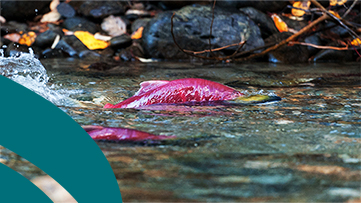
After hatching in the gravel of their stream and lakeshore spawning beds in the spring, sockeye salmon fry move into their nursery lakes and feed on plankton for one or two years, until they migrate to the ocean as smolts. Sockeye salmon are the only salmon with a strict lake rearing requirement. This freshwater phase of their life cycle is critical because mortalities are high in the lakes and their size as smolts migrating to sea directly affects their survival rate in the ocean.
Young sockeye salmon feed on small animals (zooplankton) that in turn feed on microscopic plants (phytoplankton). Like any plants, phytoplankton need nutrients and light for growth. Phytoplankton growth rates are limited by the amount of nutrients in the surface waters of the lakes. By making small, regular additions of nutrients throughout the growing season, phytoplankton growth rates are increased and more food is available for the zooplankton. More zooplankton means more food for the young sockeye. The result is better growth for the sockeye and higher survival rates both in the lake and after they migrate to sea. Increased survival rates increase the number of adult sockeye that will return to the lakes to spawn.

Nutrient addition to lakes and ponds to improve fish production has a long history throughout Asia, Europe and North America. In B.C., the Department of Fisheries and Oceans has enriched up to a dozen sockeye nursery lakes each year since 1976. The B.C. Provincial Ministry of Fisheries has added nutrients to a number of lakes and streams throughout the province to improve trout, kokanee and steelhead populations. Also, in cooperation with B.C. Hydro, some reservoirs are being enriched to improve sport fishing and to compensate for the loss of fish production due to dam construction. The Alaska Department of Fish and Game had a large on-going lake enrichment program for both sockeye and coho salmon and the State of Idaho is trying nutrient addition to help save a near-extinct race of sockeye salmon.
When lakes receive large additions of nutrients from sewage, agriculture runoff, or industrial effluents, the growth of algae in the lakes is uncontrolled and overwhelms the natural lake ecosystem. That is pollution. On the other hand, without nutrients to support the growth of algae at the base of the food chain, lakes would be like aquatic deserts, incapable of supporting fish or any other life. Some amount of nutrient is essential for all plant life, including plants that live in water. Sockeye nursery lakes in B.C. are currently among the most nutrient-deficient and least productive lakes in the world, a condition that has been furthered by the major declines in spawning salmon that historically released large amounts of nutrients to the lakes after decomposition of their carcasses. Today, most sockeye salmon nutrients end up in cans or on barbecues where they cannot naturally enrich their rearing lakes. It may be that many sockeye lakes can never be restored to their historic levels of salmon production without replacing these lost nutrients.
Nitrogen and phosphorus are the two nutrients that limit the growth of phytoplankton in lakes and are the only elements other than water that are added to lakes in the enrichment program. The nutrient solutions are a mix of liquid, agricultural-grade ammonium-polyphosphate and urea-ammonium-nitrate fertilizers. The ratio of each nutrient in the solution is balanced so that only phosphorus limits phytoplankton growth. By controlling phosphorus additions to the surface waters of the lakes, the response of the plankton communities to nutrient additions is also controlled.
All of the nitrogen and phosphorus nutrients are in forms that phytoplankton normally rely on for their growth in the lakes. Three forms of nitrogen are used: nitrate, ammonium and urea. Nitrate is the type of nitrogen that comes into all lakes in rainwater and snowmelt and it is always abundant in the deeper waters of lakes. Phytoplankton use nitrate during the spring and late fall and when high winds mix deeper water into the surface water of the lakes. Ammonium and urea are the forms of nitrogen that phytoplankton utilize during much of the growing season, and they are the "recycled" forms excreted by feeding zooplankton and fish. About 70% of the phosphorus is added as a "complexed" form of polyphosphate (a natural storage product in phytoplankton) that phytoplankton break down before using. This gives the nutrient additions a "slow-release" property that extends the growth response of the phytoplankton communities between weekly additions.
The lakes receive weekly nutrient additions from late spring until early fall, which covers most of the plankton and sockeye growing seasons. The amount of nutrient added each week is tailored to promote the best growth of the plankton communities and varies from highest levels in the late spring and early summer to lower levels in late summer. Nutrients have been applied either aerially, by experienced contractors using aircraft ranging from small helicopters and twin engine spray planes to water bombers, or from boats or barges, which release the nutrient mixture into the prop wash where it is mixed thoroughly into the surrounding water.
Nutrients are added at a rate of 8 to 12 liters per hectare of lake surface every week (not all of the lake is treated). That is about one third of a cup for a 10 meter by 10 meter patch of lake surface. This amount of nutrient is further diluted into the top 5 to 10 meters of the lake (the warm water surface layer used by the plankton). The actual nutrient concentrations in the lake waters after an application is quite low (a few parts per billion) and far below levels that would be of any concern for drinking water or the protection of aquatic life. The objective of the enrichment project is to only double the productivity of the existing plankton communities.
These types of nutrient solutions are used routinely by farmers and greenhouse operations throughout Canada and the U.S.A. for food crops. The same nutrient mix is used by the B.C. Provincial, Alaskan and Idaho State lake and stream enrichment programs. In concentrated form, they are corrosive like any salt solution but they require no other special handling or storage. Like any other salt solution, a spill of concentrated nutrient solution could kill any plant life in prolonged contact with it, so strict guidelines have to be followed for handling and storage of the fertilizer by contractors.
The Canadian Water Quality Guidelines for the Protection of Aquatic Life and the Protection of Drinking Water for Humans contain regulations for the amounts of nitrogen and phosphorus permitted in water. Nutrient concentrations during a lake fertilization program remain far lower than those permitted by regulation.. These regulations are based on scientific studies using the aquatic organisms that research has shown are more sensitive than any others to toxic substances in water: freshwater zooplankton. Increasing the growth and abundance of zooplankton is how lake enrichment works, so if the nutrient solutions were in any way toxic, lake enrichment would be a disaster for the juvenile sockeye since the zooplankton communities would perish first. Just the opposite is true.
In an extremely clear water lake where plankton are the dominant particles in the water, any increase in plankton levels due to nutrient enrichment will reduce the clarity of the water because of light absorption and scattering. In general, though, water clarity in most B.C. lakes is determined by particles and substances that are naturally washed in from their watersheds and the low levels of plankton in the lakes, even during nutrient addition, have little effect on water clarity. Clay and soils washed in from storms, mineral "flours" from glacial meltwaters and snowfields, and dissolved organic substances (brown, tea-colored humic substances) account for much of the seasonal changes in water clarity in most B.C. lakes.
Although the direct effects of nutrient additions are on the plankton communities, shoreline algae, aquatic insects, sport and coarse fish, and other organisms in the lake community also indirectly benefit from the effects of the enrichment program and may show increases in abundance and growth. All parts of a lake ecosystem are interconnected at some level and therefore benefit from nutrient addition.
Fertilization does not affect the drinking quality of the water since so little is added each week and the nutrients are quickly assimilated and diluted within the surface waters. After a fertilizer application, the plankton communities quickly take up the nutrients in the surface lake waters and there is nothing left, except for a bit more plankton. If the water was safe to drink before fertilization, it still is. You are just getting a bit more of what was already naturally present in the water.
Nutrient addition does not increase sockeye salmon abundance in every lake because some sockeye populations are not limited by their freshwater growth phase but by other factors such as fishing pressure, spawning habitat, predation or competing species. Weekly aircraft activity may not be desirable if there is significant wilderness resort or residential use of the lakes. There may also be some temporary reduction in water clarity in very clear water lakes and shoreline algae may show modest visible increases. Lake enrichment is not inexpensive nor is it a guaranteed fix for every depleted sockeye salmon stock. Nutrient addition cannot solve all the problems with sockeye stocks in B.C. It is only a tool to be used with good stock management and habitat protection practices.
For more information about lake enrichment projects conducted by the Department of Fisheries and Oceans, please contact: Don MacKinlay by email or phone 604-666-3520.
Annotated Bibliography of Lake Enrichment and Nutrients (Ken Ashley)
Evaluation of Restoration Efforts on the 1996 Upper Adams River sockeye salmon run (Hume et al.) (PDF)
Toxicity of Lake Enrichment Nutrients to Aquatic Life (MacKinlay) (PDF)
Sockeye salmon nursery lake fertilization: review and summary (Hyatt et al.)
For more information, see the bibliography and references