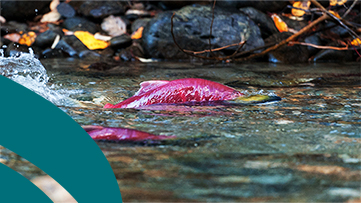
Tenderfoot Creek Hatchery was built in 1981 to enhance primarily chinook salmon stocks in the Squamish River watershed. Chinook stocks had declined since the 1960's, from an estimated 25-35 thousand fish to just one - two thousand in the early 1980's. The hatchery also enhances coho salmon and steelhead trout.
At full production the facility will contribute 20 thousand chinook, 25 thousand coho and one thousand steelhead to the commercial, sport and native food fisheries of British Columbia. Additionally, it will contribute to conservation efforts on endangered, local salmon stocks.
Although located beside Tenderfoot Lake, the hatchery is used to enhance many different stocks of chinook, coho and steelhead. These salmonids normally spawn in the mainstem of the Squamish River or its major tributaries, including the Mamquam River, Ashlu River, Elaho River, Cheakamus River, Tenderfoot Creek and in the Indian River, 36 Mile Creek and Shop Creek. This process, called satelliting, makes use of a large, centrally located hatchery designed to enhance several different stocks, instead of operating several smaller hatcheries built beside each river.
Today, Tenderfoot Creek Hatchery produces 1.6 million chinook smolts, 300,000 coho smolts and 100,000 chum fry each year. Up to 3 million pink salmon and 100,000 steelhead trout are added to the production on some years, depending upon escapement levels and fishery requirements.
To produce these salmon for the various fisheries, the hatchery uses state-of-the-art hatchery techniques. From beginning egg to later smolt stage, salmon are nurtured in a protected environment. They are safe from predators and environmental pressures that normally, in nature, take a heavy toll on their survival. Then the hatchery releases the smolts into their rivers of origin, where they begin migration to the ocean, or directly into the ocean. These salmon return as adults in much larger numbers than found in nature.
The hatchery process begins with the capture of large adult fish, called broodstock. A variety of methods are employed, depending on species. Almost all of the chinook salmon broodstock are captured by seine boat in salt water, in areas where they are heavily concentrated. They are then put into transport trucks and moved to raceways at the hatchery, where they are held until ready for spawning, about 4 to 6 weeks. Coho salmon are captured primarily by drifting gill nets through known holding areas in the rivers. The exception to this is the Tenderfoot Creek coho salmon which are captured using a swim-in trap located on the creek. Coho are also transported to the hatchery by truck and held until ready for spawning.
The broodstock are regularly sorted to remove the "ripe" fish for spawning. This often involves anaesthetizing them with harmless carbon dioxide gas to allow for ease of handling and reduce injury. The fish quickly recover within five minutes of their return to fresh water. While the fish are sedated, fish culturists examine them judge their stage of ripeness. If ready, the females are stripped of their eggs and the males of their sperm. When salmon are not ripe, they are returned to the raceways until they mature.
Eggs and sperm are stirred together in the incubation room. After fertilization, the eggs incubate in stacked trays for three to four months. Each tray hold approximately 7,000 eggs. Water flows down through the trays at a carefully controlled rate and temperature. Tenderfoot Creek Hatchery also incubates up to 500,000 chum salmon eggs in "bulk boxes" located in the intermediate rearing troughs. These eggs are distributed at the "eyed" stage to a variety of public volunteer projects and school classroom incubators. Once the eggs hatch they are called alevins. When their yolk sac, a self contained food supply, has been consumed they are moved to rearing channels. At this stage they are called fry.
Fry are fed a commercially produced diet of fish meal (herring, anchovy and groundfish) with various vitamins and minerals added.

A trough feeder used to feed the fry.
The rearing ponds are supplied pumped water from deep wells on the hatchery property. Each species has its own unique release "strategy" based on size, time and location. At this stage they are called smolts. Chinook are reared for about 150 days and released at 6 to 10 grams in weight, either directly into the river, directly in the ocean or into salt water nets pens for a short period of acclimatization and rearing prior to release. Coho for about 15 months and released to their stream of origin at about 20 grams.