
Geoduck fishery
The following profile provides the socioeconomic context of the geoduck fishery in British Columbia. It includes an overview of the commercial sector. This overview is based on data collected from DFO commercial harvest logbooks and sale slips, public reports, and DFO surveys on harvest prices.
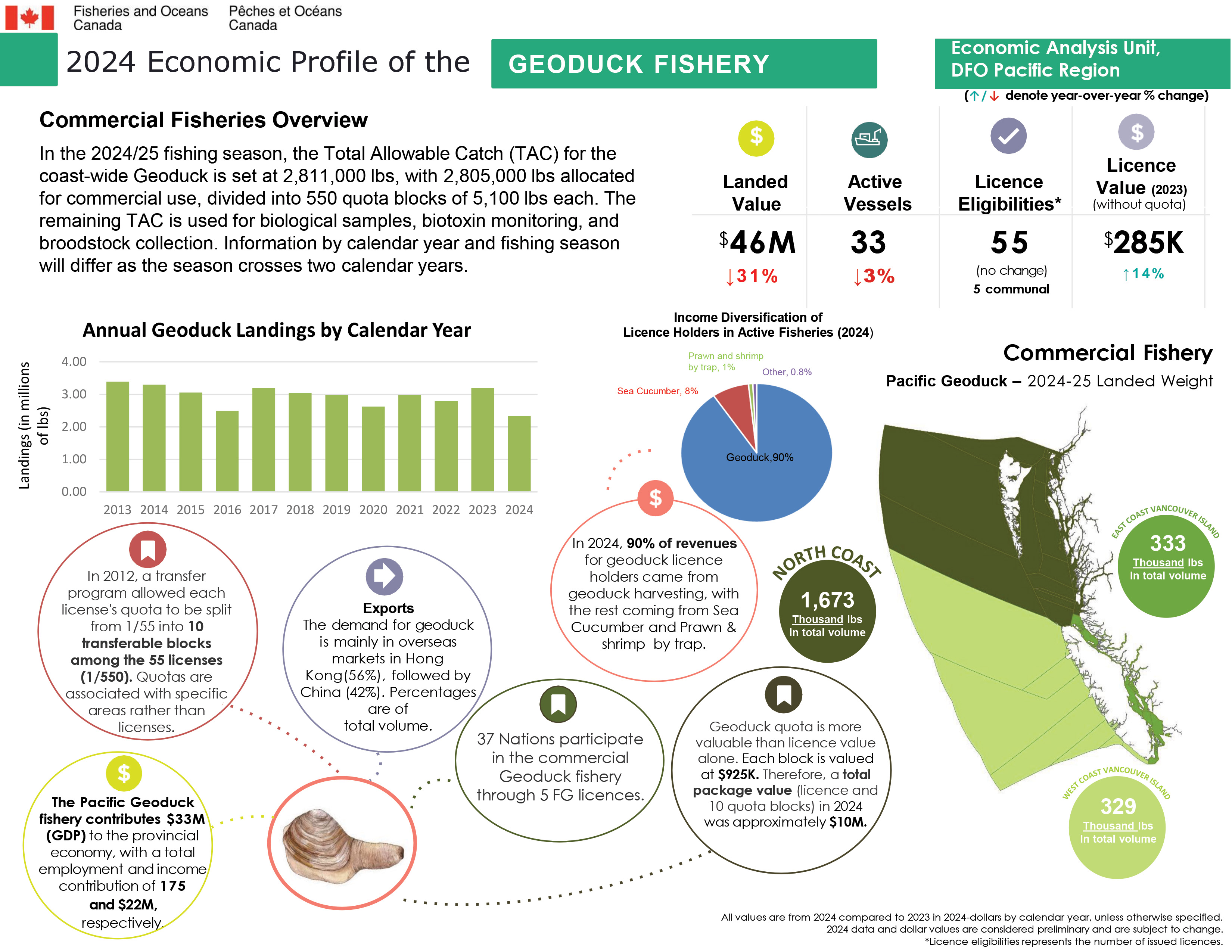
Long text version
2024 Economic profile of the geoduck fishery
Commercial fisheries overview
In the 2024/25 fishing season, the Total Allowable Catch (TAC) for the coast-wide Geoduck is set at 2,811,000 lbs, with 2,805,000 lbs allocated for commercial use, divided into 550 quota blocks of 5,100 lbs each. The remaining TAC is used for biological samples, biotoxin monitoring, and broodstock collection. Information by calendar year and fishing season will differ as the season crosses two calendar years.
All values are from 2024 compared to 2023 in 2024-dollars by calendar year, unless otherwise specified.
Key metrics for the geoduck fishery, all values are from 2024 and in 2024 dollars:
- Landed value ($46M), decreased by 31% since 2023.
- Active vessels (33), decreased by 3% since 2023.
- Licence eligibilities (55, no change since 2023), with 5 being communal licences. Licence eligibilities represents the number of issued licences.
- Licence value (without quota) ($285K in 2023), increased by 14% since 2022.
2024 data and dollar values are considered preliminary and are subject to change.
Annual geoduck landings (in pounds) by calendar year
- 2013 – 3.4M lbs
- 2014 – 3.3M lbs
- 2015 – 3.1M lbs
- 2016 – 2.5M lbs
- 2017 – 3.2M lbs
- 2018 – 3.0M lbs
- 2019 – 3.0M lbs
- 2020 – 2.6M lbs
- 2021 – 3.0M lbs
- 2022 – 2.8M lbs
- 2023 – 3.2M lbs
- 2024 – 2.3M lbs
Commercial fishery Pacific geoduck - 2024-25 landed weight map
- North coast: 1,673 thousand lbs in total volume
- West Coast Vancouver Island: 329 thousand lbs in total volume
- East Coast Vancouver Island: 333 thousand lbs in total volume
Income diversification of licence holders in active fisheries (2024)
In 2024, 90% of revenues for geoduck licence holders came from geoduck harvesting, with the rest coming from sea cucumber (8%), prawn and shrimp trap (1%), and other (0.8%).
Exports: The demand for geoduck is mainly in overseas markets in Hong Kong (56%), followed by China (42%). Percentages are of total volume.
The Pacific geoduck fishery directly contributes $33M (GDP) to the provincial economy, with a total employment and income contribution of 175 and $22M, respectively.
In 2012, a transfer program allowed each license's quota to be split from 1/55 into 10 transferable blocks among the 55 licenses (1/550). Quotas are associated with specific areas rather than licenses.
Geoduck quota is more valuable than licence value alone. Each block is valued at $925K. Therefore, a total package value (licence and 10 quota blocks) in 2024 was approximately $10M.
37 Nations participate in the commercial geoduck fishery through 5 FG licences.
Data
The commercial data that informed this work can be downloaded here.

- Date modified: