
Green sea urchin fishery
The following profile provides the socioeconomic context of the green sea urchin fishery in British Columbia. It includes an overview of the commercial sector. This overview is based on data collected from DFO commercial harvest logbooks and sale slips, public reports, and DFO surveys on harvest prices.
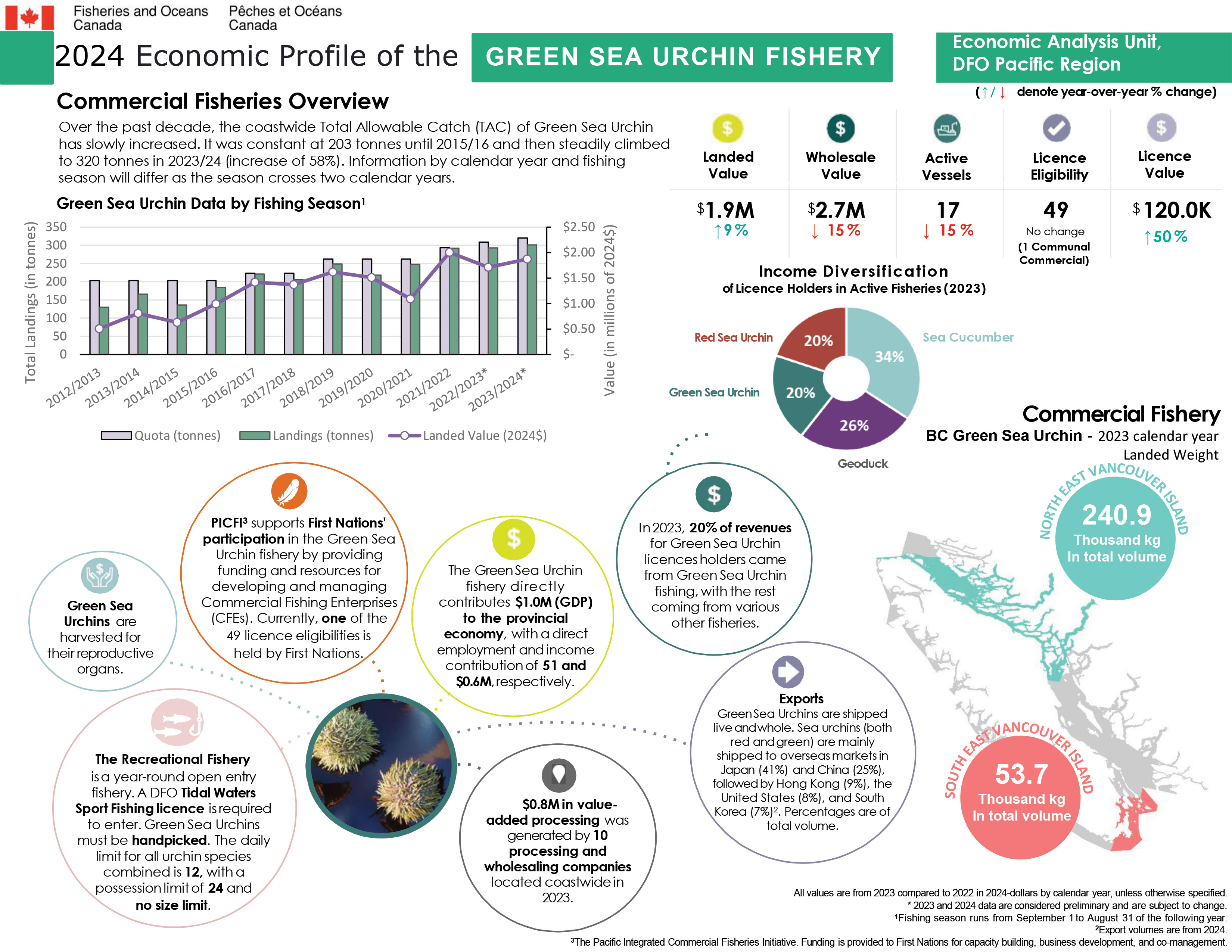
Long text version
2024 Economic profile of the green sea urchin fishery
Commercial fisheries overview
Over the past decade, the coastwide Total Allowable Catch (TAC) of green sea urchin has slowly increased. It was constant at 203 tonnes until 2015/16 and then steadily climbed to 320 tonnes in 2023/24 (increase of 58%). Information by calendar year and fishing season will differ as the season crosses two calendar years.
All values are from 2023 compared to 2022 in 2024-dollars by calendar year, unless otherwise specified.
Key metrics for the green sea urchin fishery, all values are from 2023 and in 2024 dollars:
- Landed value ($1.9M), increased by 9% since 2022.
- Wholesale value ($2.7M), decreased by 15% since 2022.
- Active vessels (17), decreased by 15% since 2022.
- Licence eligibility (49, no change since 2022) with 1 being communal commercial licence). Licence eligibilities represents the number of issued licences.
- Licence value ($120K in 2023), increased by 50% since 2022.
2023 and 2024 data are considered preliminary and are subject to change.
Fishing season runs from September 1 to August 31 of the following year.
Green sea urchin quota (in metric tonnes), landings (in metric tonnes) and value (in 2024 dollars) by fishing season
Quota (in tonnes)
- 2012-2013 – 203 t
- 2013-2014 – 203 t
- 2014-2015 – 203 t
- 2015-2016 – 203 t
- 2016-2017 – 223 t
- 2017-2018 – 223 t
- 2018-2019 – 262 t
- 2019-2020 – 262 t
- 2020-2021 – 262 t
- 2021-2022 – 293 t
- 2022-2023 – 309 t
- 2023-2024 – 320 t
Landings (in tonnes)
- 2012-2013 - 130 t
- 2013-2014 - 166 t
- 2014-2015 - 136 t
- 2015-2016 - 184 t
- 2016-2017 - 221 t
- 2017-2018 - 205 t
- 2018-2019 - 249 t
- 2019-2020 - 218 t
- 2020-2021 - 248 t
- 2021-2022 - 292 t
- 2022-2023 - 293 t
- 2023-2024 - 301 t
Landed value (in 2024$)
- 2012-2013 - $0.51M
- 2013-2014 - $0.81M
- 2014-2015 - $0.63M
- 2015-2016 - $0.99M
- 2016-2017 - $1.42M
- 2017-2018 - $1.37M
- 2018-2019 - $1.62M
- 2019-2020 - $1.51M
- 2020-2021 - $1.09M
- 2021-2022 - $2.00M
- 2022-2023 - $1.71M
- 2023-2024 - $1.87M
Commercial fishery BC green sea urchin – 2023 landed weight map
- North East Vancouver Island: 240.9 thousand kilograms in total volume
- South East Vancouver Island: 53.7 thousand kilograms in total volume
Income diversification of licence holders in active fisheries (2023)
In 2023, 20% of revenues for green sea urchin licence holders came from green sea urchin fishing, with the rest coming from various other fisheries. Geoduck (26%), sea cucumber (34%), and red sea urchin (20%).
Exports: Green sea urchins are shipped live and whole. Sea urchins (both red and green) are mainly shipped to overseas markets in Japan (41%) and China (25%), followed by Hong Kong (9%), the United States (8%), and South Korea (7%). Percentages are of total volume. Export volumes are from 2024.
$0.8M in value-added processing was generated by 10 processing and wholesaling companies located coastwide in 2023.
The green sea urchin fishery directly contributes $1.0M (GDP) to the provincial economy, with a direct employment and income contribution of 51 and $0.6M, respectively.
Green sea urchins are harvested for their reproductive organs.
The recreational fishery is a year-round open entry fishery. A DFO tidal waters sport fishing licence is required to enter. Green sea urchins must be handpicked. The daily limit for all urchin species combined is 12, with a possession limit of 24 and no size limit.
PICFI is the Pacific Integrated Commercial Fisheries Initiative. Funding is provided to First Nations for capacity building, business development, and co-management.
PICFI supports First Nations' participation in the green sea urchin fishery by providing funding and resources for developing and managing Commercial Fishing Enterprises (CFEs). Currently, one of the 49 licence eligibilities is held by First Nations.
Data
The commercial data that informed this work can be downloaded here.

- Date modified: