
Salmonid Enhancement Program Aquaculture Licence under the Fisheries Act - 2026

On this page
- Licence to conduct Salmonid Enhancement Activities (DFO facilities) under the Fisheries Act, licence conditions
- Part A. Definitions
- Part C. General licence conditions
- Application and licensed species
- Production
- Facility management plan
- Transfer of fish
- Fish health
- Major mortality event
- Escape prevention
- Release of fish
- Adult carcass management
- Records
- Reporting
- Appendices
- Appendix I - List of significant diseases
- Appendix II - Salmonid health management plan (HMP)
- Appendix III - Monitoring fish health, disease, and mortality
- Appendix IV - Brood summary information
- Appendix V - Fish transfer and release summary information
- Appendix VI - Licence conditions for net pens operated by enhancement facilities
- Appendix VII - Facility management plan template
- Appendix VIII - Salmonid transfer zones
Licence to conduct Salmonid Enhancement Activities (DFO facilities) under the Fisheries Act, licence conditions
Licensed for: Aquaculture
Effective date: July 1, 2026
Licence No.: AQSEP «DFO_Prefix» «DFO_Lic_No» «YEAR»
Expiry Date: «Expiry_Date»
Issued to:
«LICENCE_HOLDER»
«CORPORATION ADDRESS»
All parts of this licence are issued under the authority of the Fisheries Act and confer, subject to provision of the Fisheries Act and Regulations made there under, the authority to carry out aquaculture activities including cultivation and harvest of fish and prescribed activities under the conditions included herein and/or attached hereto.
It is the responsibility of the licence holder to obtain all other forms of authorization from federal or provincial agencies that may have jurisdiction for aquaculture facilities. As well, it is the licence holder's responsibility to be informed of, and comply with, the Fisheries Act and the regulations made there under, in addition to these conditions.
The above licence holder is authorized by this licence to carry on salmonid enhancement activities under the Pacific Aquaculture Regulations at the following location(s):
| Facility reference | Location and legal description |
|---|---|
| «Site_ref_number» | Facility: «Site_name» Legal Description: «Legal» |
Site specific conditions
Species and Total Maximum Production at the Enhancement Facility: As listed in the annual Fisheries and Oceans Canada Regional Production Plan for the licensed project.
Required record keeping and reporting: Details are contained within the attached conditions of this licence.
Compliance advisory: Persons carrying out activities under the authority of this licence may only do so in accordance with the conditions of this licence.
A copy of this licence must be kept on site at the licensed facility and be made available for inspection by a fishery officer or fishery guardian.
Part A. Definitions
- "Containment Structures"
- are structures used to contain finfish for the purposes of aquaculture.
- "Department"
- means of Fisheries and Oceans Canada (DFO).
- Emergency Release, Transport, or Destruction Plan
- means the plan set up to guide emergency transfers or releases of fish in the event of an emergency that results in failure of critical animal life support systems or that poses an imminent risk to the facility or its operation.
- Licensed Facility
- means the collective structures constructed or primarily utilized for the purposes of culture, detailed in the Facility Management Plan. This generally includes all infrastructure between the source of water and its release, including but not limited to, intake/outfalls, buildings, tanks, raceways, ponds, settling ponds, net pens, wells and screens, as well as in-water infrastructure like fences, incubation boxes, etc.
- "Facility Operator"
- means the person who oversees the operation of the facility and who is authorized by the Department to act for the Department respecting the operation of the facility.
- Fall Parr
- means the life stage between fry and smolt having been reared in the hatchery environment through the first spring and summer and released in the fall as pre-smolts. Average size range >4g <10g.
- "Fish"
- as per the Fisheries Act includes parts of fish, shellfish, crustaceans, marine animals and any parts of shellfish, crustaceans or marine animals, and the eggs, sperm, spawn, larvae, spat and juvenile stages of fish, shellfish, crustaceans and marine animals.
- "Fish Habitat"
- as per the Fisheries Act means spawning grounds and nursery, rearing, food supply and migration areas on which fish depend directly or indirectly in order to carry out their life processes.
- Fish Health Event
- means a suspected or confirmed disease occurrence that requires the involvement of a Fish Health Veterinarian and implementation of mitigation to reduce associated impact(s) or risk(s). Actions/mitigation could include: treatment(s), targeted sampling, site quarantine, enhanced biosecurity, or culling to control suspected or confirmed disease.
- "Fish Health Management Plan (FHMP)"
- means a document containing all of the facility specific standard operating procedures (SOPs) that are used to manage fish health.
- "Fish Health Veterinarian (FHV)"
- means a veterinarian licensed in the Province of BC, on staff, contracted with, or otherwise engaged by the Salmonid Enhancement Program of the Department for the care of fish in aquaculture facilities.
- "Major Mortality Event"
- means mortalities , in any rearing container, exceeding 1% per day for four consecutive days and necessitates a Major Mortality Event report to the FHV veterinarian; the FHV veterinarian will report mortality events involving infectious events.
- "Regional Production Plan"
- means Salmonid Enhancement Program facility production targets that have been developed and approved through the Salmonid Enhancement Program integrated production planning process.
- "Stock"
- means a group of fish from one production cycle that are defined by the system of origin, species and run timing.
- “Yearling”
- means a juvenile salmon that has been reared for a full year and is released after the second spring in the hatchery environment. Average weight at release is 15-20g.
Part C. General licence conditions
1. Application and licensed species
1.1 These conditions apply to the cultivation of fish in an enhancement facility owned and operated by the Department.
1.2 This licence authorizes the enhancement facility to cultivate and release species of fish and quantities as set out in the Regional Production Plan.
2. Production
2.1 The maximum production of cultivated fish from this enhancement facility shall be consistent with the Regional Production Plan.
3. Facility management plan
3.1 The licence holder shall have a Facility Management Plan that includes all elements identified in Appendix 7.
3.2 Any change to the Facility that may impact wild fish or Fish Habitat must be reflected in a revised Facility Management Plan, unless authorized through a site-specific condition of licence.
4. Transfer of fish
4.1 Only fish of the species, stocks, and production targets listed on the Regional Production Plan may be transferred to the enhancement facility.
4.2 Under this licence, the licence holder is permitted to transfer juvenile fish (younger than Fall Parr) to this facility from another facility possessing a valid aquaculture licence issued pursuant to Section 3 of the Pacific Aquaculture Regulations, provided that:.
- the facility is located within the same Salmonid Transfer Zone (Appendix 8); and
- the following conditions are met:
- Mortalities in any stock reared at the source enhancement facility have not exceeded 0.05% per day due to infectious diseases, for any four consecutive day period during the rearing period; and
- No stock at the source enhancement facility is known to have had any significant diseases (Appendix I - List of Significant Diseases), or other infectious agents of concern to the Department.
- Where conditions 4.2 (b) (i) or (ii) cannot be met, written approval from the Fish Health Veterinarian (FHV) is required following a risk assessment of site records, review of diagnostic reports, evaluation of stock compartmentalization, related biosecurity measures, and/or any other appropriate documentation or testing prior to fish being transferred.
4.3 Under this licence, the licence holder is permitted to transfer Fall Parr and Yearling fish to this facility from another facility possessing a valid aquaculture licence issued pursuant to Section 3 of the Pacific Aquaculture Regulations, provided that:
- the facility is located within the same Salmonid Transfer Zone (Appendix 8); and
- the licence holder completes a written attestation confirming the following conditions are met:
- In the past 90 days, there have been no suspected or active infectious disease occurrences within the facility that required veterinary intervention; and
- No discrete container of fish to be transferred have experienced mortalities equal to or greater than 0.05% per day/{tank/pond/channel/raceway/pen} for four (4) consecutive days during the last 30 days; and
- The written attestation must accompany fish during the transfer and must be made available upon request to a Fishery Officer or other representative of the Department.
4.4 All other transfers of salmon (including gametes) into and between enhancement facilities must receive a separate authorization by the BC Introductions and Transfers Committee.
4.5 In the event of unexpected conditions that result in failure of critical animal life support systems or that poses an imminent risk to the facility or its operation, early emergency transfer of stocks may be considered to prevent catastrophic mortality. Any emergency transfer must occur in accordance with the site's Emergency Release, Transport, or Destruction Plan and be reported immediately to BC Introductions and Transfers Committee.
4.6 Biosecurity measures for the transfer of fish shall be consistent with the Fish Health Management Plan (FHMP).
4.7 Records of all transfers, including attestations, shall be kept and reported as set out in Section 10 and 11.
4.8 A copy of this licence must accompany all transfers of fish between enhancement Facilities.
5. Fish health
5.1The enhancement facility shall have in place and shall follow an up-to-date Fish Health Management Plan (FHMP).
5.2 The FHMP shall contain all the Health Concepts and Required Elements for Enhancement Facilities set out in the Salmonid Health Management Plan (Appendix II).
5.3 The facility operator shall ensure that the fish cultivated in the enhancement facility are given care and attention consistent with their biological requirements.
5.4 The facility operator shall notify the Departmental FHV if there is a fish health problem:
- there shall be immediate notification if unexplained mortalities in any rearing container at the enhancement facility have exceeded 0.05% per day for a four consecutive day period; and
- on suspicion of infectious disease, surveillance shall be increased, the FHV consulted and samples must be submitted to a FHV-approved diagnostic laboratory for diagnosis, if required.
5.5 The facility operator shall keep complete and accurate records of fish health and inventory in the enhancement facility, including diagnostic test results, therapeutant use and vaccination records(Appendix III).
6. Major mortality event
6.1 Fish health emergencies shall be addressed as part of the Fish Health Management Plan.
6.2 Where fish are destroyed, the procedures shall follow the FHMP unless otherwise directed by the FHV.
6.3 The facility operator shall report major mortality events to the FHV within 24 hours to discuss event management, mitigation and disposal of the mortalities. (Appendix IV)
6.4 The disposal of mortalities as well as the cleaning and disinfection of the containers in which the fish were held and the mortality collection equipment shall follow the FHMP bio-security protocols.
7. Escape prevention
7.1 The facility operator shall take all reasonable precautions to prevent the escape of cultivated fish:
- while transporting fish on, over or through fresh or tidal waters
- while transporting fish to or from the enhancement facility and
- while transferring fish between containment structures within the enhancement facility
7.2 The facility operator shall ensure that no person deliberately releases cultivated fish from the enhancement facility except as permitted under this licence.
8. Release of fish
8.1 Fish shall only be released in accordance with the Regional Production Plan.
8.2 Under this licence, the licence holder is permitted to release juvenile fish (younger than Fall Parr) from this facility, provided that:
- the release location is within the same Salmonid Transfer Zone (Appendix VIII); and
- the following conditions are met:
- there is no suspicion of infectious disease; and
- in the last 3 months there was less than 5% cumulative mortality, after hatching, in that stock; and
- In the past 90 days, there has not been a Fish Health Event.
8.3 Where conditions 8.2(b) (i), (ii) or (iii) cannot be met, a risk assessment must be completed and written approval by the FHV is required prior to release.
8.4 Under this licence, the licence holder is permitted to release Fall Parr and Yearling fish from this facility, provided that:
- the release location is within the same Salmonid Transfer Zone (Appendix VIII); and
- the licence holder completes a written attestation confirming the following conditions are met:
- In the past 90 days, there have been no suspected or active infectious disease occurrences within the facility that required veterinary intervention; and
- No discrete container of fish to be released have experienced mortalities equal to or greater than 0.05% per day/{tank/pond/channel/raceway/pen} for four (4) consecutive days during the last 30 days
- The written attestation must accompany fish during the release and must be made available upon request to a Fishery Officer or other representative of the Department.
8.5 In the event of unexpected conditions that result in failure of critical animal life support systems, or that pose an imminent risk to the facility or its operation, early emergency release of stocks may be considered to prevent catastrophic mortality. Any emergency release must occur in accordance with the site's Emergency Release, Transport, or Destruction Plan and be reported immediately to BC Introductions and Transfers Committee.
8.6 All other releases of salmon from this facility must receive a separate authorization issued by the BC Introductions and Transfers Committee.
8.7 A copy of this licence shall accompany the fish to the site of release.
8.8 Records of all releases, including attestations, shall be kept and reported as set out in Section 10 and 11.
9. Adult carcass management
9.1 Fish that have been spawned or are in excess to spawning, shall be disposed of in a manner that does not impact the health of fish in fish habitat.
10. Records
10.1 An up-to-date copy of all records listed below relating to the enhancement facility shall be kept at the enhancement facility for a period of 6 years and shall be produced upon request to a Fishery Officer or other representative of the Department.
10.2 Records shall be kept in accessible and legible format, protected from damage. They may be kept either electronically or in a paper version.
10.3 Using Appendix IV - Brood Summary Information as a guideline, the facility operator shall maintain records of:
- (a) the fish entering or introduced to the enhancement facility as well as all releases and transfers from the enhancement facility by
- species;
- age/developmental stage;
- quantity; and
- date of transfer to or from the source facility or water body.
10.4 Using Appendix III - Fish Health Information as a guideline, the facility operator shall maintain records of:
- the number on site, by species and age/developmental stage;
- the number, by species and age/developmental stage of fish mortalities;
- the reason for losses, diagnosis (where applicable);
- any treatment applied; and
- vaccination.
11. Reporting
11.1 The facility operator must make available information on all transfers to and from the facility, as well as all releases, including transplants, from the facility to the Salmonid Enhancement Program Planning and Assessment Unit.
- All information listed in the Transfer and Release Summary Information as set out in Appendix V shall be collected and reported. Records may be submitted in hard copy or electronically.
- Reports shall be completed by June 30 of each year for the information on spring releases and transfers.
- Reports shall be completed by October 31 of each year for information on summer and fall releases.
- Copies of reports that contain information on releases authorized by the BC Introductions and Transfers Committee must also be sent to salmonITC@dfo-mpo.gc.ca
Part C. Appendices
Appendix I - List of significant diseases
The diseases and infectious pathogens listed below are considered either exotic to British Columbia (B.C) or, such as IHN that is known to exist in B.C, have the potential to emerge from the Pacific marine ecosystem. These diseases can severely impact fisheries and affect regional and national trade so they warrant urgent notification and immediate attention.
- Infectious Hematopoietic Necrosis (IHN) (causative agent: Infectious hematopoietic necrosis virus (rhabdovirus)
- Infectious Pancreatic Necrosis (IPN) (causative agent: Infectious pancreatic necrosis virus (birnavirus)
- Viral Hemorrhagic Septicemia (VHS) – European Strain (causative agent: Viral hemorrhagic septicemia virus (rhabdovirus)
- Infectious Salmon Anemia (ISA) (causative agent: Infectious salmon anemia virus (orthomyxovirus)
- Oncorhynchus masou Virus Disease (OMV) (causative agent: Oncorhynchus masou virus (herpes virus)
- Any filterable agent causing cytopathic effects in tissue culture other than the above.
- Whirling disease (causative agent: Myxobolus cerebralis)
- Cold Water Vibriosis (Hitra disease) (causative agent: Vibrio salmonicida)
Appendix II - Salmonid health management plan (HMP)
Appendix III - Monitoring fish health, disease, and mortality
Use of therapeutants
Records of the use of therapeutants shall include the following:
- cause or diagnosis for losses
- affected containers/lots of fish
- species of fish affected
- number of affected containers/lots of fish
- estimated number of mortalities
- name of drug used and prescription number if available
- date treatment started
- date treatment complete
- withdrawal time
- method of administration (bath, feed…)
- amount (kg of treated feed used, weight/volume & concentration administered by bath..)
- response description
Records of vaccines shall include the following:
- vaccine administered (trade name)
- vaccine lot numbers
- date
- fish stock/species
Major mortality event – accidental losses &/or intentional destruction reporting
A. Accidental mortality
In the event of an accidental large scale loss at any life-stage, it is mandatory that the facility operator report the event to the Fish Health Veterinarian within 24 hours to discuss event management, mitigation, and appropriate disposal of mortalities. Under these circumstances, use the “Major Mortality Event – Accidental Mortality Summary” report and submit it electronically to the Veterinarian and your Support Biologist.
This requirement is a condition of the Pacific Aquaculture Regulations.
B. Intentional destruction
Under certain circumstances (e.g. disease outbreak, excessive to production target inventory), facilities may be required to intentionally destroy a significant number of eggs/fish. Facility operators are required to complete and submit, electronically, the “Major Mortality Event – Intentional Destruction Summary” report to the veterinarian and your support biologist.
The Major Mortality Event reporting forms are available from the FHV and/or SEP Support Biologists
Appendix IV - Brood summary information
The following information must be recorded and made available upon request by departmental staff
- Facility:
- Date of reporting:
- Contact name:
Stock name:
Stock type (mixed, wild, hatchery, captive):
Species:
Run (time adults enter fresh water):
Brood year:
Broodstock taken:
Females, # used:
# prespawn morts:
Males, # used:
# prespawn morts:
Eggs:
# taken:
# transferred out/in:
Juveniles:
# ponded:
# transferred out/in:
# on hand:
Releases:
Release site:
Release date:
Release stage:
Tag code/fin clip type:
# tagged/clipped
Tag retention number:
Tag retention sample days:
# unmarked:
Total # released:
weight (g):
length (mm):
Enumeration method:
Appendix V - Fish transfer and release summary information
To be reported as stated in Section 11.1 of this licence.
Date of report:
Facility name:
Reporting for:
Spring release ______________
Fall release_______________
| Brood year | Species | Stock | Release stage | Number of transfers in | Number of transfers out | Release site | Number released |
|---|---|---|---|---|---|---|---|
Appendix VI - Licence conditions for net pens operated by enhancement facilities
1. Containment structures and support systems
1.1 Facility operators shall ensure that equipment used at the net pen facility is designed, constructed and maintained to meet generally accepted standards prevalent in the aquaculture industry.
1.2 Equipment shall be repaired or replaced with materials that meet or exceed the specifications prevalent in the aquaculture industry.
1.3 All net pen support system weights, anchoring equipment and other equipment shall be designed, constructed, installed and maintained in a manner as to prevent entanglement, catching, chafing or abrading any component of the containment system.
1.4 Above-water visual inspections of all elements of the net pen system shall be done daily or, at minimum, at every feeding.
1.5 Any irregularity or damage found during the visual inspection must be corrected or repaired immediately.
1.6 Records of visual inspections and repairs must be made and a copy of the record must be held at the enhancement facility for one year.
2. Containment structure design, installation and maintenance
2.1 Net mesh shall meet or exceed 30 lb. breaking strength.
2.2 Net mesh size shall be of a size to contain the smallest fish in each netpen.
2.3 Net pens shall be weighted at sufficient number of points to ensure the tension or weight is distributed evenly.
2.4 Sufficient weight or pressure shall be used to keep net panels taut.
2.5 Containment structures shall be stored in a manner that minimizes deterioration of the containment structure material.
2.6 Facility operators shall ensure that all tears found while handling or inspecting net pens in use or intended for use at any time are repaired immediately.
2.7 A complete visual inspection of the entire containment structure shall be completed for signs of abrasions, tears, or holes, and repairs made prior to the initial introduction of a new group of fish.
2.8 Net washing must be done in a manner that the activity does not damage fish habitat or shed fish pathogens and deleterious substances into fish habitat.
2.9 The Facility Operator shall ensure that only anchoring equipment is in contact with the sea bed.
2.10 The Facility Operator shall ensure that all refuse (including but not limited to infrastructure, equipment, gear and materials) originating from the licensed site is collected, removed, and disposed of in a lawful manner and take all reasonable measures to expediently retrieve lost gear or equipment.
3. Predator control
3.1 Net pens shall be installed and maintained such that the upper edges are secured high enough out of the water to prevent mammalian predators such as seals or otters from coming in over the top edge.
3.2 Avian predator nets (bird nets) should be stretched over the net pens to prevent fish from being taken by birds.
4. Fish health
4.1 No fish shall be introduced to the net pens except in accordance with the Fish Health Management Plan (FHMP).
4.2 The FHMP of the enhancement facility shall be followed for the fish reared in net pens. Measures to control and monitor the presence of pathogens and pests in the net pens must be included in the plan
4.3 Mortalities must be collected on a regular basis to ensure conditions set out in Section 5.4 to 5.5 of Part C of this licence are met.
4.4 Water quality in the area of the nets must be monitored before fish are transferred to the net pens and while the fish are reared in the pens to ensure the biological requirements of the fish are met.
Appendix VII - Facility management plan template
Facility management plan for SEP facilities
Facility management plans must include the following information:- Facility information, including:
- Facility reference number
- Facility type
- Contact information
- Infrastructure information, including:
- Building location
- Containment types (e.g., tanks, raceways and ponds) and location
- Water source and discharge
- Effluent treatment
- Predator and escape prevention
- A site map identifying buildings and facility infrastructure
- Any additional information relevant to the operation of the facility
Appendix VIII - Salmonid transfer zones
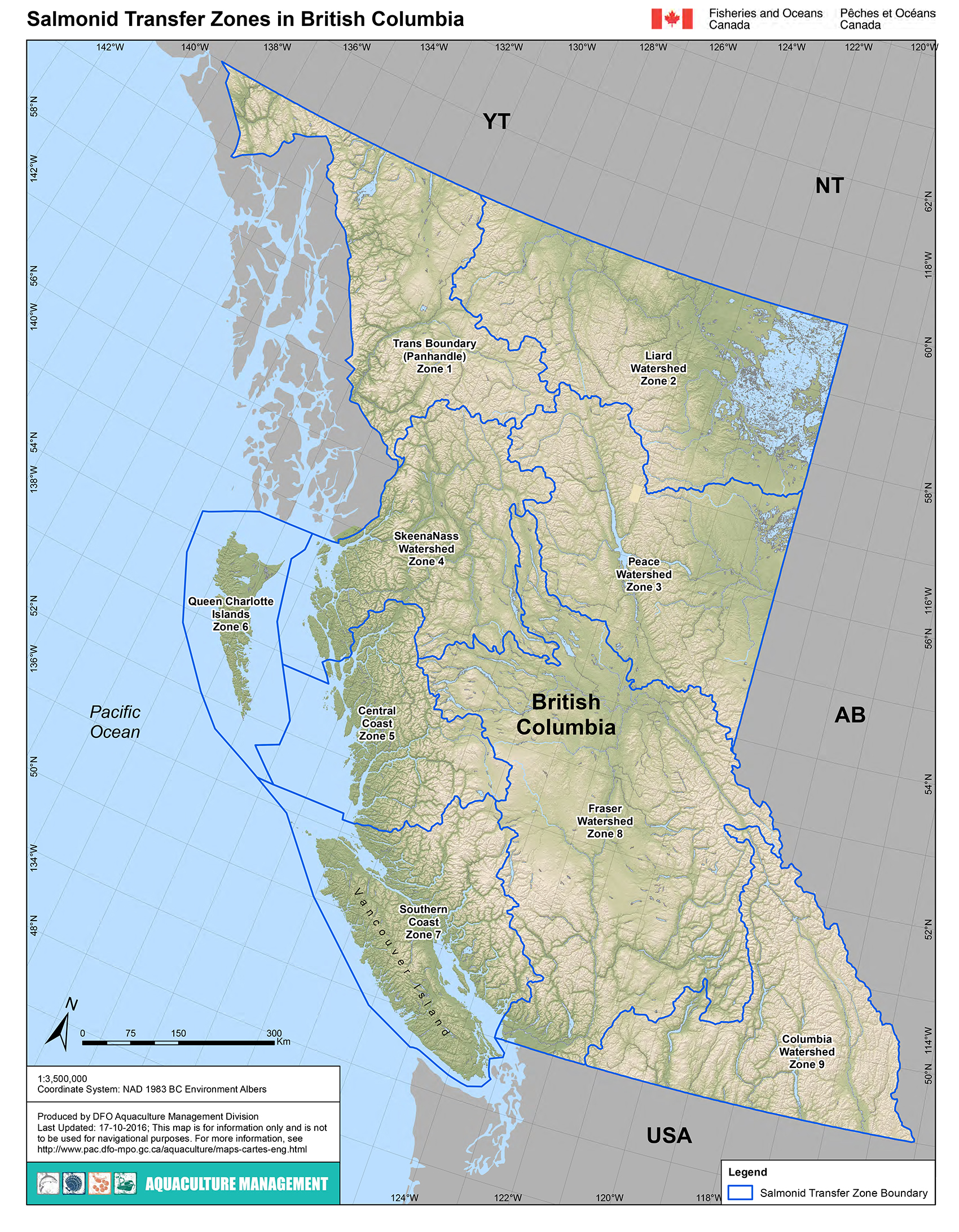
Long text version
Map of salmonid transfer zones in BC, showing the salmonid transfer zone boundary of:
- Zone 1 - Trans Boundary (panhandle)
- Zone 2 - Liard watershed
- Zone 3 - Peace watershed
- Zone 4 - SkeenaNass watershed
- Zone 5 - Central Coast
- Zone 6 - Queen Charlotte Islands
- Zone 7 - Southern Coast
- Zone 8 - Fraser watershed
- Zone 9 - Columbia watershed
- Date modified: