
Salmon habitat restoration information bulletin: channel-spanning logjams and instream wood

On this page
Purpose
This information bulletin presents a Hierarchy of Preferred Management Actions for instream wood and channel-spanning logjams using 4 R’s: Retain, Reposition, Relocate, Remove. It promotes wood retention as the most preferred option. Actions to reposition, relocate, or remove a logjam are increasingly less preferred and should only proceed following assessment by qualified professionals and necessary permitting. This bulletin describes the importance of logjams as a beneficial component of fish habitat and addresses common misconceptions about wood in watercourses.
Highlights
- Logjams occur naturally and can create beneficial habitat for Pacific salmon.
- Logjams buffer watercourses from climate change impacts by forming deep pools, enhancing groundwater exchange, wetting off-channel habitats, and attenuating peak flows.
- In most cases, logjams do not block fish passage and fish are able to navigate around them.
- Modifying or removing logjams requires expert input and provincial/federal approvals.
Before proceeding with the removal or modification of a logjam, stop and and assess the viability of alternative, preferred options!
Background
Channel-spanning logjams are accumulations of fallen trees, logs, and large branches (collectively termed large woody debris, LWD) that extend, or nearly extend, across the width of a watercourse (Figure 1). Logjams contribute to shaping fish habitat and supporting aquatic ecosystems.Footnote 1 Footnote 2 Footnote 3
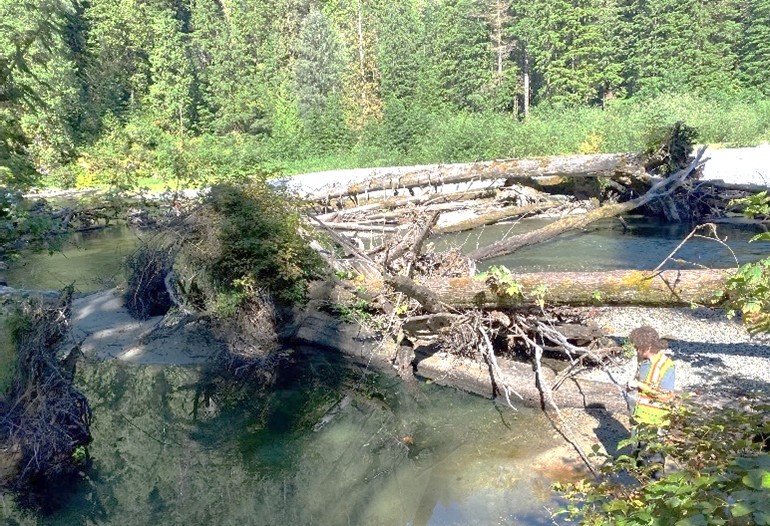
Figure 1. A channel-spanning logjam in the Indian River, BC.
Long text version
Figure 1
Figure 1 is a photo showing a section of the Indian River in BC. Logjams span across the width of the river.
Most watercourses of the Pacific Region were historically rich in large wood until ‘stream-cleaning’ initiatives were implemented in the 1940s to 1970s to remove wood from channels Footnote 4.
These initiatives aimed to improve log transport for forestry, enhance navigation, support irrigation for farming, and aid fish passage. Wood was also removed based on the belief that cleaner channels were more desirable, both aesthetically and functionally, as well as past flood management practices that viewed wood as an impediment to efficient flood control Footnote 4 Footnote 5.
The legacy of instream wood removal and riparian forest clearing has negatively impacted Pacific salmon. As a result, the goal of many habitat restoration projects today is to increase instream wood through wood additions and engineered logjams in order to improve habitat conditions and support Pacific salmon recovery Footnote 6 Footnote 7.
Benefits of wood
Channel-spanning logjams directly benefit Pacific salmon by increasing habitat heterogeneity, enhancing groundwater exchange, trapping valuable sediment, and improving floodplain connectivity Footnote 2 Footnote 3 Footnote 6 Footnote 7. These benefits result from the interaction of wood with the water and sediment moving through the channel. Logjams redirect flow and initiate localized processes of sediment erosion and deposition that produce a mosaic of habitat types such as pools, eddies, riffles, and undercut banks (Figure 2).
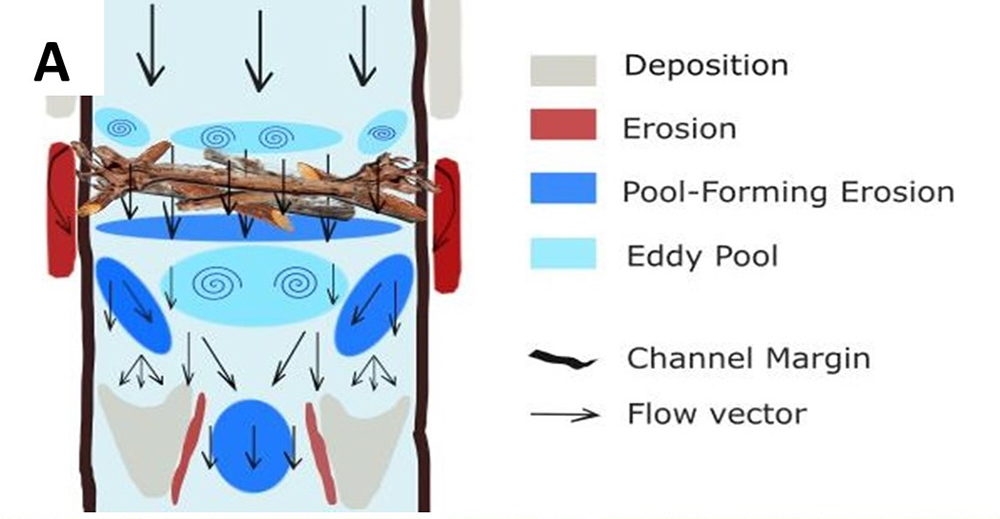
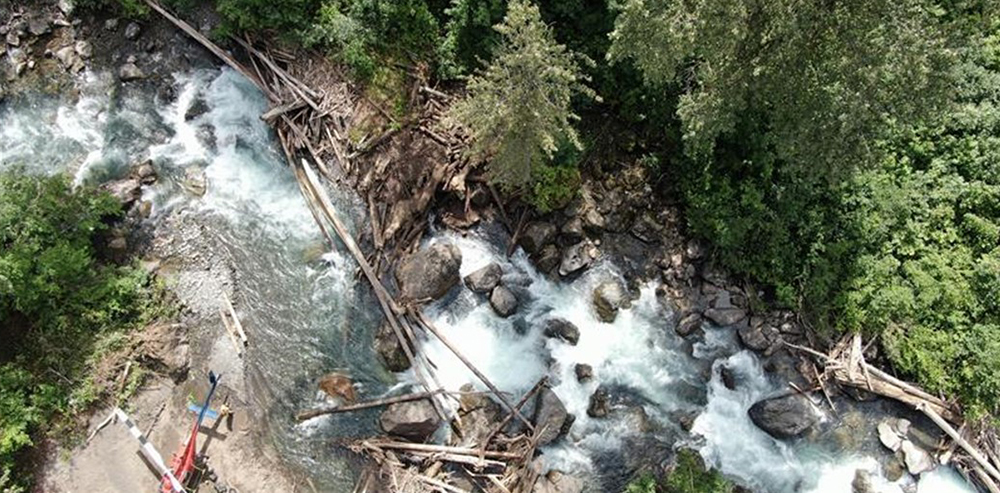
Figure 2. Schematic (A) and photo (B) illustrating the effects of channel-spanning wood on flow and processes of erosion and deposition. Schematic adapted from Wheaton et al. Footnote 8 .
Long text version
Figure 2
Figure 2 shows a diagram, Schematic (A), sitting above a photo, Photo (B).
Schematic (A) is a diagram representing a section of river as seen from above and shows the effects of channel-spanning wood on flow and on processes of erosion and deposition.
Black arrows represent the flow of water.
Turquois oval shapes represent eddy pools.
Blue oval shapes represent pool-forming erosion.
Red oval shapes represent erosion.
Light grey irregular shapes represent sediment deposits.
Photo (B) shows the effects of channel-spanning wood on flow and processes of erosion and deposition.
The schematic is adapted from Wheaton et al. Footnote 8 .
The diversity of habitat types associated with logjams supports many species and life stages of fish. Logjams provide bioenergetic benefits as well by creating areas of both slow and fast flow that enhance feeding and refuge opportunities Footnote 2 . Wood provides shade and cover for fish to avoid predation and wood-rich systems have deeper and more frequent pools, metrics that both strongly correlate with fish abundance Footnote 6 Footnote 9 . Pools are vital to supporting salmon through summer drought and cold winter conditions Footnote 10 .
Logjams increase the mixing of surface water with groundwater by redirecting flow in the hyporheic zone, which is the region of sediment and porous space directly beneath the streambed (Figure 3). Termed hyporheic exchange, this mixing helps maintain stable thermal conditions that are vital to cold-water species like Pacific salmon. Zones of cool groundwater upwelling around logjams ameliorate warm water temperatures in summer months and help sustain surface flows during low flow periods Footnote 10 .
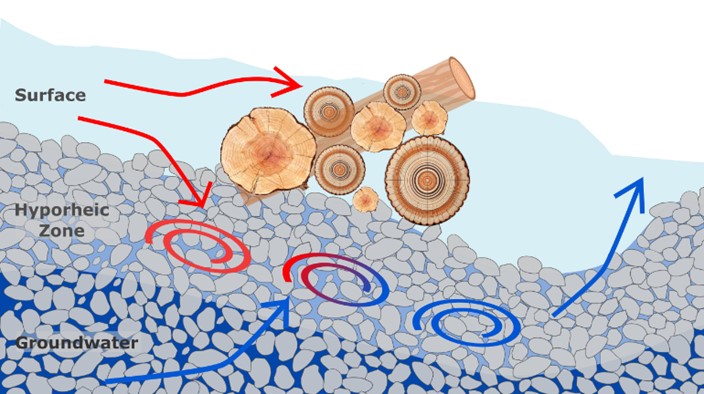
Figure 3. Schematic illustrating how logjams promote groundwater upwelling and the mixing of warm (red) surface water with cold (blue) groundwater in the hyporheic zone.
Long text version
Figure 3
Figure 3 is a diagram representing how logjams in rivers promote groundwater upwelling.
Red arrows represent warm water flowing near the surface of the river.
Blue arrows represent cold groundwater upwelling from the bottom of the river.
Red and blue swirls represent where warm and cold water is mixed together in middle of the river, also known as the hyporheic zone.
Additional indirect benefits of channel-spanning logjams are promoting floodplain connectivity and directing flow into off-channel habitats, attenuating peak flows, and intercepting sediment moving down the channel Footnote 3 Footnote 11 . Sediment deposits around logjams can provide important spawning gravel for salmon, especially in degraded systems where spawning habitat may be limiting.
Mitigating climate change impacts
Climate change is impacting watercourses and salmon habitat across the Pacific Region with rising water temperatures, shifting precipitation patterns, and more frequent droughts, floods, and wildfires Footnote 12 . These stressors degrade habitat quality and habitat availability for Pacific salmon.
Instream wood and logjams can buffer salmon populations from climate change impacts by way of increasing habitat heterogeneity, forming deep pools, enhancing hyporheic exchange and cool-water refugia, and providing shade and cover Footnote 2 Footnote 6 Footnote 7 Footnote 10 . Additionally, channel-spanning logjams can promote floodplain connectivity by redirecting flow into off-channel habitats, as well as attenuate peak flows and raise water tables Footnote 11 . In this way, logjams can mitigate the effects of major disturbance events and increase a watercourse’s resilience and capacity to recover.
Logjam assessment
There are generally two situations in which a channel-spanning logjam is assessed for potential removal:
- When it poses a potential hazard to human safety, infrastructure, and/or property, and
- When it poses a potential barrier to fish passage.
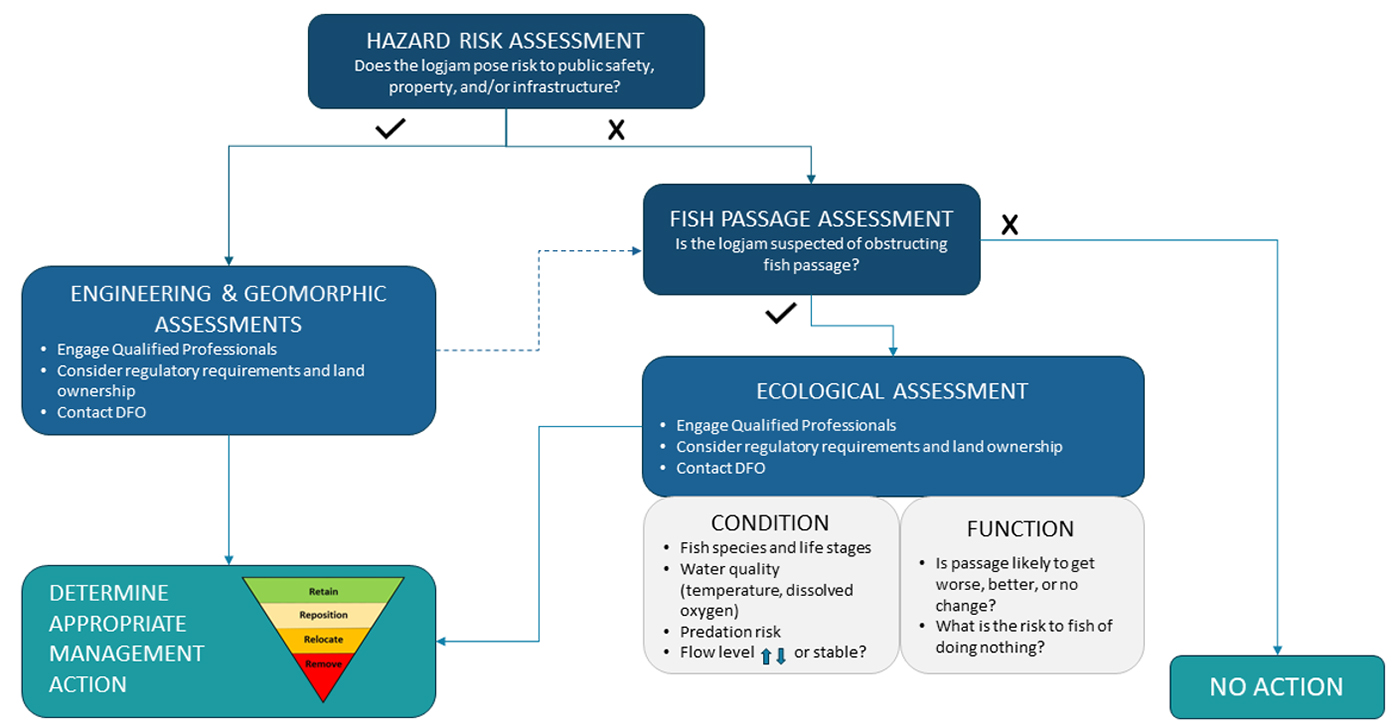
Figure 4. Assessment process for channel-spanning logjams that may pose a potential hazard to human safety, infrastructure, and/or property, or may pose a potential barrier to fish passage.
Long text version
Figure 4
Figure 4 is a diagram showing the formal process for a hazard risk assessment of a logjam in a body of water.
-
The beginning of the assessment starts with answering the first question: does the logjam pose a risk to public safety, property, and/or infrastructure?
If the answer is Yes, then it triggers engineering and geomorphic assessments which may include:
- engaging qualified professionals
- making considerations for regulatory requirements and land ownership
- contacting Fisheries and Oceans Canada (DFO)
After completing engineering and geomorphic assessments, an appropriate management action is determined which may result in any of the following actions: retain, reposition, relocate, or remove the logjam.
-
If the answer to the first question is No, then it triggers a fish passage assessment, and the next question: Is the logjam suspected of obstructing fish passage?
If the answer is No, then no action is taken.
If the answer is Yes, then it triggers an ecological assessment, which may include:
- engaging qualified professionals
- making considerations for regulatory requirements and land ownership
- contacting Fisheries and Oceans Canada (DFO)
During an ecological assessment, the following conditions are considered:
- fish species and life stages
- water quality (temperature, dissolved oxygen)
- predation risk
- does the water flow level fluctuate or is it stable?
During an ecological assessment, the following functions are considered:
- Is passage likely to get worse, better, or no change?
- What is the risk to fish if nothing is done?
After completing an ecological assessment, an appropriate management action is determined which may result in any of the following actions: retain, reposition, relocate, or remove the logjam.
Hazard risk assessment
In circumstances where channel-spanning logjams may pose a hazard to public safety, infrastructure, and/or property, a formal Hazard Risk Assessment by qualified professionals (e.g., engineers, geoscientists) is advised. Examples of such cases include
- wood accumulations impeding flow or causing blockage at bridges and culverts (Figure 5)
- logjams redirecting flow and causing bank erosion that threatens property or infrastructure
- wood hazards to recreational users such as kayakers, white water rafters, and swimmers
- potential collisions with watercraft
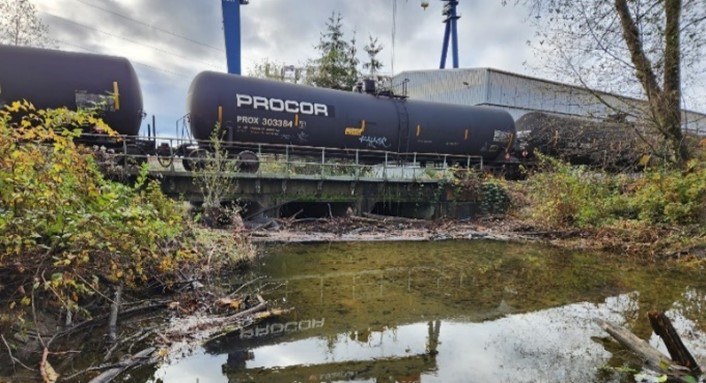
Figure 5. Wood debris at the base of a rail bridge in Mackay Creek, BC. Further accumulation could warrant wood removal.
Long text version
Figure 5
Figure 5 is a photo showing a train travelling over a body of water that also contains a large amount of wood debris.
The Hazard Risk assessment may proceed in concert with both Fish Passage and Ecological Assessments. In cases where LWD is deemed to pose significant risk to public safety, infrastructure, and/or property, management action will be necessary to mitigate the hazard. Regulatory and permitting requirements, as well as land ownership, must be considered prior to taking action.
Carrying out an Ecological Assessment will help determine the most appropriate management action and applicable measures (e.g., timing) to protect fish and fish habitat. Options such as repositioning key wood pieces or relocating the logjam should be explored before wood removal (see section on Mitigation Approaches). It is also important to assess if removing an established channel-spanning logjam may result in additional, undesirable effects such as bed scouring, bank erosion, and channel widening Footnote 3 Footnote 5 .
Fish passage assessment
When assessing fish passage at a channel-spanning logjam, it is important to keep in mind that Pacific salmon have evolved in naturally wood-rich systems and are adapted to navigating natural obstructions. While logjams may temporarily hinder fish passage, particularly in low-flow conditions, they are rarely permanent obstructions and are most often passable by fish. Figure 6 illustrates how juvenile and adult salmon can navigate through a channel-spanning logjam.
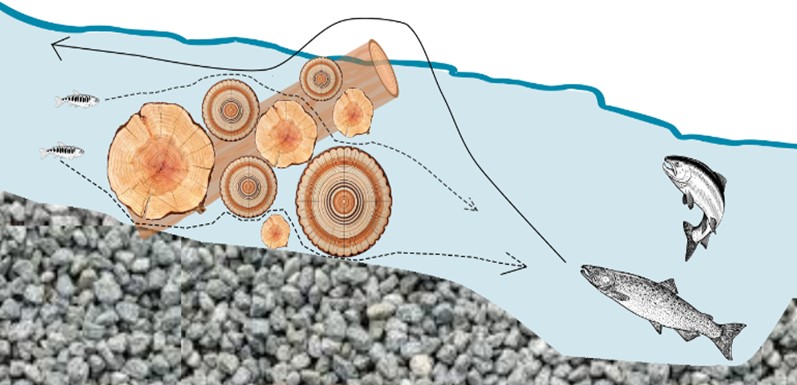
Figure 6. Schematic illustrating potential juvenile and adult salmon passage options through a channel-spanning logjam.
Long text version
Figure 6
Figure 6 is a diagram showing potential juvenile and adult salmon passage options through a channel-spanning logjam.
If a logjam is suspected of obstructing fish passage, an Ecological Assessment should be carried out by a qualified professional (e.g., fish habitat biologist) to inform what, if any, appropriate management action should be taken. This includes addressing the following questions (see Figure 4):
- What fish species and life stages are present in the river? Are they migratory and will the obstruction disrupt critical life cycle events such as estuarine arrival or spawning? Juvenile salmon out-migration and adult spawning typically occur outside of low-flow periods and seasonal flow variations generally provide opportunities for fish to navigate around or through obstacles at higher flows.
- What habitat is accessible to the fish? For example, immediate action may be unnecessary if the fish are located in a deep, groundwater-fed pool and upstream habitat conditions are unfavorable.
- Is water quality, particularly temperature and dissolved oxygen, favorable for fish health or causing stress? This is especially important in drought or high heat conditions when adult salmon may be migrating upstream to spawn. In such cases, emergency logjam modification, relocation, or removal may be warranted (see section on Mitigation Approaches).
- Are the fish at an elevated risk of predation? Are there areas of cover, refuge, or escape routes for the fish?
- Are flow conditions currently stable, or likely to increase or decrease in the near future? For example, does the upcoming weather forecast predict precipitation that may increase flows sufficiently to naturally restore fish passage? Where wood presents an obstacle to migration, salmon may wait for more favourable hydrological conditions that provide a navigable path such as re-watered side channels with smaller step-pools, or more traversable main channel margins.
An over-arching consideration when assessing fish passage at logjams is understanding the flow patterns over the full range of water levels. At higher flows, does water flow over, under, or around the debris? Measuring an assumed depth of water at bankfull conditions (i.e., bankfull depth) may help envision passage conditions at higher flows. Additional sources of information to support the assessment process are Wohl et al. Footnote 5 , Washington Department of Fisheries and Wildlife Footnote 13 , and Kemp et al. Footnote 14 .
Key takeaway
Most natural channel-spanning logjams are not migratory barriers. Salmon can typically navigate around, over, or through them over a range of flows.
If concerns about fish passage persist after evaluation, contact a Fisheries and Oceans Canada (DFO) biologist or Community Advisor (see contact information below). They can help assess whether the wood qualifies as a barrier. Include photos of any plunge or step-pools, substrate, and other relevant features to assist in the assessment.
Mitigation approaches
Prior to taking action at a site, qualified professionals such as fisheries biologists, geomorphologists, and local experts should be consulted to determine if mitigation is necessary based on the 4-R Hierarchy of Preferred Management Actions for channel-spanning logjams (Figure 7). Applicable measures to protect fish and fish habitat should be incorporated into any action plan. Consult DFO’s Projects Near Water webpage for further information and guidance.
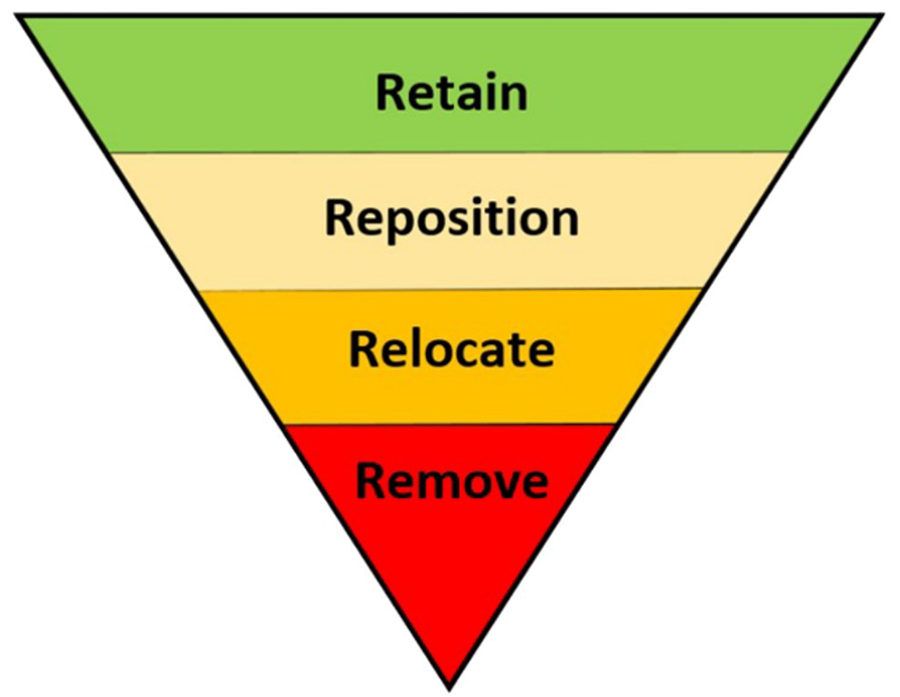
Figure 7. 4-R hierarchy of preferred management actions for instream wood. Retention is the most preferred option (top) whereas removal is the least preferred option (bottom).
Long text version
Figure 7
Figure 7 is a diagram showing an inverted triangle (with the point facing downward).
At the top is the word Retain.
Below that is the word Reposition.
Below that is the word Relocate.
Below that is the word Remove.
- Retain: In most cases, this is the preferred option unless there is a strong evidence supporting intervention (e.g., flood risk to infrastructure or adult salmon perishing due to migration delays). Frequent monitoring is recommended to assess the benefits and hazards.
- Reposition: Strategic repositioning of a few wood pieces by hand is often sufficient to create a pathway for fish and/or reduce a potential water level hazard, while still preserving the structural integrity and habitat benefits of the logjam.
- Relocate: If professional assessment confirms the need for wood removal, consider relocating the wood to a different section of channel where it may provide physical and ecological benefits.
- Remove: In rare cases, channel-spanning logjams may require complete removal due to the high hazard it poses to the public, infrastructure, or property.
It is important to consider that removing an established channel-spanning logjam may result in undesirable effects such as immediate bed scouring, bank erosion, and channel widening Footnote 5 . Post-removal monitoring should be conducted to assess habitat changes.
Before undertaking wood removal, contact a Fisheries and Oceans Canada Biologist or Community Advisor: pac.dfo-mpo.gc.ca/sep-pmvs/contact-eng.html.
Include as much information as possible, such as the location and nature of the possible obstruction, photographs of the site, the date of observation.
Habitat alterations including wood removal may require authorization from DFO (Projects Near Water) and/or approvals from other federal, provincial, territorial, municipal and Indigenous governments.
Conclusion
Understanding the benefits of channel-spanning logjams is critical for making informed decisions about instream wood management. In most cases, removing instream wood is unnecessary and may lead to undesirable and possibly harmful effects on fish and fish habitat. By carefully assessing site-specific conditions, informed decisions can be made that balance safety and fish passage needs with the broader benefits these structures provide.
©His Majesty the King in Right of Canada, as represented by the Minister of the Department of Fisheries and Oceans, 2025.
Cat. No. Fs23-799/2025E-PDF ISBN 978-0-660-79379-5
Correct citation for this publication:
Fisheries and Oceans Canada. 2025. Channel-Spanning Logjams and Instream Wood. Pacific Region, Salmon Habitat Restoration Centre of Expertise. 8p.
- Date modified: