
Sea cucumber fishery
The following profile provides the socioeconomic context of the sea cucumber fishery in British Columbia. It includes an overview of the commercial sector. This overview is based on data collected from DFO commercial harvest logbooks and sale slips, public reports, and DFO surveys on harvest prices.
Long text version
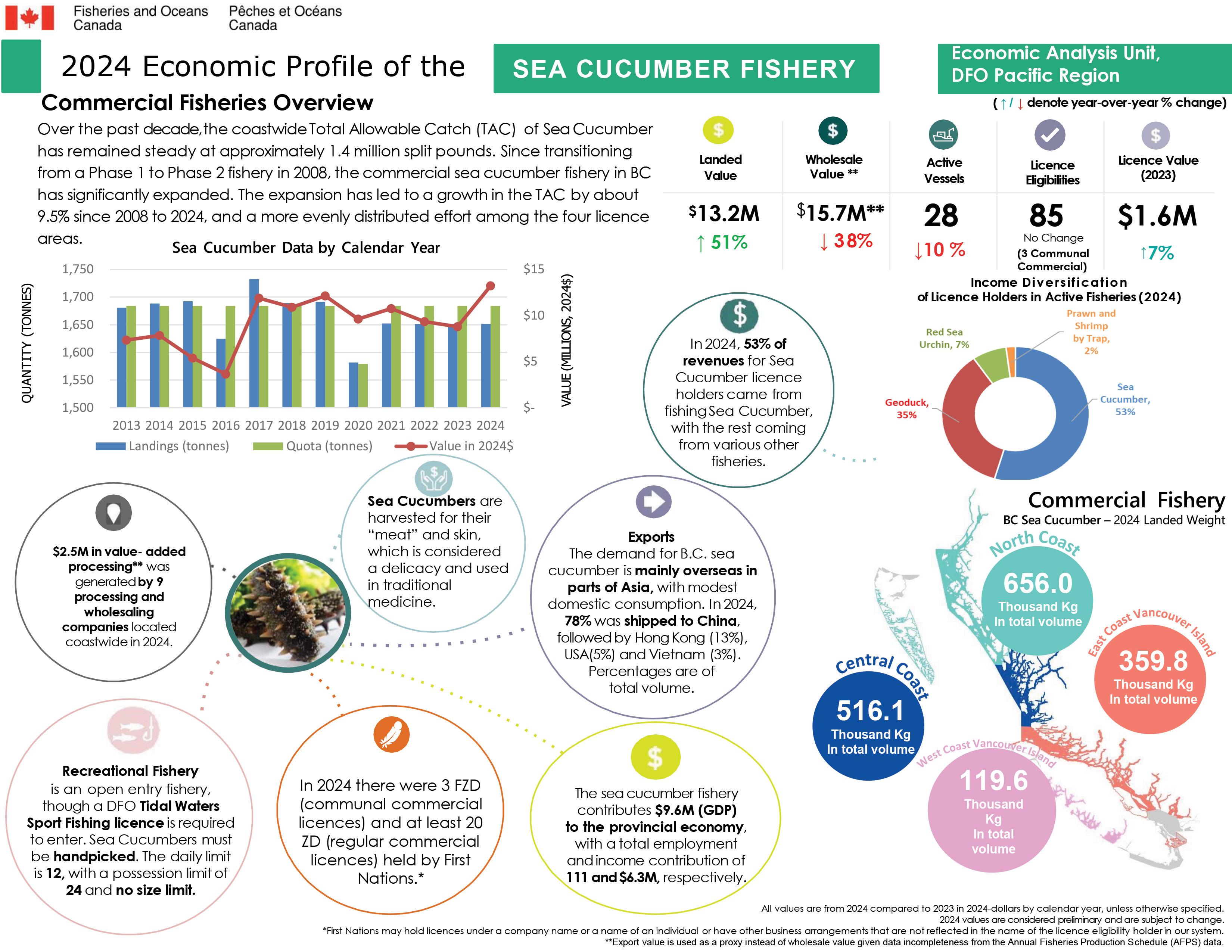
2024 Economic profile of the sea cucumber fishery
Commercial fisheries overview
Over the past decade, the coastwide Total Allowable Catch (TAC) of Sea Cucumber has remained steady at approximately 1.4 million split pounds. Since transitioning from a Phase 1 to Phase 2 fishery in 2008, the commercial sea cucumber fishery in BC has significantly expanded. The expansion has led to a growth in the TAC by about 9.5% since 2008 to 2024, and a more evenly distributed effort among the four licence areas.
All values are from 2024 compared to 2023 in 2024-dollars by calendar year, unless otherwise specified.
Key metrics for the sea cucumber fishery, all values are from 2024 and in 2024 dollars:
- Landed value ($13.2M), increased by 51% since 2023.
- Wholesale value ($15.7M), decreased by 38% since 2023. Export value is used as a proxy instead of wholesale value given data incompleteness from the Annual Fisheries Production Schedule (AFPS) data.
- Active vessels (28), decreased by 10% since 2023.
- Licence eligibilities (85, no change since 2023), 3 are communal commercial licences. Licence eligibilities represents the number of issued licences.
- Licence value ($1.6M in 2023), increased by 7% since 2022.
2024 data are considered preliminary and are subject to change.
Sea Cucumber landings (in metric tonnes), quota (in metric tonnes) and value (in 2024 dollars) by calendar year
Landings (tonnes)
- 2013 - 1,681 t
- 2014 - 1,688 t
- 2015 - 1,692 t
- 2016 - 1,624 t
- 2017 - 1,732 t
- 2018 - 1,689 t
- 2019 - 1,691 t
- 2020 - 1,582 t
- 2021 - 1,652 t
- 2022 - 1,651 t
- 2023 - 1,652 t
- 2024 - 1,652 t
Quota (tonnes)
- 2013 - 1,684 t
- 2014 - 1,684 t
- 2015 - 1,684 t
- 2016 - 1,684 t
- 2017 - 1,684 t
- 2018 - 1,684 t
- 2019 - 1,684 t
- 2020 - 1,579 t
- 2021 - 1,684 t
- 2022 - 1,684 t
- 2023 - 1,684 t
- 2024 - 1,684 t
Landed value (in 2024$)
- 2013 - $7.3M
- 2014 - $7.8M
- 2015 - $5.4M
- 2016 - $3.6M
- 2017 - $11.9M
- 2018 - $10.9M
- 2019 - $12.1M
- 2020 - $9.6M
- 2021 - $10.7M
- 2022 - $9.3M
- 2023 - $8.8M
- 2024 - $13M
Commercial fishery BC sea cucumber - 2024 landed weight map
- North Coast: 656.0 thousand Kg in total volume
- Central Coast: 516.1 thousand Kg in total volume
- East Coast Vancouver Island: 359.8 thousand Kg in total volume
- West Coast Vancouver Island: 119.6 thousand Kg in total volume
Income diversification of licence holders in active fisheries (2024)
In 2024, 53% of revenues for sea cucumber licence holders came from fishing sea cucumber, with the rest coming from geoduck (35%), red sea urchin (7%), and prawn and shrimp (2%).
Exports: The demand for B.C. sea cucumber is mainly overseas in parts of Asia, with modest domestic consumption. In 2024, 78% was shipped to China, followed by Hong Kong (13%), USA (5%) and Vietnam (3%). Percentages are of total volume.
Sea cucumbers are harvested for their “meat” and skin, which is considered a delicacy and used in traditional medicine.
$2.5M in value-added processing was generated by 9 processing and wholesaling companies located coastwide in 2024. Export value is used as a proxy instead of wholesale value given data incompleteness from the Annual Fisheries Production Schedule (AFPS) data.
The sea cucumber fishery directly contributes $9.6M (GDP) to the provincial economy, with a total employment and income contribution of 111 and $6.3M, respectively.
In 2024 there were 3 FZD (communal commercial licences) and at least 20 ZD (regular commercial licences) held by First Nations. First Nations may hold licences under a company name or a name of an individual or have other business arrangements that are not reflected in the name of the licence eligibility holder in our system.
Recreational Fishery is an open entry fishery though a DFO Tidal Waters Sport Fishing licence is required to enter. Sea Cucumbers must be handpicked. The daily limit is 12, with a possession limit of 24 and no size limit.
The tidal water recreational fishing survey data is not available for 2024.
Data
The commercial data that informed this work can be downloaded here.

- Date modified: