
Salmon (Yukon River) fishery
The following profile provides the socioeconomic context of the salmon (Yukon River) fishery. It includes an overview of the commercial and recreational sectors. This overview is based on data collected from DFO commercial harvest logbooks and sale slips, public reports, and DFO surveys on harvest prices.
Long text version
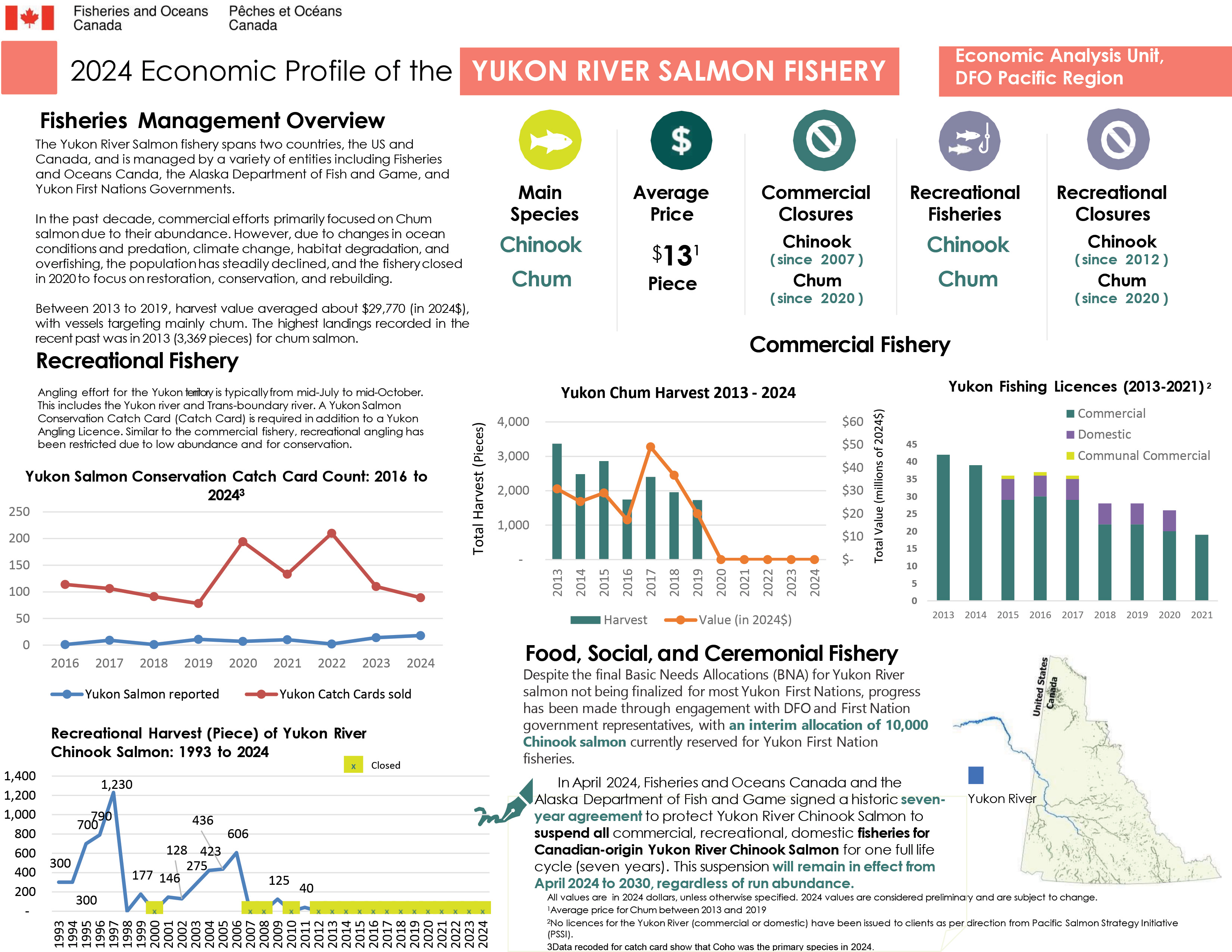
2024 Economic Profile of the Yukon River Salmon Fishery
Fisheries Management Overview
The Yukon River Salmon fishery spans two countries, the US and Canada, and is managed by a variety of entities including Fisheries and Oceans Canda, the Alaska Department of Fish and Game, and Yukon First Nations Governments.
In the past decade, commercial efforts primarily focused on Chum salmon due to their abundance. However, due to changes in ocean conditions and predation, climate change, habitat degradation, and overfishing, the population has steadily declined, and the fishery closed in 2020 to focus on restoration, conservation, and rebuilding.
Between 2013 to 2019, harvest value averaged about $29,770 (in 2024$), with vessels targeting mainly Chum. The highest landings recorded in the recent past was in 2013 (3,369 pieces) for Chum salmon.
Recreational Fishery Overview
Angling effort for the Yukon territory is typically from mid-July to mid-October. This includes the Yukon river and Trans-boundary river. A Yukon Salmon Conservation Catch Card (Catch Card) is required in addition to a Yukon Angling Licence. Similar to the commercial fishery, recreational angling has been restricted due to low abundance and for conservation.
All values are in 2024 dollars, unless otherwise specified. 2024 values are considered preliminary and are subject to change.
Key metrics for the Yukon salmon fishery
- Main species (Chinook, Chum)
- Average price for Chum between 2013 and 2019 ($13 per piece, 2024$ value).
- Commercial closures (Chinook since 2007, Chum since 2020)
- Recreational fisheries (Chinook, Chum)
- Recreational closures (Chinook since 2012, Chum since 2020)
Commercial fishery
Yukon Chum harvest (piece) and value (2024$) chart
Harvest
- 2013 - 3,369 pieces
- 2014 - 2,485 pieces
- 2015 - 2,862 pieces
- 2016 - 1,745 pieces
- 2017 - 2,404 pieces
- 2018 - 1,957 pieces
- 2019 - 1,728 pieces
- 2020 - N/A
- 2021 - N/A
- 2022 - N/A
- 2023 - N/A
- 2024 - N/A
Value
- 2013 - $31K
- 2014 - $25K
- 2015 - $29K
- 2016 - $17K
- 2017 - $49K
- 2018 - $37K
- 2019 - $20K
- 2020 - N/A
- 2021 - N/A
- 2022 - N/A
- 2023 - N/A
- 2024 - N/A
Yukon fishing licences (2013 – 2021)
No licences for the Yukon River (commercial or domestic) have been issued to clients as per direction from Pacific Salmon Strategy Initiative (PSSI).
Communal commercial
- 2013 - N/A
- 2014 - N/A
- 2015 – 1 licence
- 2016 – 1 licence
- 2017 – 1 licence
- 2018 - N/A
- 2019 - N/A
- 2020 - N/A
- 2021 - N/A
Domestic
- 2013 - N/A
- 2014 - N/A
- 2015 – 6 licences
- 2016 – 6 licences
- 2017 – 6 licences
- 2018 – 6 licences
- 2019 – 6 licences
- 2020 – 6 licences
- 2021 - N/A
Commercial
- 2013 – 42 licences
- 2014 – 39 licences
- 2015 – 29 licences
- 2016 – 30 licences
- 2017 – 29 licences
- 2018 – 22 licences
- 2019 – 22 licences
- 2020 – 20 licences
- 2021 – 19 licences
Recreational fishery
Yukon salmon Conservation Catch Card count: 2016 to 2024
Data recorded for catch cards show that Coho was the primary species in 2024.
Yukon salmon Reported
- 2016 - 1
- 2017 - 9
- 2018 - 1
- 2019 - 11
- 2020 - 7
- 2021 - 10
- 2022 - 2
- 2023 - 14
- 2024 – 18
Yukon Catch Cards sold
- 2016 - 114
- 2017 - 106
- 2018 - 91
- 2019 - 78
- 2020 - 194
- 2021 - 133
- 2022 - 210
- 2023 - 110
- 2024 - 89
Recreational harvest (piece) of Yukon River Chinook salmon (1993 to 2024)
- 1993 - 300 pieces
- 1994 - 300 pieces
- 1995 - 700 pieces
- 1996 - 790 pieces
- 1997 - 1,230 pieces
- 1998 - NA
- 1999 - 177 pieces
- 2000 - NA
- 2001 - 146 pieces
- 2002 - 128 pieces
- 2003 - 275 pieces
- 2004 - 423 pieces
- 2005 - 436 pieces
- 2006 - 606 pieces
- 2007 - NA
- 2008 - NA
- 2009 - 125 pieces
- 2010 - NA
- 2011 - 40 pieces
- 2012 - NA
- 2013 - NA
- 2014 - NA
- 2015 - NA
- 2016 - NA
- 2017 - NA
- 2018 - NA
- 2019 - NA
- 2020 - NA
- 2021 - NA
- 2022 - NA
- 2023 - NA
- 2024 - NA
Food, Social, and Ceremonial Fishery
Despite the final Basic Needs Allocations (BNA) for Yukon River salmon not being finalized for most Yukon First Nations, progress has been made through engagement with DFO and First Nation government representatives, with an interim allocation of 10,000 Chinook salmon currently reserved for Yukon First Nation fisheries.
In April 2024, Fisheries and Oceans Canada and the Alaska Department of Fish and Game signed a historic seven-year agreement to protect Yukon River Chinook salmon to suspend all commercial, recreational, domestic fisheries for Canadian-origin Yukon River Chinook salmon for one full life cycle (seven years). This suspension will remain in effect from April 2024 to 2030, regardless of run abundance.
Data
The commercial data that informed this work can be downloaded here.
- Date modified: