
What we heard: fish habitat restoration priority planning for Pacific region
On this page
- Note to reader
- Introduction
- Engagement approach in Pacific Region
- What we heard
- Next steps
- Appendix 1: Data sources
- Appendix 2: Let's talk Pacific Salmon engagement questions
- Appendix 3: Species identified during engagement
- Appendix 4: Important areas in Pacific Region
- References
- Footnotes
- Related links
Note to reader
This What We Heard report summarizes feedback that was used to draft the Fish Habitat Restoration Priority Planning for Pacific Region (restoration priorities plan). It is intended to capture and reflect the perspectives shared during engagement. The information contained herein does not represent the views, positions, or policy direction of Fisheries and Oceans Canada (DFO). It should not be interpreted as indicating DFO’s response to, or level of support for, any specific feedback, recommendation, or opinion expressed.
Introduction
The restoration priorities plan identifies regional goals and objectives for fish habitat restoration in Pacific Region (includes British Columbia and the Yukon). This work began in 2022 and was guided by the “Framework to Identify Fish Habitat Restoration Priorities” (the National Framework), a national approach to establishing fish habitat restoration goals in all seven DFO regionsFootnote 1. The National Framework outlines an iterative process for identifying habitat restoration priorities that includes the following steps:
- Gather information
- Describe the current state of fish habitat restoration activities
- Identify important species, areas, and ecosystem functions
- Set restoration goals and supporting actions
- Identify restoration priorities
- Evaluate and update restoration priorities
The restoration priorities plan was drafted based on extensive engagement with the restoration community, including First Nations, federal, provincial, territorial, and local governments, environmental non-governmental organizations, academics, consultants, industry proponents, and fishers across Pacific Region. The findings summarized in this report reflect feedback received by Fisheries and Oceans Canada’s (DFO) Restoration Center of Expertise (RCOE) during the engagement process, which took place between 2023 to 2025.
Engagement approach in Pacific Region
The RCOE prioritized comprehensive and inclusive engagement during the first four steps in the National Framework. The goal was to listen to as many voices as possible to ensure that the restoration priorities plan accurately reflected the diverse perspectives and experiences of those involved, and those who wished to be involved, in habitat restoration.
Engagement with the restoration community was undertaken following a principles-based approach. The three principles for engagement were:
- Uphold and follow principles in the United Nations Declaration on the Rights of Indigenous Peoples Act Action Plan (UNDRIP)
- Gather input from the restoration community
- “Hold the pen” for the restoration community
This approach aligns with the principles respecting the Government of Canada’s relationship with Indigenous peoples and advancing measures in the Principles respecting the Government of Canada's relationship with Indigenous peoples, Canada’s adoption of UNDRIP under the Federal United Nations Declaration on the Rights of Indigenous Peoples Act (UNDA) and its accompanying Action PlanFootnote 2. Together, these recognize the importance of meaningful engagement and collaboration in advancing reconciliation based on the recognition of rights, respect, co-operation, and partnership.
Engagement approach and overview
Information on habitat degradation, habitat restoration, and locally important species and areas were sourced from web searches, internal DFO libraries, and engagement participants. Information sources that were reviewed are listed in Appendix 1.
The engagement approach prioritized open and round-table discussions, real-time content editing, and active follow-up (Figure 1).
To promote inclusiveness and minimize barriers to participants, engagement was iterative and included:
- interactive online presentations
- in-person workshops
- cross-organizational meetings
- email correspondence sharing reports, technical documents, and written feedback
- online surveys hosted on DFO’s Let’s Talk Pacific Salmon portal. A list of questions from the Phase 1 and Phase 2 surveys is presented in Appendix 2.
- note-takers who transcribed participants questions and comments and edited versions of the plan during engagement sessions
- funding provided to First Nations participants by the Indigenous Habitat Participation Program (IHPP)
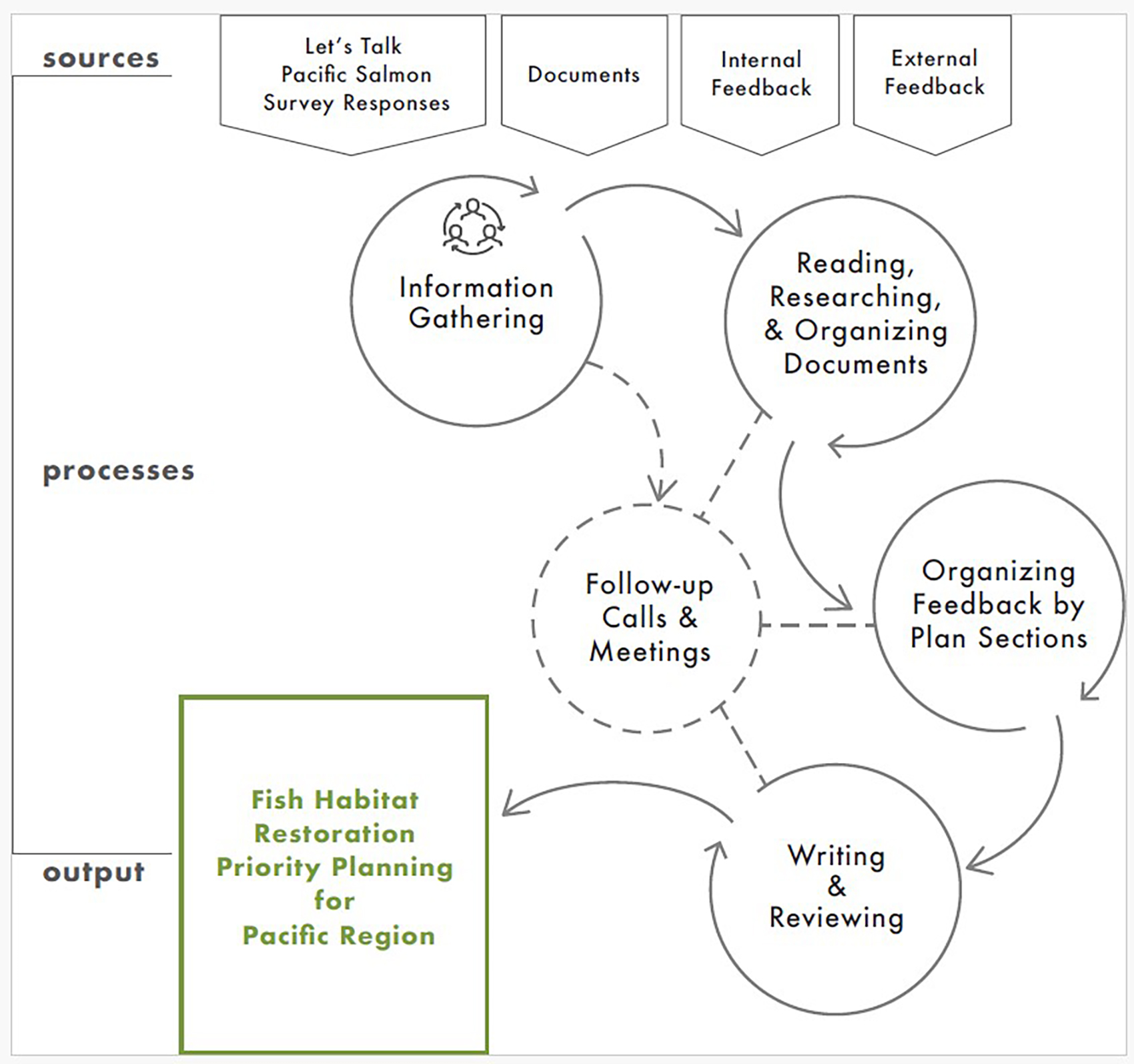
Figure 1: Feedback work flow during drafting of the Fish Habitat Restoration Priority Planning for Pacific Region (restoration priorities plan). The polygons at the top of the figure show all sources of information that were received and reviewed from Spring 2023 to Winter 2024. The middle circles depicts the iterative workflow of reviewing, organizing, following up on engagement and synthesizing information.
A final draft of the restoration priorities plan was published in March 2026. The document will be updated periodically as new information is gathered.
Engagement proceeded in 3 phases, described below:
Phase 1 - Spring 2023 to Winter 2023
Phase 1 sought feedback on the first draft of the restoration priorities plan and focused on:
- identifying important species, areas, and ecosystem processes
- understanding current habitat restoration projects, goals, and activities in Pacific Region
- how restoration project goals, supporting actions, and priorities were identified and developed
- identifying various restoration project prioritization processes
- data sources used to identify habitat restoration priorities
- spatial scale(s) for which restoration should be prioritized (for example, watershed, sub-regional)
- revision and reporting methods
Feedback was organized into common themes, which were used to draft the first draft of habitat restoration goals and objectives.
Phase 2 – Spring 2024 to Winter 2024
Phase 2 sought feedback on the first draft of the fish habitat restoration goals and objectives and continued to gather input on topics covered during phase 1. Additional questions and topics discussed during phase 2 included:
- how applicable the draft goals and objectives were to restoration initiatives in the region
- the language and wording used throughout the draft plan
- identifying limiting factors that hindered restoration planning and implementation
Phase 3 – Spring 2025
Phase 3 was added at the request of Phase 2 engagement participants who wanted to see a more complete version of the plan before it was finalized. Phase 3 continued to gather feedback on content from previous phases of engagement, along with input on:
- how language regarding relevant UNDRIP articles and accompanying UNDA Action Plan measures were incorporated
- how important species, areas, priorities and importance were defined
- if habitat indicators and management measures supporting restoration success reflected previous feedback
Engagement by the numbers
The Let’s Talk Pacific Salmon portal was used for public engagement during Phase 1 and Phase 2. The portal received 61 survey responses during Phase 1 and 25 during Phase 2 and a total of 4,209 website visits during both phases. The Indigenous Habitat Participation Program provided $368,000 to support First Nations’ engagement during this time.
Between spring 2023 and spring 2025, DFO hosted 92 meetings and workshops with the restoration community across Pacific Region. Of these, 72 were hosted online, 15 were held in-person, and 5 were hybrid, combining in-person, and online engagement.
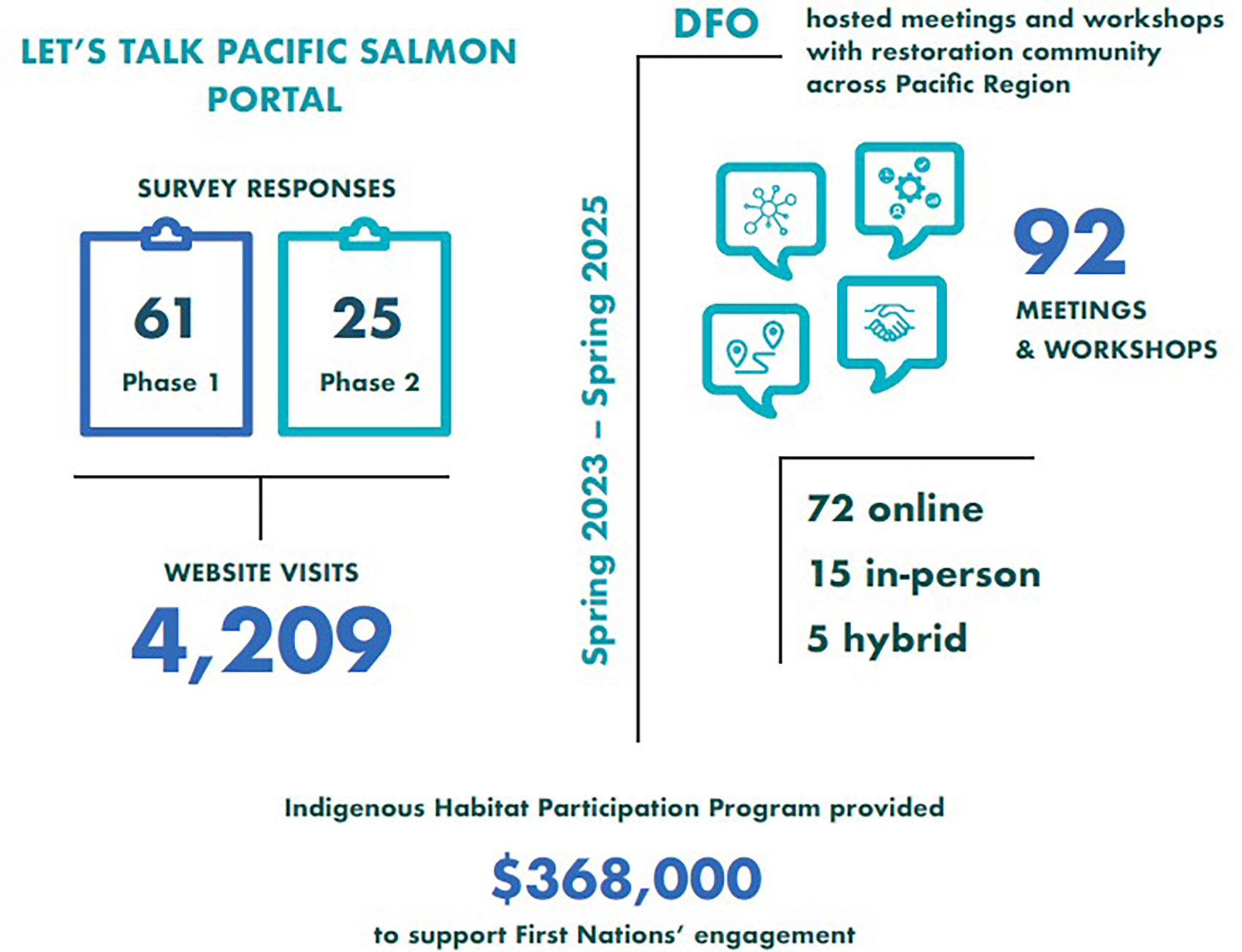
Figure 2: Let’s Talk Pacific Salmon portal engagement numbers and DFO-hosted meetings and workshops in the Pacific Region between Spring 2023 and Spring 2025
Compilation
Feedback from all sources was compiled into a master tracking document. To support clarity and efficient integration, the master tracking document was sorted by sections of the restoration priorities plan and categorized into themes. Comments and revisions were then embedded into subsequent restoration priorities plan drafts to ensure careful consideration and incorporation. Drafting of the document was continuous, and follow-up meetings were scheduled as needed, based on requests from individuals, organizations or DFO. Documents shared by participants, such as scientific papers, management plans, and local case studies, were thematically sorted and individually reviewed, and in many cases cited, to inform and strengthen the restoration priorities plan. Publicly-available documents are itemized in Appendix 1.
Considerations and limitations
Not every First Nation or member of the restoration community in Pacific Region was able to directly engage or provide input on the restoration priorities plan. In some cases First Nations relied on non-governmental organizations or multi-Nation organizations they were part of to represent their interests during meetings. At the request of Yukon First Nations, RCOE staff attended workshops for the Yukon River Chinook Rebuilding strategy and participated in meetings with the Council of Yukon First Nations to avoid over-burdening limited staff in the territory. In British Columbia, the First Nation’s Fisheries Council of BC facilitated workshops and provided funding for First Nations staff to attend meetings.
Although significant efforts were made to reduce barriers to participation, such as rescheduling meetings and providing multiple ways to provide feedback, not everyone was able to engage. As a result, the restoration priorities plan reflects the knowledge, values, perspectives and input from those who participated in engagement.
Feedback was carefully reviewed and thoughtfully considered to determine whether it was aligned with the scope of the restoration priorities plan. Although all input was reviewed and documented, not every suggestion was incorporated, as some fell outside the scope of the restoration priorities plan or restoration activities more broadly. Feedback deemed out of scope was redirected to the appropriate contacts to ensure it was still acknowledged. This approach ensured the plan remained focused while still respecting and capturing the breadth of perspectives shared.
What we heard
Participants shared thoughtful and nuanced feedback for the restoration priorities plan. Input included a range of specific points that reflected diverse perspectives and priorities. Their feedback has been summarized and organized under the following broad themes:
- Species and areas
- Environmental considerations
- First Nations’ perspectives, rights, and reconciliation
- Socioeconomic and management
Species and areas
Engagement participants identified a diversity of freshwater and marine fishes, bivalves and shellfish as important to them. Many definitions of “importance” were shared, and importance in Pacific Region is being defined as something that holds significant value for those who depend on the species being considered. Species that the restoration community identified during engagement are listed in Appendix 3. This list does not include all species, stocks, or populations in Pacific Region but rather reflects what we heard during engagement.
The range of waterbodies engagement participants identified during engagement included watersheds and coastal areas across Pacific Region (Appendix 4). In many cases, this list represents places where people live, where they connect with nature, or the places that support their culture and lifestyle. This list of waterbodies in Appendix 4 showcases what we heard during engagement.
Neither the appendices are exhaustive and can be updated during future versions of the plan.
Environmental considerations
Climate change mitigation and resiliency: Participants stated the importance of integrating climate change considerations into restoration planning to help habitats adapt to shifting conditions. Building habitat resilience is key to mitigating the impacts and increasing severity of climate-related emergencies (for example, drought, floods, wildfires, and sea level rise). For example, allowing rivers space to adjust to higher flows, and doing ground-based assessments to understand local climate change impacts.
“I think this planning should be framed with climate change in mind. Climate adaptation should be an integral part of this. Restoration solutions that used to work won't work anymore. Restored habitats won't be useful if they are not restored with solutions adapted to their specific climate change vulnerability (e.g., restoring a stream habitat but with droughts, that habitat doesn't get any water late summer, so all fish die.) This is really technical habitat restoration planning, and it excludes different types of knowledge or solutions.”
Anonymous Participant - Let’s Talk Pacific Salmon Phase 2 SurveySuggestions included developing and implementing innovative and proactive fish habitat restoration approaches, climate trajectory modeling methods, and effective land and water use strategies (for example, drought management and agricultural practices) to assess and adapt to new climate realities. Participants also highlighted the need for guidance on restoration approaches that respond to climate-driven ecological changes. For example, pink salmon (Oncorhynchus gorbuscha) are expanding beyond their historic range to the north Pacific and Arctic regions, leading to uncertainty and disagreement over how to restore habitat and manage their presence.
Cumulative effects: Participants emphasized the importance of understanding cumulative effects when planning fish habitat restoration. They highlighted the need to address overlapping ecological and social threats that impact fish, fish habitat, and broader ecosystem processes. In particular, participants called for greater education and awareness around the cumulative impacts on salmon and their habitats.
“Doing one-off restoration projects in the big scheme of things isn’t the way forward if we don’t have responses to other stressors on those habitats.”
Anonymous Participant - Lower Fraser Region Engagement Session, April 24, 2024
Biodiversity: Participants noted the importance of identifying, preserving, and maintaining species and habitat diversity to strengthen resilience against disturbances. Preserving genetic diversity was also highlighted as essential to support the long-term health and adaptability of fish populations. Participants stressed the need to account for the unique biodiversity of Pacific Region when planning habitat restoration. They noted that the region’s ecological complexity requires diverse, locally tailored approaches, as actions in one area will often influence conditions in another.
Habitat connectivity and fish passage: Reducing or removing barriers such as culverts and dams was identified by participants as essential to supporting fish movement and ensuring access to key habitats for spawning, rearing, feeding, overwintering, and refuge. Maintaining connectivity between headwaters and downstream areas, along with continuous riparian corridors, was seen as vital to sustaining healthy fish populations.
Investments in upgrading existing infrastructure were recommended to improve water flow and enhance fish passage. Participants also highlighted the need for ongoing maintenance and monitoring of fish passage infrastructure to ensure long-term functionality and effectiveness. Ensuring fish can reach critical habitats was consistently noted as a top priority.
Participants also emphasized the need for clear guidance to carry out urgent fish passage work during climate emergencies, such as landslides or droughts. They noted that responding effectively requires quick access to funding, fast-tracking permits and approvals, and bringing in external support to restore habitat connectivity and reduce impacts on fish.
“Salt marshes and eelgrass meadows are blue carbon habitats that support nearshore biodiversity, as nursery and foraging habitats. These nearshore ecosystems are expected to migrate landward in response to accelerated sea level rise. However, human modifications of coastlines from seawalls and dikes prevent the migration of shallow subtidal and intertidal coastal habitats, resulting in decline or loss of these habitats to coastal squeeze. Thus, to retain these important habitats, it is important to remove barriers that prevent landward migration of nearshore coastal habitats (e.g., salt marshes and eelgrass meadows) by investing in living shorelines. It is vital to prioritize barriers to migrating fish and habitats that are no longer meeting the original intent.”
Anonymous Participant - Let’s Talk Pacific Salmon Phase 2 Survey
First Nations’ perspectives, rights and reconciliation
Recognizing First Nations’ rights and Title, authority, and the integration of the United Nations Declaration on the Rights of Indigenous Peoples Act into restoration planning: Preserving First Nations’ access to land and water, and acknowledging First Nations governance systems, were seen as essential to fostering genuine collaboration and effective restoration outcomes. Building trust through consistent, respectful engagement followed by meaningful action was identified as a key step toward empowering First Nations communities and ensuring their active participation.
“Indigenous people need stable, reliable access to their salmon watersheds in order to be able to rebuild their restoration, monitoring, and management systems, and in order to be able to make accurate assessments of habitat restoration needs.”
Anonymous Participant - Let’s Talk Pacific Salmon Phase 1 Survey
Incorporating UNDRIP and UNDA into restoration planning was strongly supported as a way to uphold First Nations' rights, and ensure equitable involvement in habitat restoration. Participants also stressed the importance of recognizing First Nations' authority over their territories to strengthen cultural connections and support long-term stewardship of their lands and waters.
“Including First Nations on the ground helps reconnect First Nations membership with their Rights and responsibilities in their territories.”
Anonymous Participant - Northeast and Southeast Engagement Session, November 19, 2024
First Nations’ and local knowledge integration: It is important to involve and include local knowledge holders throughout all stages of decision-making to ensure that Indigenous Knowledge is respected and meaningfully integrated into restoration efforts. Participants called for greater recognition of Indigenous Knowledge Systems, noting that community-driven approaches and the inclusion of Indigenous perspectives in both planning and implementation can lead to more culturally appropriate, respectful, and effective restoration.
“Those that live along the rivers and watersheds hold the expertise and knowledge needed to safeguard local resources.”
Anonymous Participant - Lower Fraser Region Engagement Session, April 24, 2024
“Recognition of First Nations Knowledge Systems as legitimate expertise is crucial.”
Anonymous Participant - Interior Region Engagement Session, April 30, 2024
First Nations’ self-determination, leadership, collaboration, and partnerships: Direct involvement and input from First Nations is essential to ensure restoration efforts reflect local needs, values, and priorities. Supporting First Nations-led and -partnered restoration work was seen as critical to building trust and fostering meaningful partnerships. Improved engagement and collaboration between First Nations and Crown agencies were recommended to align efforts and integrate diverse worldviews and knowledge systems.
Participants highlighted the Indigenous Guardians Program as a strong example of this approach. Guardians support habitat monitoring and protection by training community members to oversee stewardship activities, enforce local regulations, and collect data. The program’s success comes from combining Traditional Ecological Knowledge and local practices with Western science, which strengthens local stewardship and conservation efforts.
Participants also called for funding for Indigenous Guardian and other community-run programs to build capacity and professional expertise, particularly in remote regions. Mentorship programs that share resources, data, and lessons learned were suggested to reduce capacity strains and support long-term stewardship. Creating pathways for knowledge sharing and supporting First Nations access and opportunity were viewed as key to ensuring restoration efforts are culturally relevant and sustainable.
Redefining “importance” and adopting a holistic approach to fish habitat restoration: Ranking restoration goals at the regional level and identifying their “importance” was cautioned, with participants noting it can undermine and oversimplify the complexity of habitat restoration and overlook local context. Participants emphasized the importance of having a holistic, ecosystem-based approach to habitat restoration that acknowledges the complexity and interconnections between species, their habitats, and people who have reciprocal relationships with them.
“I don’t like looking through the lens of a priority. As First Nations, we can’t pick and choose what to prioritize, it’s all important. Our future will not be very bright if we don’t do what we need to do, which is fix it together – we must improve Indigenous-Crown relationships.”
Anonymous Participant - Coastal Engagement Session, April 11, 2024
Participants highlighted that all restoration goals are interconnected and should not be prioritized in isolation. Setting broad regional goals to guide restoration efforts, while allowing for local communities the flexibility to address their unique priorities and challenges, was recommended to reflect local ecological, cultural, and community needs. This more nuanced approach recognizes that restoration priorities are deeply interconnected and cannot be effectively addressed in isolation.
“The plan needs to focus on a holistic picture. There is not just one piece of the puzzle to fix. All is one and everything is interconnected.”
Anonymous Participant - February 20, 2024
Restoration of culturally significant species and areas: Participants emphasized the importance of prioritizing restoration efforts that support culturally significant species and areas vital to First Nations cultures, traditions, and food security. Restoring these species and areas plays a key role in preserving cultural heritage and strengthening traditional practices, livelihoods, and community well-being. Engagement participants highlighted that protecting sacred sites and culturally important landscapes from development and degradation was essential to maintaining First Nations’ economies, sovereignty, and long-term resilience. Participants also called for the inclusion of First Nations stewardship practices in restoration planning. They stressed the need to recognize the value of species and areas that hold economic, commercial, and recreational importance to First Nations communities.
It is important to think about how different people, especially First Nations, are defining restoration. Part of that is redefining restoration from relationship perspectives.”
Anonymous Participant - Version 2.0 Engagement Session, March 10 and 18, 2025
Incorporating biocultural indicators of success: Participants recommended advancing the use of biocultural indicators of success in habitat restoration projects to ensure alignment with each Nation’s specific values and priorities. Embedding these indicators into restoration plans was seen as a way to support the revitalization of Indigenous Knowledge Systems and cultural practices, while strengthening community-led approaches to restoration.
Socioeconomic and management considerations
Fish habitat protection and conservation: Participants emphasized that intact and restored habitats should be safeguarded from current anthropogenic impacts and future land use such as urban development, resource extraction, and recreational vehicles (for example, jet boats and all-terrain vehicles). Suggestions included the use of conservation mechanisms such as Indigenous Protected and Conserved Areas and Ecologically Significant Areas. For example, important habitats, headwaters, wetlands, and estuaries must be prioritized to prevent future losses and reduce the need for costly and less effective restoration.
There was strong support for strengthening the enforcement of existing regulations to ensure fish populations and aquatic habitats are adequately protected from industrial, urban, recreational, and agricultural threats. Participants also called for guarantees that restored habitats will not be subject to future development. A consolidated watershed plan that integrates relevant policies, regulations, and conservation goals was recommended to guide protection efforts. There was an overall consensus that protection should be the first line of defence for fish habitat and work in tandem with restoration.
Habitat protection and conservation should not be limited spatially only to protected areas. Valuable habitat that has viable potential to be restored should also be protected, not just pristine habitat.”
Anonymous Participant - April 2, 2025
Funding and capacity building: Participants emphasized that fish habitat restoration requires increased and sustained funding, along with targeted training and recruiting expertise to support restoration work without the uncertainty of fluctuating support. There was a strong call for stable, flexible, and non-competitive funding mechanisms that are adaptable to the specific needs of different regions and communities, support the full lifecycle of restoration projects, and help recruit and retain skilled staff, especially in remote areas around Pacific Region. Participants also recommended dedicated funding for baseline assessments, long-term monitoring and maintenance, and emergency responses to climate events to support lasting and adaptive restoration outcomes.
“Consistent, easy to access, and long term funding that doesn't take a lot of internal capacity to apply for, and can be secured in a timely manner. Without competition/bidding between different Nations. 'Restoration accommodation funding' would be great as a model. Similar to other accommodation funding opportunities versus applying to grants that are competed against from multiple Nations/organizations. And have the funding available well in advance of restoration works windows.”
Anonymous Participant - Let’s Talk Pacific Salmon Phase 2 Survey
Participants emphasized the importance of ensuring that funding and reporting processes support restoration work while minimizing administrative burdens. Suggestions including restructuring funding applications and reporting processes to be more streamlined, flexible, and results-focused. Accessible and well-structured funding was seen as essential to enabling consistent and meaningful progress. Participants also recommended designating funding for specialized equipment, professional services, infrastructure, and travel to carry out restoration in difficult-to-access areas such as in the Yukon and along British Columbia’s north and central coasts.
“Funding opportunities and permitting processes needed to be more understanding of one another. There has been many instances where one of the core risks to a project being carried out within funding window is permitting timelines. Furthermore, lack of clarity about which regulations and permits apply within certain areas (ex: the intertidal) have been another area of risk to projects.”
Anonymous Participant - Let’s Talk Pacific Salmon Phase 1 Survey
Improve regulatory coordination, communication, and collaboration: Participants emphasized the need for improved regulatory coordination, communication, and collaboration to support effective fish habitat restoration. The multi-jurisdictional nature of restoration in Pacific Region often involves numerous agencies, leading to confusion about roles and points of contact, especially within Crown governments, where staff turnover can be common. Participants also highlighted the importance of ensuring accountability for environmental damage, with suggestions that those responsible should pay the costs for restoration. A unified approach was recommended to clearly define agency responsibilities, streamline regulatory navigation, and reduce overlap across jurisdictions.
“The fragmentation of jurisdiction and authority among different levels of government and agencies complicates effective habitat protection and restoration.”
Anonymous Participant - North Region Engagement Session, April 18, 2024
Existing regulatory frameworks were described as complex and rigid, creating barriers to timely restoration, particularly during climate-related emergencies such as drought-induced fish salvages. Participants called for more flexible processes and increased capacity for restoration evaluations, permitting, and implementation. Establishing working groups to support restoration along migration routes and across large watersheds was also suggested. Strengthening collaboration with provincial ministries and resource extraction industries was seen as key to reducing jurisdictional silos and improving restoration project delivery. Developing proactive policies that anticipate challenges like climate change and habitat degradation was viewed as essential to achieving restoration goals.
“Community members would like to hear more from DFO about the successes and failures the departmental restoration teams are facing so the community can capitalize on the lessons.”
Anonymous Participant - Vancouver Island engagement session, February 20, 2024
Monitoring, Data Management, and Knowledge Transfers: The lack of baseline data, particularly in remote areas of Pacific Region, was identified as a barrier to restoration planning and implementation, highlighting the need for enhanced data collection and management. Improved coordination between First Nations, Crown agencies, and ENGOs was recommended to reduce redundancy in fieldwork and ensure efficient use of resources.
A robust monitoring and evaluation framework was seen as essential to track progress and adapt restoration efforts over time. Without proper monitoring, participants cautioned that restoration activities may fall short of delivering intended outcomes. Strengthening these systems will help ensure restoration is informed, responsive, and effective.
“Short-term nature of monitoring/performance measures limits our ability to learn and improve methods. Many sites in my region are no-one's responsibility after a 5-year monitoring period, and we are now dealing with a legacy of aging projects in need of repair. Many sites also lack baseline data, so impacts to pre-existing flora and fauna are often not considered in benefits calculations.”
Anonymous Participant - Let’s Talk Pacific Salmon Phase 1 Survey
Next steps
The engagement process gave valuable insight into the state of restoration knowledge in Pacific Region. It showed how restoration is interconnected with the restoration community, the land and waters, and reconciliation with Indigenous peoples. There are significant opportunities to build trust in Pacific Region between DFO, First Nations, and other members of the restoration community. Much of the restoration work to support fish, including Pacific salmon, would be difficult for a single organization to complete, and requires committed collaboration and coordination.
The authors acknowledge and thank all engagement participants for their feedback on the restoration priorities plan and the restoration community for their efforts to improve conditions for fish in a changing landscape.
Appendix 1: Data sources
Reports, plans, documents and data provided during engagement and reviewed for the Habitat Restoration Priorities Plan for Pacific Region.
Appendix 2:Let’s Talk Pacific Salmon engagement questions
Survey questions listed in the “Restoration Priorities Plan for Pacific Region Survey” from Phase 1 engagement, active from April 2023 to January 2024:
- Are you responding on behalf of an organization or as an individual?
- Do you self-identify as Indigenous?
-
What are your individual interests in Pacific salmon? Please select all that apply.
- Conservation and Stewardship
- Salmon Enhancement
- Indigenous fishing
- Commercial fishing
- Recreational fishing
- Industry or Business Activities
- Collaboration and Engagement to Address Pacific Salmon Declines
- Monitoring and Enforcement
- General Interest
- Other
- What are the first 3 digits of your postal code/your ZIP code?
- Are you responding on behalf of an Indigenous organization?
- What is your organization type?
-
What are your organizations interests in Pacific Salmon?
- Conservation and Stewardship
- Salmon Enhancement
- Indigenous fishing
- Commercial fishing
- Recreational fishing
- Industry or Business Activities
- Collaboration and Engagement to Address Pacific Salmon Declines
- Monitoring and Enforcement
- General Interest
- Other
- What are the first 3 digits of your organization’s postal code/ZIP code?
- Do you have information or documents, not listed in Appendix 3 that can be reviewed and shared in the regional plan?
- Please share your comments on “Information sources” for the Restoration Priorities Plan.
- Please upload documents using the “choose file” link below.
- What do you think would be the most useful way to organize the data in the regional plan?
-
Which Indigenous-based boundary structure do you think would be most useful in terms of interpreting the information in the regional plan?
- Traditional Territories
- Indigenous language boundaries
- Regions represented by Tribal Councils and Indigenous Aggregates
- I do not know
- Other
- Do you have any other comments on how the data, goals and priorities could be organized?
- Please let us know your thoughts on how the data, goals and priorities could be organized.
-
What do you think are the greatest barriers to fish habitat restoration success in your area?
- Climate change
- Land access
- Uncertainty about project outcomes
- Lack of expertise
- Lack of capacity to do the work
- Lack of standardized monitoring or performance measures
- Lack of existing information or baseline studies
- Remoteness of location
- Regulations
- Risks to existing infrastructure
- Lack of standards, guidelines or BMPs
- Funding structure/limitations
- Lack of funding
- None
- I do not know
- I prefer not to answer
- Other
- Which fish habitat standard, guideline or best management practice should be a priority to develop?
- Do you have any other comments about barriers to fish habitat restoration success in your area?
- Please let us know your thoughts on barriers to fish habitat restoration success.
-
Please select the ecologically important species in your area. Check all that apply.*
- Arctic grayling
- Bivalve species (for example, mussels, clams, scallops)
- Bull trout
- Burbot
- Chinook salmon
- Chum salmon
- Coho salmon
- Dace species (for example, Nooksack dace, speckled dace)
- Eulachon
- Green Sturgeon
- Kokanee
- Pacific Herring
- Pink salmon
- Rainbow trout
- Rockfish species
- Sculpin species
- Sockeye salmon
- Steelhead trout
- Stickleback species
- Sucker species
- Westslope cutthroat trout
- White sturgeon
- Whitefish
- I do not know
- Other (please specify all that apply)
- Please select the culturally important species in your area. Check all that apply.
- Please select the commercially important species in your area. Check all that apply.
- Please select the recreationally important species in your area. Check all that apply.
- What are the important areas (for example, watersheds, waterbodies) in your area?
- What are the important ecosystem functions in your area?
-
Please select up to 5 habitat restoration needs in your area:
- Increase water quantity
- Improve water quality
- Reduce stream temperature
- Improve access to cold water refugia
- Improve instream habitat structure, complexity and cover
- Improve biological, hydrological or geomorphic processes
- Improve horizontal habitat connectivity
- Improve vertical habitat connectivity
- Improve instream fish passage
- Improve marine habitat connectivity
- Increase floodplain engagement along rivers, lakes or estuaries
- Improve or stabilize coastal or inland riparian areas
- Improve functional estuarine or salt marsh habitat
- Improve riparian areas
- None
- I do not know
- I prefer not to answer
- Other
- Do you have additional comments, questions or feedback on habitat restoration needs in your area?
- Please share your comments, questions or feedback on habitat restoration needs in your area.
- Do you have experience prioritizing habitat restoration needs at a local or regional scale?
- Please describe the process you followed (for example, decision framework) or provide a link to the resource(s) you used.
- How would you prioritize habitat restoration needs in your area?
- Do you have additional comments, questions or feedback on habitat restoration priorities in your area or the prioritization process?
- Please provide your comments on habitat restoration priorities or the prioritization process.
- Do you have anything else you would like to share about habitat restoration or the draft Restoration Priorities Plan for Pacific Region?
Survey questions listed in the “Phase 2 Survey: Habitat Restoration Goals and Objectives” from Phase 2, active from March 2024 to July 2024
- Are you responding on behalf of an organization or as an individual?
- Do you self-identify as Indigenous?
-
What are your individual interests in Pacific salmon? Please select all that apply.
- Conservation and Stewardship
- Salmon Enhancement
- Indigenous fishing
- Commercial fishing
- Recreational fishing
- Industry or Business Activities
- Collaboration and Engagement to Address Pacific Salmon Declines
- Monitoring and Enforcement
- General Interest
- Other
- What are the first 3 digits of your postal code/your ZIP code?
- Are you responding on behalf of an Indigenous organization?
- What is your organization type?
- What are your organizations interests in Pacific Salmon?
- What are the first 3 digits of your organization’s postal code/ZIP code?
- Would you like to respond to questions on content discussed in Version 1.0? If you reply yes, you will be directed to questions on information sources, geospatial organization, barriers to restoration success, and important species, areas, and ecosystem functions. If you reply no, you will skip ahead to questions on the draft goals and priorities. You may press the “Previous” button at any time to return to the beginning of the survey and review questions on Version 1.0.
- Do you have information or documents, not listed in Appendix 3 that can be reviewed and shared in the regional plan?
- Please share your comments on “Information sources” for the Restoration Priorities Plan.
- Please upload documents using the “choose file” link below.
- What do you think would be the most useful way to organize the data in the regional plan?
-
Which Indigenous-based level of organization could be added to help interpret the information in the Regional Plan? Please check all that apply.
- Traditional Territories
- Indigenous language boundaries
- Regions represented by Tribal Councils and Indigenous Aggregates
- I do not know
- Other
- Do you have any other comments on how the data, goals, and priorities could be organized?
- Please let us know your thoughts on how the data, goals, and priorities could be organized.
-
What do you think are the greatest barriers to fish habitat restoration success in your area? Please check all that apply.
- Climate change
- Land access
- Uncertainty about project outcomes
- Lack of expertise
- Lack of capacity to do the work
- Lack of standardized monitoring or performance measures
- Lack of existing information or baseline studies
- Remoteness of location
- Regulations
- Risks to existing infrastructure
- Lack of standards, guidelines or BMPs
- Funding structure/limitations
- Lack of funding
- None
- I do not know
- I prefer not to answer
- Other
- Which fish habitat standard, guideline or best management practice should be a priority to develop?
- Do you have any other comments on barriers to fish habitat restoration success in Pacific Region?
- Please let us know your thoughts on barriers to fish habitat restoration success.
-
Please select the ecologically important species in your area. Check all that apply.*
- Arctic grayling
- Bivalve species (for example, mussels, clams, scallops)
- Bull trout
- Burbot
- Chinook salmon
- Chum salmon
- Coho salmon
- Dace species (for example, Nooksack dace, Speckled dace)
- Eulachon
- Green Sturgeon
- Kokanee
- Pacific Herring
- Pink salmon
- Rainbow trout
- Rockfish species
- Sculpin species
- Sockeye salmon
- Steelhead trout
- Stickleback species
- Sucker species
- Westslope cutthroat trout
- White sturgeon
- Whitefish
- I do not know
- Other (please specify all that apply)
- Please select the culturally important species in your area. Check all that apply.
- Please select the commercially important species in your area. Check all that apply.
- Please select the recreationally important species in your area. Check all that apply.
- What are the important areas (for example, watersheds, waterbodies) in your area?
- What are the important ecosystem functions in your area?
- Do you agree with draft Habitat Restoration Goal A: Increase the quantity, quality, and diversity of aquatic habitat?
- Do you have comments on Draft Goal A?
- Comments on Draft Goal A:
-
Draft objectives for Draft Goal A:
- Restore natural processes in watersheds and along marine shorelines (for example, process-based restoration: create space in the riverscape for flooding and channel migration, improve longshore drift and regain natural sediment transportation)
- Increase habitat diversity (for example, large wood, bioengineered habitat)
- Improve the quantity and quality of fish habitat needed for spawning, rearing, feeding, refuge, overwintering, and migration. Do you have comments on the draft objectives?
- Comments on Draft Goal A objectives. What other objectives would you include for Draft Goal A?
- Do you agree with draft Habitat Restoration Goal B: Improve habitat connectivity (i.e., lateral, vertical and horizontal water flow)?
- Do you have comments on Draft Goal B?
- Comments on Draft Goal B.
-
Draft objectives for Draft Goal B:
- Reconnect or reconstruct instream, shoreline, off-channel, floodplain, and wetland habitat
- Promote groundwater recharging. Do you have comments on the draft objectives?
- Comments on Draft Goal B objectives. What other objectives would you include for Draft Goal B?
- Do you agree with draft Habitat Restoration Goal C: Improve Fish Passage?
- Do you have comments on Draft Goal C?
- Comments on Draft Goal C.
-
Draft objectives for Draft Goal C:
- Remove barriers to migrating fish such as coastal floodgates, jetties, weirs/dams, and undersized culverts. Do you have comments on the draft objective?
- Comments on Draft Goal C objectives. What other objectives would you include for Draft Goal C?
- Do you agree with draft Habitat Restoration Goal D: Improve water quality?
- Do you have any comments on Draft Goal D?
- Comments on Draft Goal D.
-
Draft objectives for Draft Goal D:
- Maintain and/or improve stream temperature using shading methods (for example, overhanging vegetation, large wood)
- Protect or improve access to groundwater sources and cold water refugia
- Increase riparian vegetation cover (i.e., improve filtration to reduce point source pollution, decrease anthropogenic sources of sedimentation). Do you have any comments on the draft objectives?
- Comments on Draft Goal D objectives. What other objectives would you include for Draft Goal D?
- Do you agree with draft Habitat Restoration Goal E: Improve water quantity for fish?
- Do you have comments on Draft Goal E?
- Comments on Draft Goal E.
-
Draft objectives for Draft Goal E:
- Increase channel complexity and reduce channelization to slow flow
- Develop or expand storage opportunities (for example, promote groundwater recharging)
- Contribute to improving water depth and fish passage conditions. Do you have any comments on the draft objectives?
- Comments on Draft Goal E objectives. What other objectives would you include for Draft Goal E?
- Do you agree with draft Habitat Restoration Goal F: Re-establish regenerative slope stability?
- Do you have comments on Draft Goal F?
- Comments on Draft Goal F.
-
Draft objectives for Draft Goal F:
- Plant and seed native trees and shrubs to stabilize slopes at higher elevations in the watershed
- Reduce slope length using bioengineering techniques to encourage vegetation growth
- Revegetate riparian areas with native trees and shrubs. Do you have any comments on the draft objectives?
- Comments on Draft Goal F objectives. What other objectives would you include for Draft Goal F?
- Do you have experience prioritizing habitat restoration goals at a local or regional scale?
- Please describe the process or method used (for example, decision framework) or provide a link to the resource(s) you used.
- Which major watershed do you live or work in?
- How would you prioritize (for example, rank) the draft habitat restoration goals for your watershed?
- Do you have anything else you would like to share about habitat restoration planning in British Columbia and Yukon?
* The species list provided as options for participants is the same for Questions 21 to 23 for the Phase 1 and 2 surveys.
Appendix 4: Species identified during engagement
Table 4.1. Species and groups of species identified by the restoration community during engagement of the restoration priorities plan.
| Common name | Scientific name |
|---|---|
| Vancouver lamprey | Entosphenus macrostomus |
| Western Brook lamprey | Lampetra richardsoni |
| White sturgeon | Acipenser transmontanus |
| Green sturgeon | Acipenser medirostris |
| Pacific herring | Clupea pallasii |
| Northern Anchovy | Engraulis mordax |
| Longnose daceFootnote 5 | Rhinichthys cataractae |
| Nooksack dace | Rhinichthys cataractae |
| Speckled dace | Rhinichthys osculus |
| Cordilleran suckerFootnote 6 | Pantosteus bondi |
| Salish sucker | Catostomus sp. cf. catostomus |
| Bull trout | Salvelinus confluentus |
| Chinook salmon | Oncorhynchus tshawytscha |
| Chum salmon | Oncorhynchus keta |
| Coho salmon | Oncorhynchus kisutch |
| Pink salmon | Oncorhynchus gorbuscha |
| Sockeye salmon | Oncorhynchus nerka |
| Kokanee | Oncorhynchus nerka |
| Rainbow trout | Oncorhynchus mykiss |
| Steelhead trout | Oncorhynchus mykiss |
| Coastal cutthroat trout | Oncorhynchus clarkii clarkii |
| Westslope cutthroat trout | Oncorhynchus clarkii lewisi |
| Arctic grayling | Thymallus arcticus |
| Whitefish | various |
| Northern Pike (Jackfish) | Esox lucius |
| Burbot | Lota lota |
| Eulachon | Thaleichthys pacificus |
| Surf Smelt | Hypomesus pretiosus |
| Pacific halibut | Hippoglossus stenolepis |
| Lingcod | Ophiodon elongatus |
| Threespine stickleback | Gasterosteus aculeatus |
| Sculpin species | various |
| Pacific Sand Lance | Ammodytes personatus |
| Rockfish | various |
| Mussels | various |
| Cockles | Clinocardium nuttallii |
| Little necks | Leukoma staminea |
| Butter clams | Saxidomus gigantea |
| Horse clams | Tresus spp. |
| Scallops | various |
| Geoduck | Panopea Generosa |
| Abalone | various |
| Oysters | various |
| Dungeness crab | Metacarcinus magister |
| Red rock crab | Cancer productus |
Appendix 5: Important areas in Pacific Region
Appendix Table 5.1. Important geographic areas identified by Let’s Talk Pacific Salmon survey participants during engagement from April 2023 to March 2025. Responses have been categorized by watershed or major basin. This table includes responses from all forms of participant engagement. It is not an exhaustive list of all important areas, watersheds, rivers or streams within Pacific Region.
| Watershed or basin name Footnote 3, Footnote 4 |
Engagement participant response |
|---|---|
| Alberni Inlet | Alberni Inlet |
| Alberni Inlet | Barkley Sound |
| Alberni Inlet | Klanawa River |
| Alberni Inlet | Klanawa Valley |
| Alberni Inlet | Pachena Bay |
| Alberni Inlet | Somass Watershed |
| Alsek | Alsek River |
| Alsek | Kathleen Lake |
| Campbell River | Campbell River |
| Campbell River | Quinsam Lake |
| Campbell River | Quinsam River |
| Clayoquot | Clayoquot Sound |
| Clayoquot | Kennedy Lake |
| Clayoquot | Strathcona Park |
| Columbia River | Columbia River |
| Columbia River | Columbia Valley |
| Columbia River | Columbia Watershed |
| Columbia River | Okanagan Lake |
| Columbia River | Okanagan Valley |
| Comox | Black Creek |
| Comox | Brooklyn Creek |
| Comox | Brown River |
| Comox | Comox Lake |
| Comox | Comox Watershed |
| Comox | Courtenay Estuary |
| Comox | Courtenay River |
| Comox | Cruickshank River |
| Comox | K'omoks Estuary |
| Comox | Little River |
| Comox | Millard Creek |
| Comox | Morrison Creek |
| Comox | Oyster River |
| Comox | Piercy Creek |
| Comox | Portuguese Creek |
| Comox | Puntledge River |
| Comox | Roy Creek |
| Comox | Southwest Cortes Island |
| Comox | Trent River |
| Comox | Tsolum River |
| Cowichan | Chemainus River |
| Cowichan | Copper Canyon |
| Cowichan | Cowichan Estuary |
| Cowichan | Cowichan Lake |
| Cowichan | Cowichan River |
| Cowichan | Koksilah River |
| Cowichan | Koksilah Watershed |
| Cowichan | S'amunu Watershed |
| Fraser | West Road River/Blackwater River |
| Fraser River | Alouette River |
| Fraser River | Bertrand Creek |
| Fraser River | Boundary Bay |
| Fraser River | Bowron River |
| Fraser River | Cheslatta River |
| Fraser River | Chilcotin River |
| Fraser River | Chilliwack River |
| Fraser River | Coldwater River |
| Fraser River | Cottonwood River |
| Fraser River | Fraser Plateau of the Cariboo-Chilcotin |
| Fraser River | Fraser River |
| Fraser River | Fraser River Estuary |
| Fraser River | Fraser River Watershed |
| Fraser River | Harrison Lake |
| Fraser River | Harrison River |
| Fraser River | Kanaka Creek |
| Fraser River | Little Campbell River |
| Fraser River | Miami River |
| Fraser River | Morkill River |
| Fraser River | Nazko River |
| Fraser River | Nechako River |
| Fraser River | Nicola River |
| Fraser River | Nicomekl River |
| Fraser River | Ootsa River |
| Fraser River | Quesnel River |
| Fraser River | Serpentine River |
| Fraser River | Shuswap Lake |
| Fraser River | Shuswap Watershed |
| Fraser River | Silverdale Creek |
| Fraser River | Spius River |
| Fraser River | Stuart River |
| Fraser River | Takla Lake |
| Fraser River | Thompson River |
| Fraser River | Sx̱ótsaqel (Chilliwack Lake) |
| Fraser River | Upper Pitt River |
| Fraser River | Vedder River |
| Gold River | Nootka Sound |
| Headwaters Yukon | McIntyre Creek |
| Kalum River | Kitsumkalum Watershed |
| Lakelse | Lakelse Watershed |
| Nass River | Nass Estuary |
| Nass River | Nass River |
| Owienko Lake | Chuckwalla/Kildala Watershed |
| Owienko Lake | Owikeno Lake Watershed |
| Parksville | Beaufort watershed |
| Parksville | Nile Creek |
| Parksville | Qualicum River |
| Parksville | Rosewell Creek |
| Parksville | Tsable River |
| Peace River | Parsnip River |
| Salmon River-Vancouver Island | Salmon River Watershed |
| San Juan River | Charters Creek |
| San Juan River | Gordon River |
| San Juan River | Juan De Fuca Strait |
| San Juan River | Loss Creek |
| San Juan River | Nitinat Watershed |
| San Juan River | San Juan River |
| San Juan River | Sooke Harbour |
| San Juan River | Sooke River |
| San Juan River | Sooke Watershed |
| Skagit River | Skagit River |
| Skeena River | Skeena Estuary |
| Skeena River | Skeena River |
| Skeena River | Skeena Watershed |
| Squamish | Burrard Inlet |
| Squamish | Howe Sound |
| Squamish | Indian Arm |
| Squamish | Mossom Creek |
| Squamish | Noons Creek |
| Squamish | North Schoolhouse Creek |
| Squamish | Squamish River Watershed |
| Squamish | SuterBrook Creek |
| Tahsis | Kyuquot Sound |
| Taku River | Taku River |
| Toba inlet | Okeover Inlet |
| Toba Inlet | Theodosia River |
| Toba Inlet | Unwin Creek |
| Toba Inlet | Unwin Lake |
| Toba Inlet, Comox, Jervis Inlet, Squamish, Lower Fraser, Victoria, Cowichan, Parksville | Strait of Georgia |
| Toba Inlet, Comox, Jervis Inlet, Squamish, Lower Fraser, Victoria, Cowichan, Parksville, San Juan River | Salish Sea and associated watersheds |
| Toba Inlet, Jervis Inlet | Tla’amin (Powell River) |
| Upper Yukon | Kluane Lake |
| Victoria | Bilston Creek |
| Victoria | Bowker Creek |
| Victoria | Chalet Creek |
| Victoria | Chatham Sound |
| Victoria | Colquitz River |
| Victoria | Craigflower Creek |
| Victoria | Esquimalt Harbour |
| Victoria | Goldstream Estuary |
| Victoria | Goldstream River |
| Victoria | Graham Creek |
| Victoria | Gulf Islands |
| Victoria | Hagan Creek |
| Victoria | Haro Strait |
| Victoria | James Island |
| Victoria | Millstream Creek |
| Victoria | Reay Creek |
| Victoria | Saanich Inlet |
| Victoria | Shawnigan Lake |
| Victoria | Shawnigan Creek |
| Victoria | Shawnigan Watershed |
| Victoria | Shoal Harbour |
| Victoria | Sidney Channel |
| Victoria | Sidney Island Beaches |
| Victoria | Sidney Spit |
| Victoria | Ten Ten Creek |
| Victoria | Tetayut Creek |
| Victoria | Tod Creek |
| Victoria | Tsehum Harbour |
| Victoria | Tseycum Creek |
| Victoria | Tyron Beach |
| Victoria | Victoria Harbour |
| Yukon River | Yukon River |
References
Fisheries and Oceans Canada 2023. Framework to Identify Fish Habitat Restoration Priorities. Fish and Fish Habitat Protection Program, Ottawa, ON. p. 16.
Government of Canada 2023. United Nations Declaration on the Rights of Indigenous Peoples Act Action Plan. Department of Justice. p. 96.
Related links
- Date modified: